






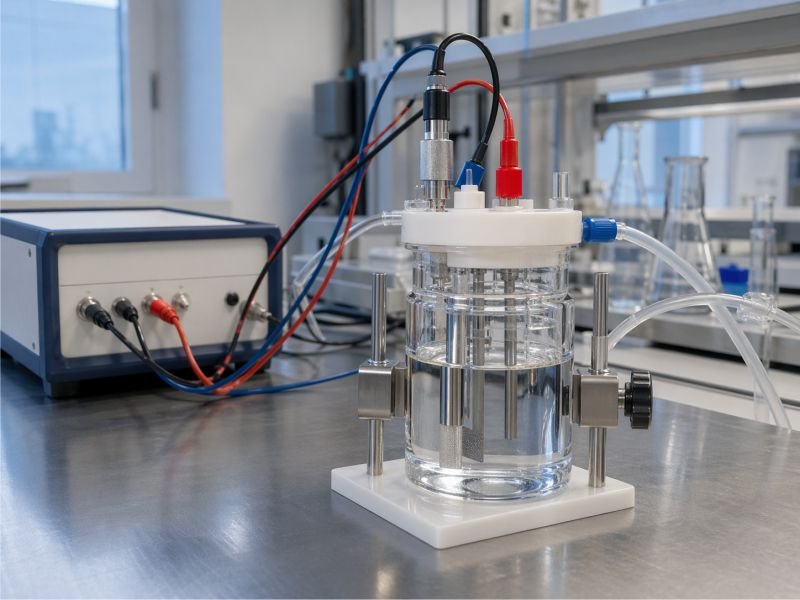
What Is Electrochemical Overpotential?
Electrochemical overpotential is the extra voltage required beyond the equilibrium potential of an electrochemical reaction to make that reaction proceed at a practical rate. It measures how far a real electrode departs from ideal reversible behavior under load. A common expression is eta = E_applied – E_eq, where the difference represents the additional driving force consumed by real losses.
In working cells, overpotential can arise from charge-transfer kinetics, ionic resistance, and mass-transport limits near the electrode surface. Its value changes with current density, catalyst activity, temperature, and reactant concentration, so the same chemistry can behave differently under different operating conditions. In electrochemical energy systems, overpotential directly affects cell voltage, heat generation, and overall conversion efficiency.
This concept matters because reducing overpotential improves performance without changing the underlying chemistry. Lower losses mean higher voltage efficiency in electrolyzers, less wasted energy in fuel cells, and better control in plating or sensing applications. Used in devices include electrolyzers, fuel cells, metal-plating baths, and electrochemical sensors. Engineers analyze overpotential to decide whether a limitation is rooted in catalysts, transport, electrode design, or operating conditions, and to quantify where improvement effort will matter most.
Example:
A water electrolyzer requires a higher applied voltage than the reversible decomposition voltage because electrode reactions and transport losses create overpotential.
Related Terms:
- Nernst Equation
- Exchange Current Density
- Charge Transfer Resistance
NoSuchDevice is a free archive of machines that do not exist yet but already have a shadow in physics. I research and write every entry alone, with no ads. Take a look around the archive, or help keep it free.