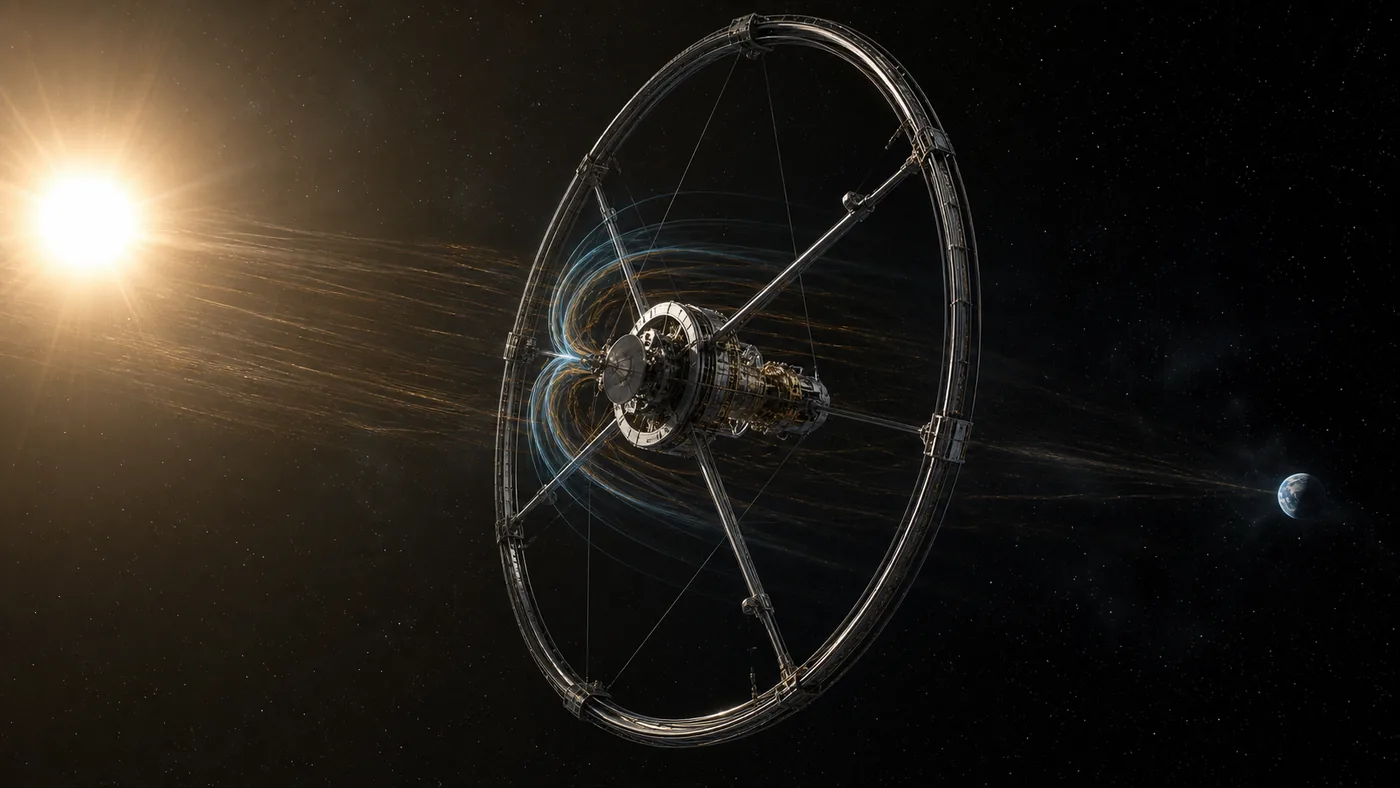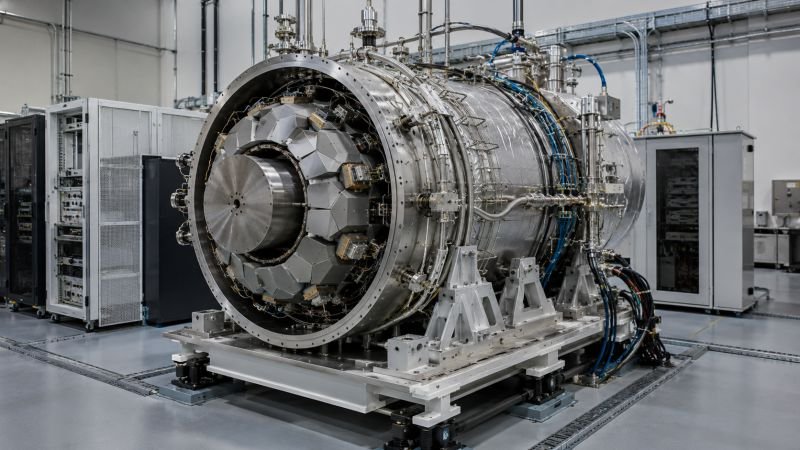



The fuel cartridge for a personal fusion energy cell weighs about eight grams, and most of that is casing. What sits inside is a pinch of hydrogen drawn from ordinary seawater, and it lasts a house a year. The cartridge waits on a utility room shelf next to a spare water filter and a box of fuses. The machine it feeds holds a plasma hotter than the core of the Sun.
That gap, between the dull little shelf and the physics behind the access panel, is not something the mind makes ordinary quickly.
The short version: A personal fusion energy cell holds a hydrogen plasma hot and dense enough that atomic nuclei fuse, and it turns the energy that fusion releases into household electricity. The fuel is hydrogen drawn from water, so a year of power for a home weighs about as much as a vitamin tablet. The reaction is fragile by nature. It needs heat, density, and containment all at once, and it stops the instant any one of them slips. That fragility is the whole safety story.
Key Takeaways
- A year of household fuel weighs around 150 milligrams, lighter than a vitamin tablet
- The hydrogen that feeds the cell comes from ordinary seawater, which holds a usable amount in every few liters
- There is no runaway failure mode in fusion: the moment containment drops, the plasma cools and the reaction ends
- The plasma inside runs at over a hundred million degrees, far hotter than the center of the Sun
- The cell behaves like any other thermal power source. What changes is where the heat comes from
Table of Contents
The Grid That Cannot Follow You: Why Homes Need Their Own Fusion Cell
The power grid has one habit that has not changed since the 1880s. Big, distant generators push electricity outward over long wires, and everything at the far end, every home, every clinic, every remote station, depends on those wires staying up. The arrangement scaled beautifully while the wires were being strung. It also tied every household to infrastructure that floods, freezes, and simply stops at the edge of where it pays to build. Hundreds of millions of people live past that edge, and that number has shifted far more slowly than the world’s hunger for electricity.

The Scale Gap That Home Fusion Fills
There is a size mismatch underneath all of it. A conventional power station only makes economic sense at hundreds of megawatts. A house wants a few kilowatts. The distance between the smallest sensible central plant and what the lights actually draw is enormous, and it is exactly the space a personal fusion cell is imagined to fill. Not a shrunk-down power station, but a different kind of object entirely, sized from the start for the load of a single building.
A home with one of these cells asks nothing of the grid. The cell is the only generator the building has, and a grid connection, if it exists at all, becomes a backup nobody thinks about. What that means for the places the grid never reached is not subtle, and it is where the rest of this gets interesting.
How the Personal Fusion Energy Cell Runs a Plasma at 150 Million Degrees
Here is the fact that makes a fusion cell calmer than its reputation. The deuterium-tritium plasma inside cannot keep itself going. It needs to be held, and the moment it stops being held, it quits. Remove the magnetic field and it cools in a flash. There is no momentum in it, no smoldering, no chain that carries on once the conditions break. The cell makes energy only while everything is working at once.
That is a very different animal from a machine that keeps producing heat as long as fuel is in the room.
The Plasma Core and the Energy It Releases
Strip the electrons off hydrogen and what is left are bare nuclei, all carrying the same positive charge, all shoving each other away. Heat them enough and they move fast enough that, now and then, two of them slam together hard enough to merge instead of bounce. When they merge, they release a burst of energy. The energy comes off in two forms. Some of it stays in the plasma and helps keep it hot. The rest streams outward and is caught by the surrounding structure as heat. From there on, the cell is unremarkable: the heat boils a working fluid, the fluid turns a generator, and the house gets electricity. The exotic part is the source of the heat. Everything downstream is the same physics that runs a coal plant or a kettle.
Magnetic Confinement vs. Inertial Confinement at Residential Scale
There are two broad ways to hold a fusion plasma. Magnetic confinement cages the plasma inside powerful magnetic fields, with no solid wall ever touching the hot core. Inertial confinement instead squeezes a tiny pellet of fuel so fast that fusion happens before the material can fly apart. The inertial route leans on continuous, power-hungry laser systems that do not shrink gracefully, so the home-scale idea favors the magnetic approach, which holds the plasma steadily and continuously. The superconducting coils that make those fields have to be kept very cold, and the quiet advance that makes a home version thinkable is in the magnets themselves, which now reach the strength needed without the bulk earlier versions would have demanded.
AI-Managed Plasma Stability
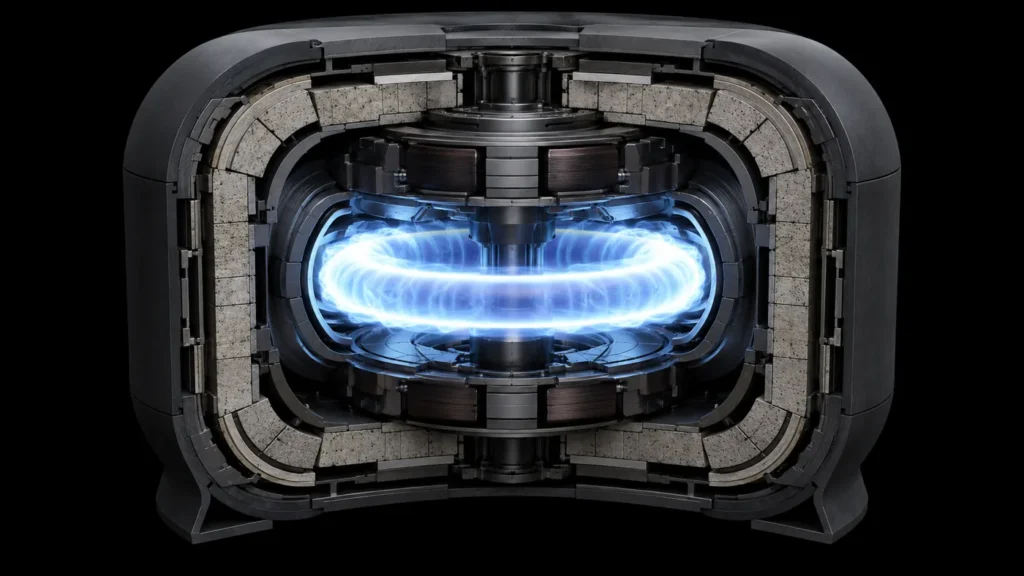
The plasma is not a steady flame you light and leave. It is a restless, twitchy thing that wants to wander off, cool down, or squirm out of whatever is holding it, and left alone for even a fraction of a second it loses its shape. So the cell leans on a fast control system that watches the plasma and nudges the fields to keep it where it belongs, far faster and far more steadily than a person ever could, around the clock, for months. The broader story of how that kind of automated control works in eco-tech devices sits in The Role of Artificial Intelligence in Eco Tech. For the cell, the short version is that the machine minds the fire so nobody has to.
The Lawson Criterion: The Threshold the Plasma Has to Hit Before Power Comes Out
Fusion has a line it has to cross before it gives back more than it takes. The Lawson criterion is the name for that line. Below it, holding the plasma costs more energy than the plasma returns, and the whole thing is a very expensive way to stay warm. Above it, the mergers happening inside throw off enough heat to keep the plasma going and leave a surplus for the house. The line is set by three things working together: how hot the plasma is, how densely it is packed, and how well it is held. Push all three high enough at the same time and the cell tips from consuming to producing.
This is the real difficulty of fusion, and it is worth being honest about. Holding a plasma is like holding heat in cupped hands. The conditions are hard to reach and harder to keep, and most of the engineering history of fusion is the story of staying above that line for longer than a flicker.
Why Quantum Tunneling Makes the Required Temperature Achievable
For a long time the numbers looked hopeless. A simple reading of the physics said you would need temperatures of billions of degrees to force two nuclei close enough to merge, because they fight you the whole way in, repelling each other harder the nearer they get. That repulsion is the Coulomb barrier, and nothing that fits in a utility room holds a plasma at billions of degrees.
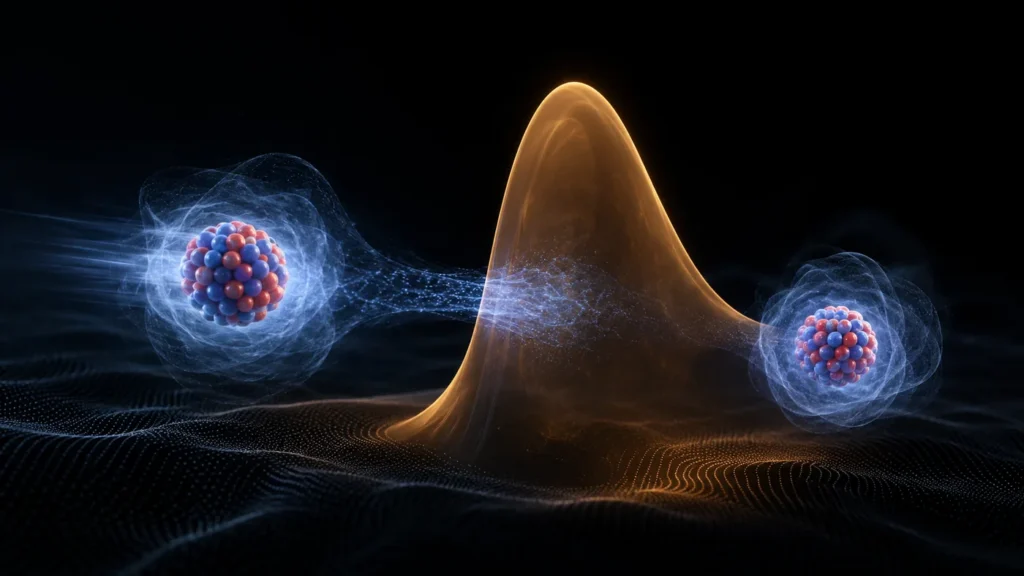
Quantum mechanics is what rescues the idea. At the small scale, a nucleus is not a hard little ball with a fixed position. It behaves partly like a wave, smeared out, with a real chance of turning up on the far side of a barrier it did not technically have the energy to climb. So two nuclei can merge at temperatures far below the brute-force figure, by slipping through the wall instead of going over it. The chance of any single pair doing this is tiny, but in a dense, hot plasma there are enormous numbers of pairs, and the rare event happens often enough to run a reactor. The wave behavior behind this is covered in Quantum Mechanics in Eco-Tech. The consequence for the cell is the thing that matters: it lets fusion happen at a temperature a compact machine can actually reach, instead of one found only inside stars.
Deuterium, Tritium, and the Fuel Arithmetic Behind Personal Fusion Energy Cells
The number people refuse to believe is not the temperature. It is the fuel. A house, for a year, on something that weighs less than a coin. It sounds like a misplaced decimal, so it is worth walking through where it comes from, at the level of intuition rather than engineering.
Fusion releases a staggering amount of energy per gram because it taps the binding energy of the nucleus itself, which is millions of times denser than the chemical energy you get from burning something. Chemistry rearranges the outer electrons of atoms. Fusion rearranges the heart of the atom. That is the entire reason the fuel mass is so absurdly small.
A rough way to feel the scale:
energy out ≈ fuel amount × energy locked in each merger
You do not need to run the figures to feel the shape of it. The energy released in a single fusion merger is millions of times larger than the energy from a single chemical reaction, like burning one molecule of fuel. So where a gas boiler eats cubic meters of gas across a winter, a fusion cell of the same usefulness eats a smear of hydrogen you could balance on a fingertip. Put a household’s yearly electricity on one side and the fuel needed to make it on the other, and the fuel lands at roughly 150 milligrams. The arithmetic is not a trick. It is just what happens when the energy per gram climbs by that many orders of magnitude.
Where the Deuterium Comes From
The fuel is a heavy form of hydrogen, and the sea is full of it. Every few liters of ordinary seawater hold enough to be worth extracting, which means the supply is, for all human purposes, endless and spread across every coastline on Earth. There is no field to deplete, no seam to mine out, no single place sitting on the deposit. The extraction happens at the facility that makes the cartridges, far from the home. What arrives at the house is a sealed unit, already charged, that came, in the end, from a bottle of seawater.
The cell also leans on a second light element, lithium, to round out its fuel cycle, so the whole supply chain comes down to two ordinary ingredients: water and a common metal. Neither is rare, neither is fought over, and both turn up almost everywhere.
How the Fuel Compares to Other Energy Sources
| Energy Source | Annual Home Fuel | Carbon Output | Fuel Origin |
|---|---|---|---|
| Personal fusion cell | A pinch of hydrogen, around 150 mg | None | Seawater, effectively unlimited |
| Natural gas | Roughly a tonne and a half | High | Fossil extraction |
| Diesel generator | Hundreds of liters | High | Fossil extraction |
| Solar plus home battery | Sunlight, plus stored charge | None in use | Sunlight, panels and battery materials |
A pinch of seawater standing in for a year of a household’s power is the kind of scale this archive exists to sit with.
I make all of it alone, with no ads. If it is worth a coffee a month to you, that keeps the next one coming.
Keep it alive →Plasma-Facing Materials, Neutron Shielding, and Why Fusion Cells Are Safe at Home
A fusion cell has to square two things that sound like they cannot share a room. The fire inside is hotter than anything a solid surface could survive, and the box around it has to be safe enough to stand in a hallway. The way those two facts coexist is the heart of why the device is calmer than people expect.
The Inner Surface: Plasma-Facing Materials
The first half of the answer is that nothing solid ever touches the hot plasma. It floats inside its magnetic cage with a gap all around it. The cage does the holding, and the walls of the cell never meet the worst of the heat. That single choice, holding the fire without touching it, is what lets the whole thing exist. The surfaces that do face the plasma across that gap are built from the most stubbornly heat-tolerant materials known, the same family of plasma-facing materials that let the cell shrug off conditions no ordinary metal could survive.
Neutron Shielding, Passive Shutdown, and the Case Against Meltdown
Some of the energy a fusion reaction throws off comes out as fast particles, and the surrounding structure is built to soak them up, turning that stream into the heat the cell actually uses. The casing is designed so that what reaches the outside is warmth and nothing more.
The second half of the answer is the part worth sitting with, because it is where fusion parts ways with the reactors people are afraid of. The reaction has no way to run away. It is not a fire that spreads as long as there is fuel. It is a balancing act that needs heat, density, and containment all at the same instant, and the moment any one of them fails, the plasma cools and the reaction simply stops. Cut the power to the cell and you do not get a crisis. You get a cold box. There is no smoldering core to keep cooling for days, no chain reaction with its own momentum, no scenario where losing control lets the reaction feed itself. The off switch is built into the physics, and you could not disable it if you tried.
The energy and materials that go into making one of these cells in the first place are not nothing, and a serious version of this technology has to account for that the way any clean device does. The broad thinking on that lifecycle question lives in Principles of Sustainable Design. The honest summary is that a cell pays back the energy spent building it many times over across its life, because the thing it does, run a home for years on almost no fuel, is so lopsided in energy terms.
From Sealed Cartridge to Distributed Arc: The Evolutionary Path of the Fusion Cell
The first cells of this kind were not domestic at all. They were the size of a shipping container and lived where the alternative was worse: remote research stations, far-flung settlements, islands running on diesel barged in at painful cost. Places where almost anything beats the logistics of trucking in fuel forever. From there the story is one of shrinking, the same arc a lot of technology walks, from a room, to an appliance, to a thing nobody notices, helped along by steady advances in magnets and plasma-facing materials.
What the Current Appliance Form Looks Like
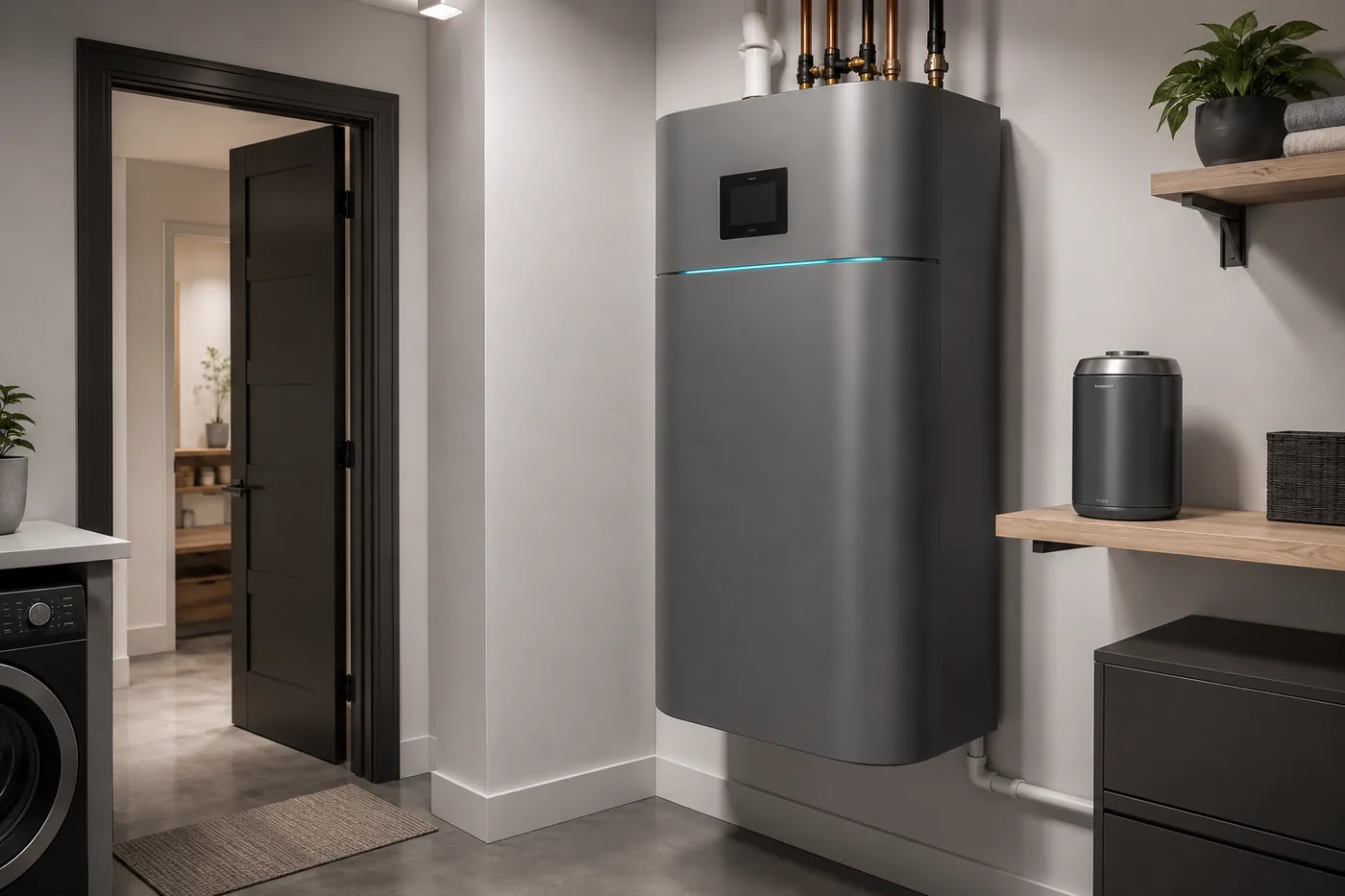
A mature cell, the kind imagined sitting in a home, is closer in size and manner to a large water heater than to anything that looks like a reactor. It stands in a utility room, shows a quiet status light, and asks nothing of the people in the house. There is nothing to tend and nothing to adjust. It is meant to be treated as infrastructure, installed and then forgotten, the way nobody thinks about the pipes behind a wall.
The cartridge arrives sealed and ready, and a service arrangement handles delivery and return the way bottled gas already works for restaurants. The involvement of the person living there amounts to being home for a delivery now and then. Beyond that, the cell is simply part of the building.
D-D and Helium-3: Where the Next Development Cycle Points
The version most familiar today runs on a pair of hydrogen fuels and needs a touch of tritium breeding built into its fuel cycle to keep itself supplied. The directions people find most interesting point toward cleaner reactions still, ones that lean on a single hydrogen fuel, or on helium, and that ask less of the shielding around them. Each of those paths trades one difficulty for another, a hotter plasma here, a scarcer fuel there, and which one matures first is an open question. What they share is a direction: toward fewer ingredients and a simpler, calmer machine.
Off-Grid Deployment and Home Storage Integration
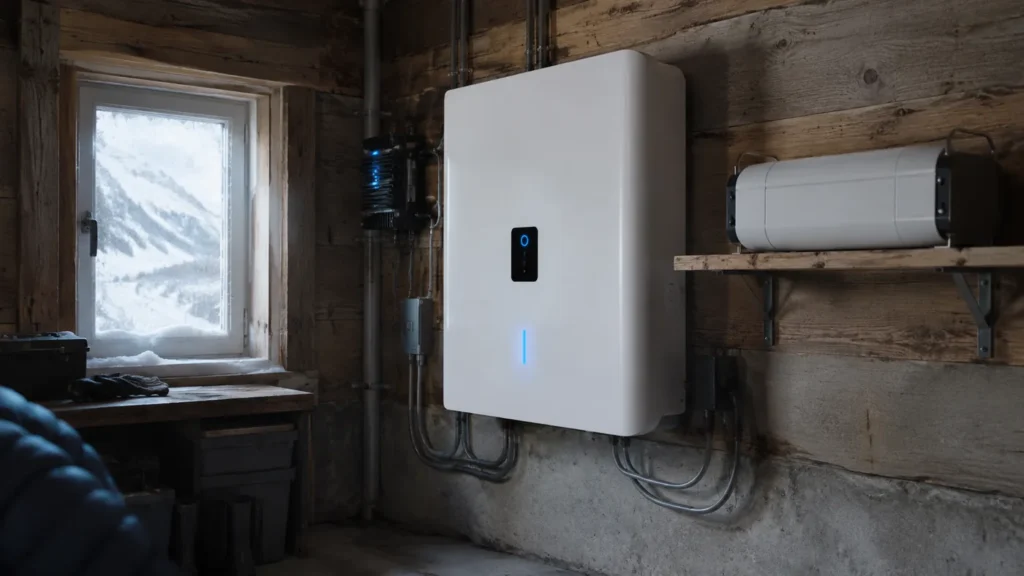
The places that gain the most are the ones the grid serves worst. Remote communities, islands, farms and stations already paying a premium for diesel, anywhere the wire is thin or absent. A cell needs a flat surface and very little else, and it carries its own fuel sealed inside, so it does not lean on anything around it.
In a home that does have grid power, a cell usually works alongside a battery, which smooths the gap between the cell’s steady output and the way a house actually uses power in bursts. The physics of that storage pairing is its own subject, covered in Energy Storage Systems: The Physics of Saving Power. Together, a cell and a battery can carry a household on their own, indefinitely, with nothing coming in from outside but the occasional sealed cartridge.
The View From NoSuchDevice
I find it useful to ask, of any energy device, which constraint it actually removes. Solar panels remove the cost of fuel. Batteries remove the problem of timing. A heat pump removes the waste in turning electricity into warmth. The personal fusion cell removes the oldest constraint of all, the need to be tethered to a working fuel supply. A pinch of hydrogen from the sea, once a year, and the house is on its own.
What I keep turning over is not whether the physics is interesting. It is. What stays with me is what it would mean for a home to need nothing from outside. The places this matters most are the ones the grid abandoned, the remote and the unreachable, and I do not think most people have sat with what it would do for them. A clinic that does not lose power. A village that stops waiting for a line that was never coming.
What I stay cautious about is the sheer amount of cleverness folded into the box. A device like this is a plasma problem, a control problem, and a materials problem all at once, asked to run quietly in a hallway for years with nobody watching. That is a tall order, and the honest version of this technology does not pretend the difficulty away. Holding star fire steady is hard, and the hardness does not vanish because the casing is painted to match the wall.
So my view is a split one. The idea is sound at the level that matters, which is the physics. The fuel really is that small, the safety really does come from the nature of the reaction rather than from bolted-on precautions, and the thing it would free people from is real. Whether it becomes ordinary is a question of patience and engineering, not of whether nature allows it. Nature, as far as I can tell, already said yes. That is exactly the kind of machine this archive was built to take seriously.
You read the whole thing.
That is rarer than it should be. A home that runs for a year on a pinch of seawater, and stays safe because the reaction quits the moment you stop holding it, is exactly the kind of machine this archive exists to take apart. I make every piece alone, with no ads and no investor deciding what gets written. If you want the next machine taken apart like this one, you can help me make it.
A coffee a month is enough to keep it free for everyone.
Prefer crypto or a one time gift? Other ways to give →