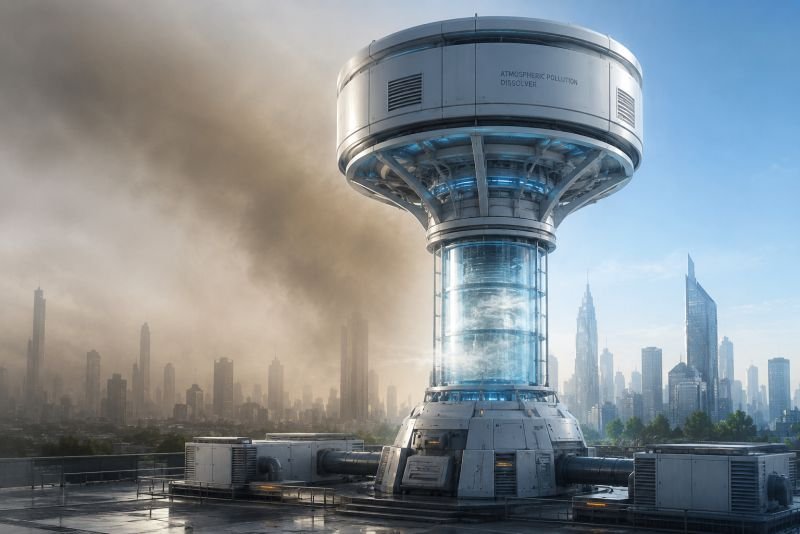




A water treatment plant in Utrecht runs a final purification stage that looks nothing like the rest of the facility. The conventional infrastructure spreads across two hectares. Sedimentation basins, sand filters, activated carbon columns, a high-pressure reverse osmosis bank processing 100,000 cubic meters daily. The quantum filtration module appended to the downstream end of that chain occupies a footprint about the size of a standard door. No high-pressure pump feeds it.
The output meter reads 0.15 nanograms of PFOA per liter. The inlet to the quantum stage reads 486. The EPA limit is 4.
The carbon-fluorine bond has a dissociation energy of 544 kilojoules per mole. Compounds built around it resist every classical treatment the water industry has applied to them. The activated carbon and reverse osmosis stages upstream reduce the raw catchment concentration and handle suspended solids, bacteria, and most heavy metals efficiently. PFAS survives. The quantum filtration stage handles what survived.
The device does not work by pushing water harder through smaller holes.
The short version: A quantum filtration system sorts molecules by their quantum mechanical properties. Carbon nanotube channels 0.8 nanometers wide carry water via coherent quantum transport at near-zero pressure loss, while PFAS chains, heavy metal ions, microplastics, and radioactive isotopes are rejected by wave function exclusion, electron spin sorting, and Quantum Zeno confinement. Single-pass PFAS rejection runs at 99.97 percent. At a source concentration of 486 ng/L, the output is 0.15 ng/L – from one pass through a membrane running at 1 to 3 bar, against the 15 to 25 bar required by high-pressure reverse osmosis.
Key Takeaways
- Carbon nanotube channels at 0.8 nm carry water as a coherent quantum wave, producing flow rates 100 to 1,000 times higher than classical fluid dynamics predicts at that diameter – the same effect that drops operating pressure to a fraction of what RO requires
- PFAS chains are rejected through wave function incompatibility with the CNT wall – a selectivity mechanism no classical filter can replicate, and a direct answer to why the forever chemicals problem persists under conventional treatment
- Heavy metal ions smaller than a water molecule – arsenic at 0.058 nm, lead at 0.119 nm – are caught by magnetic spin-state sorting before they reach the membrane at all
- The Quantum Zeno effect operates as an active rejection mechanism: quantum dot sensors interrogate approaching contaminants frequently enough to prevent the state evolution required for membrane penetration
- The device handles radioactive isotope removal from nuclear wastewater by quantum state discrimination – an application more technically precise than consumer water purification, and largely absent from mainstream coverage of the technology
Table of Contents
What Conventional Filtration Hits at the Sub-Nanometer Scale
Reverse osmosis carries the highest rejection rating of any commercial water treatment technology for dissolved contaminants. A well-maintained system achieves 94 to 99 percent efficiency against PFAS (per- and polyfluoroalkyl substances) under good operating conditions. The numbers look adequate until applied to a source where contamination is severe enough that 1 to 6 percent residual still exceeds the regulatory limit.
The Geometry Problem Below 1 Nanometer
PFAS compounds span 0.47 to 0.9 nanometers in effective molecular diameter. RO membranes operate at 0.1 to 1 nanometer nominal pore size – an overlap suggesting near-total rejection. At this scale, molecular geometry is not the only variable controlling passage. Electronic polarizability, charge distribution along the fluorinated backbone, and quantum mechanical interaction between the molecule and the membrane material all contribute to whether a given molecule passes or stays behind. A PFAS chain can be geometrically oversized for a pore and still negotiate passage through orbital interactions the membrane was never designed to address. No specific membrane formulation resolves this. The limitation belongs to the operating principle.
Ions Smaller Than Water
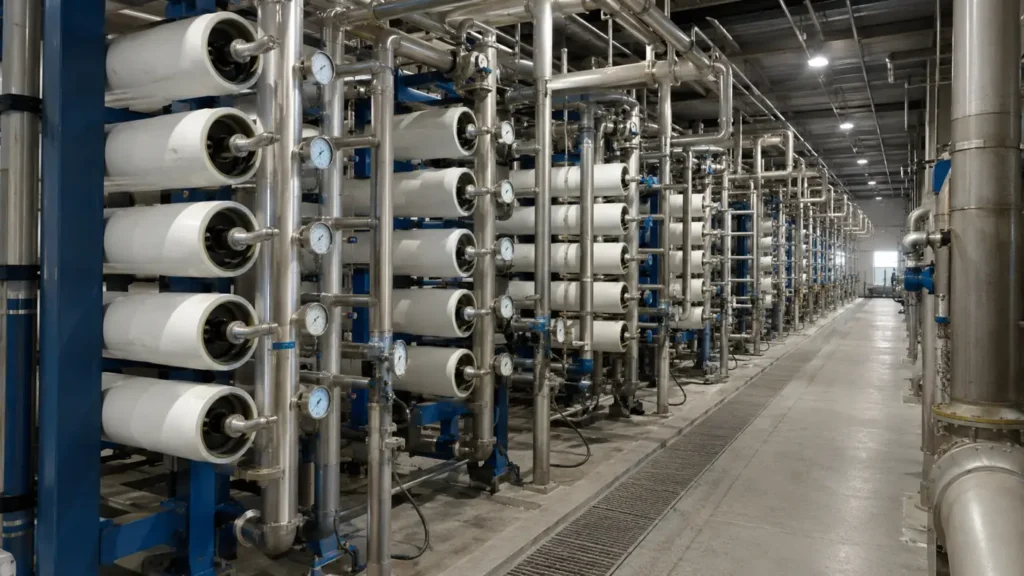
Heavy metal ions present a harder version of the same problem. Lead Pb²⁺ carries an ionic radius of 0.119 nm. Arsenic As³⁺ sits at 0.058 nm. Both are smaller than a water molecule in relevant configurations. Classical filtration has no reliable mechanism for rejecting an ion smaller than the molecule it needs to pass. Ion exchange resins fill this gap in conventional treatment – but resins require periodic regeneration cycles, generate contaminated secondary waste, and reach practical throughput limits at the volumes involved in large-scale nuclear wastewater treatment.
The quantum filtration system does not ask how large an ion is. It asks what the ion’s electron configuration looks like. That is a question classical chemistry never learned to answer in real time.
How a Quantum Filtration System Reads and Rejects a Molecule
Two processes operate in sequence inside a quantum filtration membrane. The CNT architecture creates a channel geometry where water moves via coherent quantum transport at near-zero pressure differential. At the channel entrance, the membrane discriminates between molecular species based on quantum state, not physical size.
Carbon Nanotube Channels and Coherent Water Transport
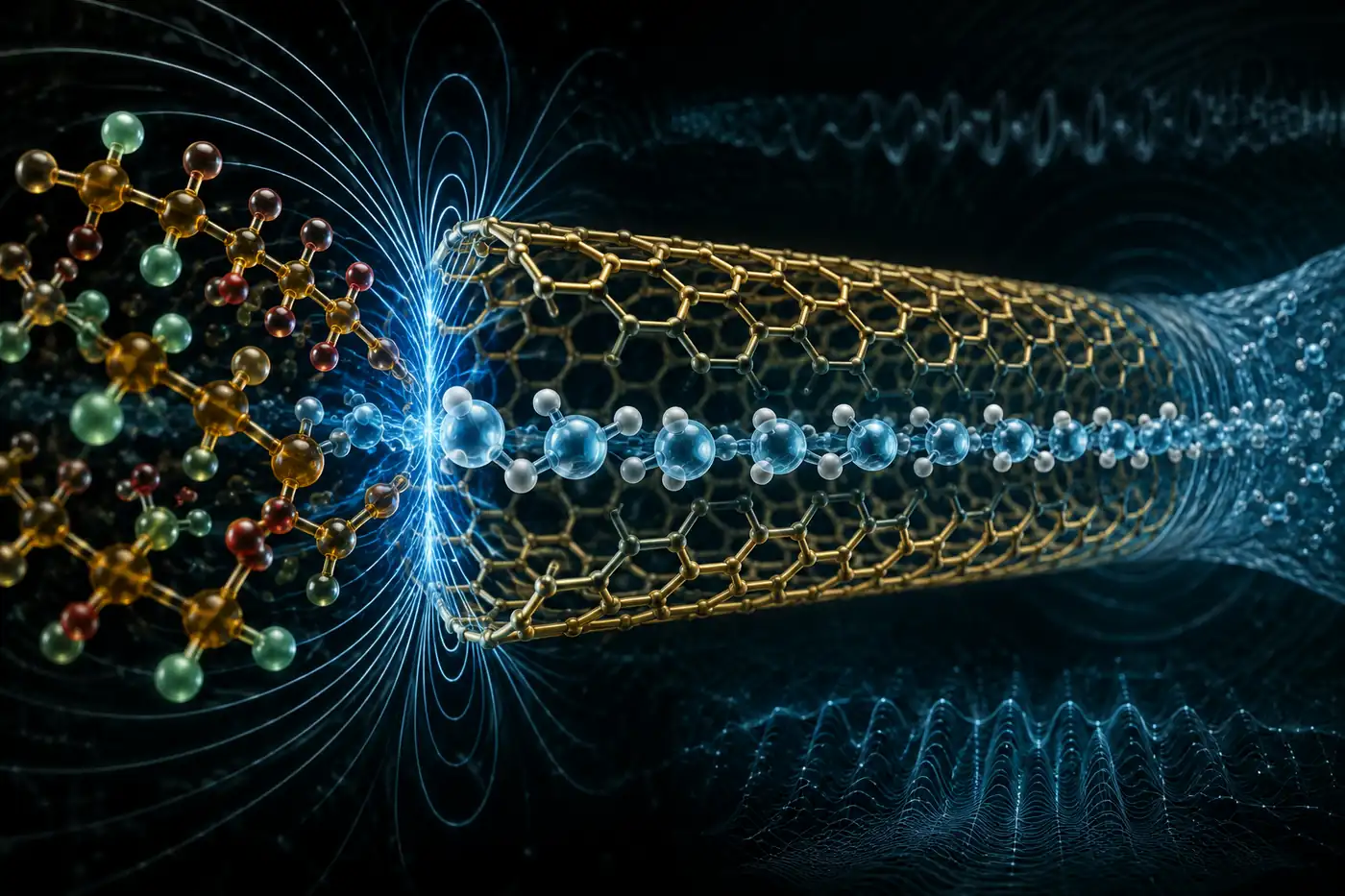
The membrane is built from single-wall carbon nanotubes, oriented perpendicular to the membrane plane, with internal diameters of 0.8 to 1.2 nanometers calibrated to the target contaminant profile. That range is not picked for convenience. It is roughly where the de Broglie wavelength of a water molecule confined at room temperature becomes comparable to the channel width itself – the point at which a molecule stops behaving like a particle following a path and starts behaving like a wave occupying the space available to it. Open the channel to a few nanometers and the wavelength becomes irrelevant next to the geometry, and water reverts to ordinary fluid behavior. Below 1.4 nanometers, it does not.
The Hagen-Poiseuille equation governs classical flow through cylindrical channels. Flow rate scales with the fourth power of the channel radius. Applied to a 0.8 nm diameter pore, the equation predicts negligible flux at low pressure. Measured CNT water flux runs 100 to 1,000 times the Hagen-Poiseuille value. The explanation is quantum coherence. At sub-nanometer channel diameters, water molecules form ordered chains linked by hydrogen bonding, and the phase relationship between each molecule’s quantum state survives along the length of the chain instead of collapsing at every collision with the wall. That survival is what lets the chain move through the channel as a single object, with effective wall friction orders of magnitude lower than any classical surface. Water moves through at a fraction of the pressure RO systems require.
Wave Function Discrimination at the Channel Entrance
Every molecule carries a wave function – a probability distribution encoding where its electrons are located. At the entrance to a CNT channel, the interaction between a molecule’s wave function and the electronic structure of the graphene lattice determines whether the molecule enters or is rejected.
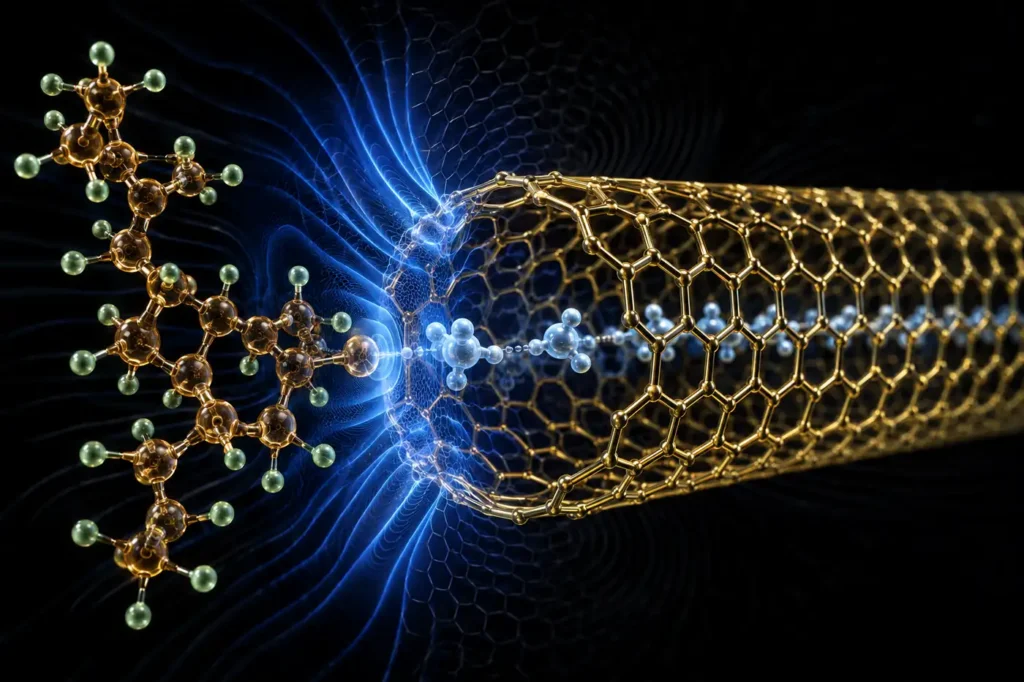
Water has a compact, symmetric wave function whose coupling with CNT wall electrons supports coherent transport. PFOA carries a wave function shaped by the electronegative fluorine atoms along its carbon backbone. That electron density interacts repulsively with the graphene pi-electron system, creating a potential energy barrier the molecule lacks sufficient thermal energy to cross. The molecule arrives at the channel entrance. The energy barrier does not permit entry.
Lead Pb²⁺, with electron configuration [Xe]4f¹⁴5d¹⁰, generates strong quantum confinement at the pore mouth through its orbital interaction with CNT wall electrons. Arsenic produces interference patterns between its ionic wave function and the graphene lattice, yielding near-total destructive interference for passage probability. Classical geometry says these ions can fit through the channel. The quantum mechanics of the channel entrance says otherwise. The device operates on the second statement.
Spin States, Zeno Locks, and the Quantum Dot Array
Wave function exclusion handles the majority of target contaminants. Two additional mechanisms in the architecture address what the membrane alone cannot fully resolve.
Magnetic Spin Sorting Upstream of the Membrane
Certain transition metal ions carry electron spin configurations distinct from water and from most organic co-contaminants. Cadmium Cd²⁺, hexavalent chromium Cr⁶⁺, and several manganese oxidation states fall into this category.
A magnetic field gradient upstream of the CNT membrane, calibrated to interact with targeted spin configurations, deflects the corresponding ions toward a rejection channel before they reach the membrane surface. Each ion carrying the targeted spin state experiences a deflection force proportional to the gradient strength and its magnetic moment. The operating principle is identical to the one behind magnetic resonance imaging, applied here as a sorting mechanism rather than a scanning one. For ions where wave function exclusion leaves a small residual passage probability, spin sorting eliminates the remainder. The two stages cover overlapping rejection territory, and their combination produces results neither achieves independently.
Quantum Dots as Sensor and Active Gatekeeper
An array of quantum dots – nanometer-scale semiconductor crystals with quantized energy levels – is embedded within the membrane structure. Each dot fluoresces at a specific wavelength when a target molecule enters its interaction radius. An optical readout monitors the fluorescence pattern continuously across the entire membrane surface at millisecond resolution.
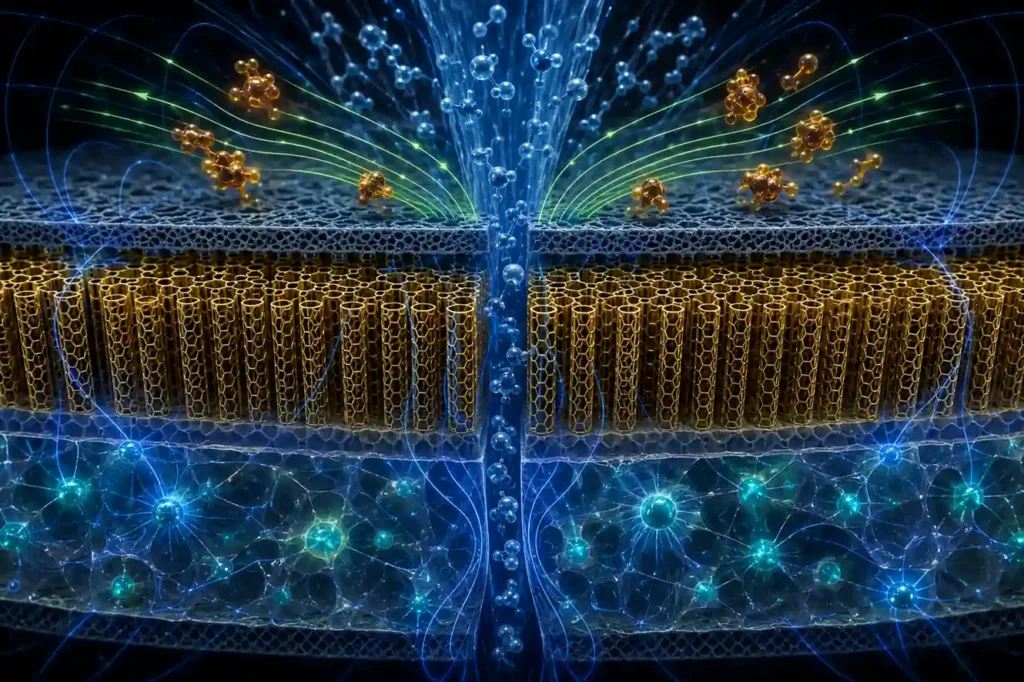
The array’s deeper function is not passive monitoring. The Quantum Zeno effect operates here as an active rejection mechanism. A contaminant molecule approaching the membrane is interrogated repeatedly by the quantum dot sensor field. Each measurement collapses its wave function back to its initial state, preventing the state evolution required for membrane penetration. The sensor and the gatekeeper are the same object. Observing what is happening at the membrane surface turns out to be mechanically inseparable from controlling what can happen there.
The four mechanisms – CNT wave function discrimination, magnetic spin sorting, Zeno confinement, and quantum dot sensing – cover overlapping but non-identical rejection territory. Where nanotechnology in environmental remediation attacks pollutants by building reactive surfaces smaller than the contaminant, quantum filtration discriminates by quantum state instead of surface chemistry, which is what lets it reach the sub-nanometer ions the nanoscale-surface approach still loses. No single layer produces the device’s full rejection profile. Each addresses what the others miss. The combined rejection curve does not resemble anything in classical filtration.
The Quantum Filtration Measurement That Matters: 0.15 ng/L
A contaminated groundwater source runs PFOA at 486 nanograms per liter – a concentration documented in real catchments near industrial facilities and fire-training areas. The EPA maximum contaminant level for combined PFOA and PFOS, set in 2024 after fifteen years of regulatory and legal pressure, is 4 ng/L. A best-in-class reverse osmosis system at 98 percent rejection processes the source and produces 9.7 ng/L in the output. Two and a half times the legal limit, after full conventional treatment.
Adding a second RO pass brings the output to roughly 0.19 ng/L at optimal performance – meeting the standard at approximately seven times the energy cost of a single quantum filtration pass, with real-world performance variance in municipal infrastructure frequently keeping the number above 4 ng/L during operational degradation.
Single-pass output concentration from a quantum filtration membrane follows directly from one formula:
C_out = C_in × (1 – RE)
Where C_in is the inlet concentration and RE is the per-pass rejection efficiency.
At 99.97 percent rejection:
C_out = 486 × (1 – 0.9997) = 486 × 0.0003 = 0.146 ng/L
Rounded to measurement precision: 0.15 ng/L. Twenty-seven times below the EPA limit. From one pass through a membrane running at 1 to 3 bar.
The energy arithmetic follows from the pressure differential. Pumping energy scales approximately linearly with operating pressure at a given flow rate. Running at one-tenth of RO operating pressure in one pass rather than two produces an energy cost per cubic meter of roughly 0.07 kWh, against 0.5 kWh for double-pass RO. For a plant processing 100,000 cubic meters daily, the difference is approximately 43,000 kWh saved per day. The output is cleaner and the energy bill is lower. These two outcomes do not normally arrive together in filtration engineering.
| Technology | PFAS Rejection | Heavy Metal Rejection | Energy (kWh/m³) | Passes to Reach 4 ng/L from 486 ng/L |
|---|---|---|---|---|
| Activated Carbon | 60-70% | 30-60% | 0.1-0.2 | Does not reach target |
| Nanofiltration | 85-95% | 70-90% | 0.2-0.4 | 3 to 4 passes |
| Reverse Osmosis | 94-99% | 95-99% | 0.3-0.6 | 2 passes (above limit at 98%) |
| Quantum Filtration | 99.95-99.99% | 99.97%+ | 0.04-0.10 | 1 pass |
The RO row requires a second look. Optimal two-pass operation theoretically produces 0.19 ng/L. Real municipal systems running at operational rather than laboratory conditions rarely hit 98 percent rejection across the full PFAS compound spectrum. Quantum filtration’s 0.15 ng/L output arrives from a single pass and does not degrade with source concentration variance the way multi-pass arithmetic does.
0.15 nanograms per liter from a source reading 486 is the kind of number this archive exists to track down.
I make all of it alone, with no ads. If it is worth a coffee a month to you, that keeps the next one coming.
Keep it alive →Where Quantum Filtration Systems Get Installed
The contamination profile determines the deployment context. The device handles the full range of sub-nanometer target contaminants in one stage, which places its application range well beyond the PFAS-in-drinking-water case.
Municipal Water Treatment as the Primary Deployment
The standard municipal installation is a quantum filtration polishing stage appended to the downstream end of an existing treatment train. Conventional infrastructure handles suspended solids, bacterial load, bulk organics, and most heavy metals. Quantum filtration addresses what conventional stages leave behind: sub-nanometer ionic contaminants, PFAS chains at any inlet concentration, pharmaceutical residues at nanogram levels, and microplastics below the size threshold of classical membranes.
For utilities at the margins of RO capability against PFAS-contaminated groundwater, the polishing stage closes the compliance gap without decommissioning existing infrastructure. The existing treatment investment stays operational. The quantum module is appended downstream.
Nuclear Wastewater, Portable Units, and Pharmaceutical-Grade Production
Nuclear facility wastewater requires isotope-specific rejection at concentrations and volumes where resin-based ion exchange produces secondary waste streams large enough to constitute their own management problem. Cesium-137, strontium-90, and tritium are handled by the quantum filtration membrane through electron configuration discrimination specific to each isotope’s quantum state. Ion exchange resins do not achieve selectivity at the individual ionic species level. At decommissioning facilities and in routine cooling water management, eliminating the resin replacement cycle reduces secondary waste generation substantially.
Portable units drawing 2 to 3 bar from a solar-powered pump operate effectively in disaster response contexts where high-pressure RO is too energy-intensive for available generation. Pharmaceutical manufacturing (where contamination at nanogram levels disqualifies production batches) was the commercial niche where the device entered market deployment, prior to the municipal case reaching cost viability. On gas-phase filtration: the same quantum state discrimination principles apply in theory to airborne contaminants, but decoherence behavior in gas phase differs significantly from liquid water, and the engineering development sits considerably behind the water application.
Agricultural irrigation carrying pesticide residues is the highest-volume potential application. CNT membrane production at agricultural throughput currently runs above commercially viable pricing for bulk water treatment. Manufacturing scale reduces this, though the agricultural case is not accessible at present cost. Matching treatment intensity to the contamination actually present, rather than over-treating every stream to the same specification, is one of the core principles of sustainable design that decides where a high-selectivity device like this earns its energy cost.
From Quantum Sensing to Water Infrastructure: The Evolutionary Arc
The device entered commercial use in stages, and the history reflects which engineering problems were solved first.
First-generation commercial deployment was monitoring, not filtration. Quantum dot arrays calibrated to PFAS and heavy metal signatures entered regulatory and research use as real-time contamination detection systems – providing spatial mapping and millisecond response times that conventional analytical methods could not match for field use. No filtration. The sensors established the manufacturing base and generated the alignment knowledge needed for the CNT membrane phase.
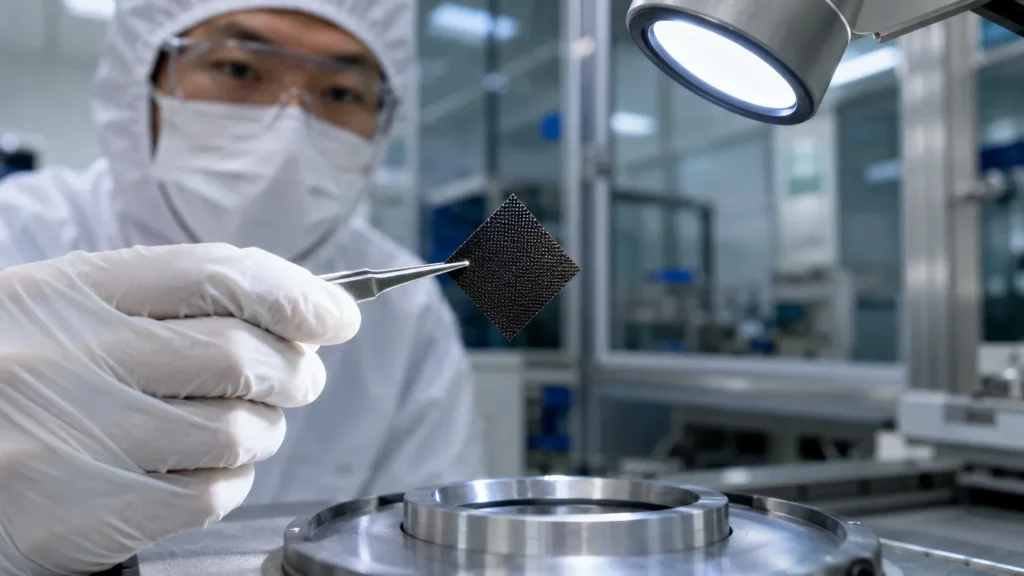
CNT membrane panels entered commercial use through pharmaceutical and semiconductor manufacturing, where ultra-pure water requirements justify per-liter production costs well above municipal pricing. Those deployments funded the solution to the alignment problem: consistent perpendicular CNT orientation at sub-nanometer diameter across large membrane areas without structural defects. A membrane with alignment defects collapses its quantum transport advantage immediately. Getting from laboratory samples to production panels took longer than any other single element of the development timeline.
Municipal polishing stage deployment followed as CNT manufacturing costs dropped toward the threshold where PFAS compliance benefits outweighed the capital cost differential against additional RO stages. The technology sits at the transition between specialty application and early infrastructure adoption.
The mature form of the device class is not a treatment module bolted onto an existing plant. It is membrane material produced at commodity cost, embedded throughout water infrastructure the way chlorination is embedded – present everywhere, invisible in operation, the mechanism the output standard depends on rather than a notable addition to it. Whether that endpoint arrives in twenty years or fifty depends primarily on how quickly regulators revise PFAS, heavy metal, and pharmaceutical residue limits downward. The physics is resolved. The manufacturing is scaling. The remaining variable is regulatory urgency.
The View From NoSuchDevice
I find this device less speculative than most in this archive, and that is not entirely a compliment.
Every mechanism is documented at the laboratory scale. Quantum-coherent water transport through CNT channels has been measured and published – the 100 to 1,000-fold enhancement over Hagen-Poiseuille is in the literature. The Quantum Zeno effect has been demonstrated in multiple systems. Spin-state magnetic sorting is deployed in clinical diagnostics. Quantum dot sensing is commercially available in research contexts. The assembly of all four into a reliable device at industrial throughput is what required engineering time, and the deployment in Utrecht suggests that time has been spent. The device is not a prototype.
What stays with me is the contamination argument. The forever chemicals problem is current, documented, and in some cases the subject of legal action against municipal systems that cannot achieve the standard their own government mandates. The gap between 0.15 ng/L and 9.7 ng/L from best-in-class RO is the gap between a solved problem and a managed one. Forty years of filtration engineering narrowed that gap substantially. Quantum filtration closed it. The reason the gap persisted for as long as it did is structural: PFAS contamination is, at a fundamental level, a quantum mechanical problem. The carbon-fluorine bond persists because its electronic structure resists classical chemical attack. The molecule navigates classical filters because membrane-molecule interaction at the sub-nanometer scale is governed by quantum state, not geometry. A classical answer to a quantum-scale problem produces a classical-scale result.
The nuclear wastewater application is technically more interesting than the drinking water case and receives a fraction of the public attention. Isotope-specific rejection by quantum state discrimination – operating on electron configuration rather than ionic radius or binding affinity – does something no previous decontamination technology could claim. The drinking water case dominates the public story by volume. The nuclear case is more precise in mechanism.
Agricultural water remains out of economic reach at current manufacturing cost. I want to be direct about this: the volume of pesticide-contaminated irrigation water globally would require CNT membrane production at scales the industry cannot currently serve at viable pricing. There is a known path to that scale. The path is not yet walked.
The distance between the device in Utrecht and membrane material embedded in every water treatment plant globally is not a physics problem. The seed was planted when quantum dot sensor arrays entered regulatory monitoring use. What grows from it depends on how quickly manufacturing economics follow the trajectory set by every previous precision fabrication technology. The physics stopped being the limiting factor some years ago.
You read the whole thing.
That is rarer than it should be. A filter that sorts molecules by electron configuration rather than hole size is exactly the machine this archive was built to take seriously. I make every piece alone, with no ads and no investor deciding what gets written. If you want the next machine taken apart like this one, you can help me make it.
A coffee a month is enough to keep it free for everyone.
Prefer crypto or a one time gift? Other ways to give →