






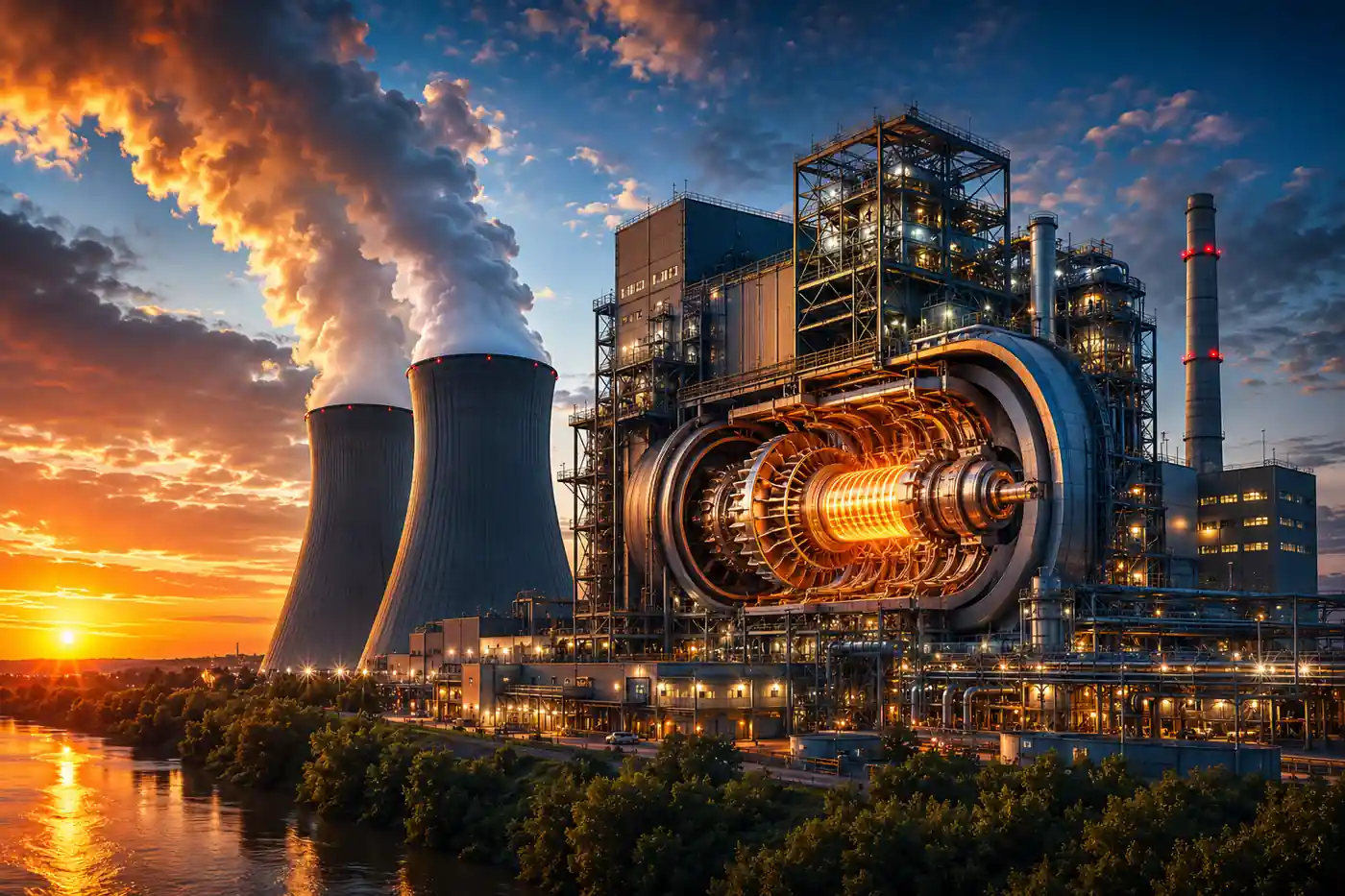
In 2016, engineers at the Bouchain combined-cycle power plant in northern France measured an output figure that has not been surpassed since. The GE 9HA.02 gas turbine achieved 62.22 percent net thermal efficiency, certified by TÜV Süd auditors and reported across the engineering press as a world record. The coverage focused on what the plant produced. Relatively little attention went to what it discarded: close to 600 megajoules out of every 1,000 burned in the combustion chamber, leaving as waste heat rather than electricity.
That missing fraction was not a flaw in the design. Thermodynamics required it.
The short version: Thermodynamics and energy efficiency are linked by a physical law with no exceptions and no workarounds. Any engine converting heat into mechanical work must discharge a fraction of that energy into a cold reservoir, and the exact fraction is determined by the temperatures at which it operates. For a gas turbine running at 1700 kelvin, Carnot’s formula puts the theoretical maximum efficiency at 82 percent. The world’s best machines reach 62 percent. That 20-percentage-point gap between what physics allows and what engineering achieves defines the entire problem of heat-to-work conversion.
Table of Contents
What Thermodynamics Actually Allows Before Engineering Begins
Two laws of thermodynamics govern every energy system ever built. The first says energy cannot be created or destroyed, only converted from one form to another. A kilogram of natural gas holds a specific quantity of chemical energy. Burning it releases that energy as heat. Heat moves a turbine. The turbine turns a generator. Nothing disappears in the accounting. Total energy is conserved from start to finish.
The second law is where the ceiling appears. Converting heat completely into mechanical work is not possible. When heat flows through a machine, some fraction of it must end up in the coldest available reservoir and cannot be recovered as useful work. The machine does not choose this. The physics imposes it.
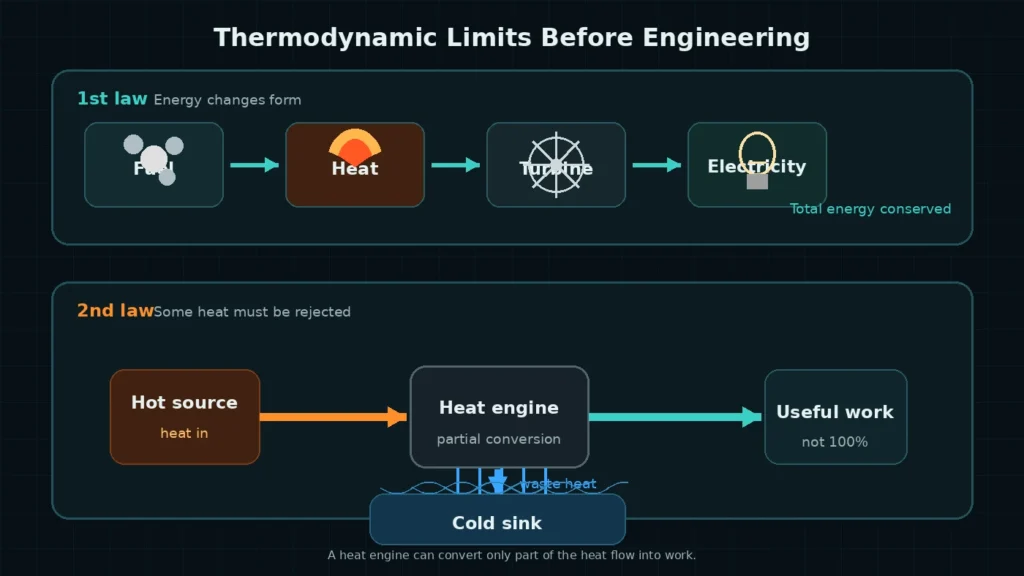
The reason sits in the direction heat naturally travels. Heat flows from hot to cold without external assistance, and reversing that flow requires spending energy from somewhere else. Any engine converting heat to work must deal with the fact that the hot side cools toward equilibrium and the energy not extracted as work becomes exhaust. The engineering challenge is not to escape that constraint. It is to get as close to its edge as materials and design allow.
Does this mean that raising combustion temperature matters more than improving fuel quality? That question has a precise answer, and the number it produces changes the way the whole problem looks.
The Carnot Limit: Thermodynamic Efficiency Has a Mathematical Ceiling
Sadi Carnot worked out the ceiling in 1824 and published it in a short paper in French. The engineering world largely ignored it for two decades. The result it contained now governs every thermal machine built today.
Carnot showed that the maximum efficiency any heat engine can achieve depends on exactly two values: the temperature of the hot reservoir it draws from and the temperature of the cold reservoir it exhausts into. The formula is:
η = 1 – (T_cold / T_hot)
where η is the maximum possible efficiency expressed as a fraction, T_cold is the cold reservoir temperature in kelvin, and T_hot is the hot reservoir temperature in kelvin. The kelvin scale starts at absolute zero, which is minus 273.15°C. Ambient air at 27°C becomes 300 K. Combustion gas at 1427°C becomes 1700 K.
Apply this to a modern combined-cycle gas plant. Combustion temperatures reach approximately 1700 K. The exhaust entering the heat recovery section runs at around 900 K before dropping toward atmosphere at roughly 300 K. For the gas turbine stage, working between 1700 K and 900 K:
η = 1 – (900 / 1700) = 1 – 0.53 = 0.47
That stage is Carnot-limited to 47 percent. A steam cycle picks up the exhaust heat and runs between 900 K and 300 K:
η = 1 – (300 / 900) = 1 – 0.33 = 0.67
Cascading both cycles, and treating the full system as spanning from 1700 K down to 300 K, gives the combined ceiling:
η = 1 – (300 / 1700) = 1 – 0.18 = 0.82
The 62 percent figure at Bouchain is not a matter of luck. It is the result of engineering pushed hard against a ceiling that Carnot’s formula set two centuries ago, closing roughly three-quarters of the available gap between zero and the theoretical maximum.
What the formula also reveals is that adding 100 K to the hot side of a 1700 K turbine raises the ceiling by roughly 3 percentage points. Adding 100 K to the hot side of a 400 K coal boiler raises it by nearly 12 percentage points. The lower the baseline temperature, the more each degree of improvement buys in thermodynamic efficiency.
That 62 percent world record measured against an 82 percent theoretical ceiling is the kind of gap this archive was built to trace back to first principles.
I make all of it alone, with no ads. If it is worth a coffee a month to you, that keeps the next one coming.
Keep it alive →Entropy: Why Perfect Thermodynamic Efficiency Is Physically Forbidden
Ask a physicist why perfect thermodynamic efficiency is impossible and they will say one word: entropy. Not entropy in the casual sense of things falling apart over time, though that reading is not entirely wrong. In thermodynamics, entropy measures the number of microscopic arrangements a system’s atoms can adopt while still matching the same observed temperature and pressure at the macroscopic level.
When heat flows from a hot body to a cold body, the total entropy of the combined system increases. Energy concentrated in the fast-moving atoms of the hot side spreads across the slower atoms of the cold side. More microscopic arrangements become consistent with the observed state. The energy occupies a wider set of possibilities, and extracting it back out of those possibilities requires external work.
For a heat engine, this means the exhaust cannot leave at zero entropy and zero residual heat content. Every irreversible process inside the machine generates entropy before the engine has finished. Friction between moving surfaces converts kinetic energy into heat deposited in the wrong place. Heat transfer across a finite temperature gradient adds entropy to the cold side before the engine has extracted everything available. Combustion products mixing with cooling gases irreversibly distribute thermal energy across more molecules than the machine can address.
The implication for thermodynamic efficiency improvements is concrete rather than abstract: every engineering gain amounts to reducing a specific, identifiable irreversibility. Better turbine aerodynamics reduce flow separation losses. Higher-temperature ceramic components allow hotter combustion. Thermal barrier coatings on turbine blades let combustion gas temperatures rise above what bare metal could survive under load. Each of these gains is quantifiable, and each narrows the distance between what a real machine does and what Carnot’s formula says is available. The gains also get harder to find as the machine approaches the ceiling.
Temperature Gaps and Thermodynamic Efficiency in Thermal Power Systems
Raising the temperature of the hot side is the most direct path to higher thermodynamic efficiency. Every kelvin added to T_hot shrinks the ratio T_cold/T_hot and lifts the Carnot ceiling. Coal plants have historically been held below roughly 800 K by the thermal limits of steel under sustained pressure. At elevated temperatures, metal creeps, deforming slowly under load, which constrains how aggressively a boiler can be pushed. The Carnot ceiling for a coal plant running between 800 K and 300 K sits at 62.5 percent. Real coal plants achieve 35 to 45 percent, with the remaining gap reflecting turbine losses, heat transfer limitations, and auxiliary power consumption.
Gas turbines shifted the calculation by burning fuel at temperatures that would destroy conventional metal components. Film cooling, in which relatively cool air flows through internal channels and over the surface of turbine blades, allows sustained combustion at 1700 K and above. The efficiency ceiling follows.
| System | Hot Temperature | Cold Temperature | Carnot Limit | Typical Actual Efficiency |
|---|---|---|---|---|
| Coal steam turbine | 800 K (527°C) | 300 K | 62.5% | 35-45% |
| Simple-cycle gas turbine | 1700 K (1427°C) | 900 K | 47.1% | 35-42% |
| Combined-cycle gas plant | 1700/900 K cascade | 300 K | ~82% | 55-62% |
| Nuclear (pressurized water) | 600 K (327°C) | 300 K | 50% | 33-37% |
| Geothermal binary cycle | 450 K (177°C) | 300 K | 33% | 10-23% |
The geothermal row is worth a pause. Binary-cycle geothermal plants use fluid heated by the Earth’s crust at temperatures that rarely exceed 177°C. Against an atmospheric cold sink at 300 K, the Carnot ceiling is only 33 percent. A plant achieving 10 to 23 percent actual efficiency is, by thermodynamic standards, performing reasonably well. The low absolute number comes from the small temperature gap, not from inadequate engineering. Thermodynamics and energy efficiency answer to temperature ratios regardless of where the heat originated.
Real Losses That Separate Thermodynamic Limits from Actual Efficiency
In the gap between the Bouchain plant’s 62 percent and its 82 percent Carnot ceiling, several categories of physical loss are identifiable and measurable. Aerodynamic losses in turbine stages occur when flow separates from blade surfaces at high angles of attack, or when rotor tip clearances allow hot gas to bypass the blade without doing useful work. Combustion losses arise when mixing across the chamber volume is imperfect and fuel burns incompletely. Heat transfer limitations appear wherever thermal energy must cross a boundary at a finite temperature gradient, generating entropy rather than output.
In a well-engineered combined-cycle plant, turbine aerodynamic losses account for roughly 3 to 5 percentage points of reduction from the Carnot ceiling. Heat transfer limitations in the steam bottoming cycle add another 5 to 8 points. Auxiliary power for pumps, cooling fans, and control systems takes a further 2 to 3 percent. The remainder of the gap reflects combustion imperfection and structural heat losses through the plant’s physical enclosure.
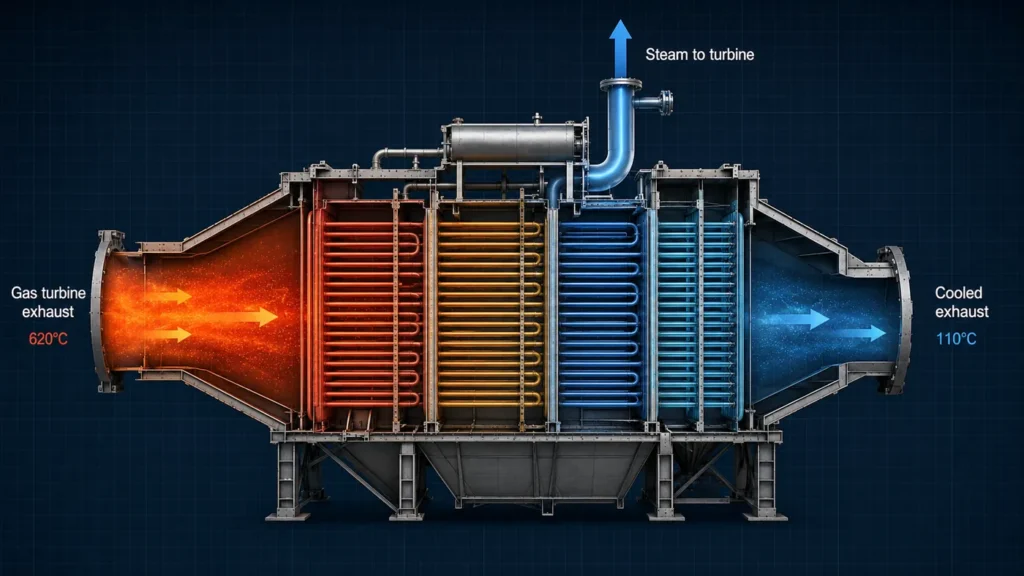
A heat recovery steam generator addresses the largest single share of this problem by capturing gas turbine exhaust at 550 to 650°C and using it to drive a secondary Rankine cycle. Exhaust that a simple-cycle turbine would vent to atmosphere becomes the heat input for a second thermodynamic machine operating at no additional fuel cost. The efficiency record at Bouchain did not come from extracting more work from the gas turbine stage alone. It came from using that turbine’s exhaust to run an entire second cycle.
Thermodynamics, Energy Efficiency, and the Eco Tech Horizon
Most emerging clean energy systems are, at their core, heat engines or devices that move heat between reservoirs. That is why thermodynamics and energy efficiency are not background context for eco technology. They are the primary physical constraint on what any of these devices can deliver.
Solar thermal plants concentrate sunlight to produce steam. Parabolic trough collectors heat a synthetic heat-transfer fluid to roughly 400°C, corresponding to 673 K. Against atmospheric exhaust at 300 K, the Carnot ceiling for that temperature is 55.4 percent. Actual thermal-to-electricity conversion in parabolic trough plants runs at 14 to 20 percent, with the gap reflecting collector heat losses, piping inefficiencies, and the standard losses of a steam turbine at moderate temperatures. Central receiver systems, which focus sunlight onto a tower-mounted heat exchanger at temperatures above 560°C, push toward higher Carnot ceilings by raising T_hot directly.
Ground-source heat pumps occupy a different thermodynamic position. A heat pump moves thermal energy from cold ground at approximately 280 K into a building at around 340 K. The performance ceiling for a heat pump is the coefficient of performance rather than an efficiency fraction, but Carnot governs that too:
COP_max = T_hot / (T_hot – T_cold) = 340 / (340 – 280) = 340 / 60 = 5.67
For every unit of electrical energy consumed, a thermodynamically perfect heat pump would deliver 5.67 units of heat energy. Real ground-source systems achieve a COP of 3 to 4, covering 53 to 71 percent of their Carnot ceiling. For a working technology in field conditions, that fraction is respectable.

Proton exchange membrane fuel cells occupy a different position entirely. They convert hydrogen’s chemical energy directly to electricity through an electrochemical reaction, bypassing the thermal stage. Because no heat engine is involved, the Carnot limit does not apply in the same way. The theoretical efficiency ceiling is set by the free energy of the hydrogen oxidation reaction, which allows efficiencies above 80 percent in principle. Real PEM fuel cells achieve 50 to 60 percent, with losses arising from electrode kinetics, membrane resistance, and water management. None of those losses are thermodynamic constraints on heat-to-work conversion. They are electrochemical engineering problems, and that distinction matters for how solvable they are.
The View From NoSuchDevice
Thermodynamics is the most honest branch of engineering. I say that with genuine admiration, and I want to be precise about what I mean.
Carnot’s formula does not negotiate. It hands engineers a ceiling based on temperature alone, and that ceiling does not shift when the funding increases or when the press release goes out. A machine running between 300 K and 1700 K cannot exceed 82 percent efficiency. The cost of the machine is irrelevant. The intentions of its builders are irrelevant. The number is what it is.
What I find less useful is how rarely this frame gets applied in popular writing about energy technology. A solar thermal plant at 20 percent efficiency gets described as underperforming. A gas turbine at 40 percent gets described as highly efficient. Both descriptions might be defensible relative to devices in their class, but neither asks the question that actually has thermodynamic meaning: how close to the Carnot ceiling is this specific device operating? A geothermal plant at 15 percent against a ceiling of 33 percent is doing reasonably well. A solar thermal plant at 20 percent against a ceiling of 55 percent has genuine room to move.

For eco technology devices in general, the honest observation is that thermodynamic efficiency is rarely the binding constraint on deployment. Material costs, manufacturing complexity, field durability, and grid integration problems tend to arrive as obstacles before the Carnot ceiling does. Heat pumps operating at 60 percent of their Carnot maximum are thermodynamically respectable. Fuel cells that bypass the Carnot constraint entirely have an efficiency argument that holds up under scrutiny.
Where thermodynamics and energy efficiency deserve more rigorous attention is in industrial process heat, cement and steel production, and direct air capture systems operating at significant thermal loads. Those applications sit in a temperature regime where pushing the hot side by 50 K meaningfully changes the Carnot ceiling and, by extension, what an optimized device at that ceiling would cost to run at scale. The power generation conversation has largely absorbed this lesson over the past 40 years of combined-cycle development. The industrial decarbonization conversation has not.
You read the whole thing.
That is rarer than it should be. A 200-year-old formula still sets the ceiling on the most advanced power plants on Earth, and that is worth sitting with for a moment. I make every piece alone, with no ads and no investor deciding what gets written. If you want the next machine taken apart like this one, you can help me make it.
A coffee a month is enough to keep it free for everyone.
Prefer crypto or a one time gift? Other ways to give →
Technologies Related to This Concept
| Technology | Concept |
|---|---|
| Quantum Energy Grid Systems | City-wide energy grids utilizing quantum entanglement for instant energy transfer without losses. |
| Solar-Hydrogen Hybrid Engines | Engines that switch between solar and hydrogen power for maximum efficiency. |
| Bio-Synthetic Fuel Production | Creating fuels through bio-synthesis that are carbon-neutral. |
| Nano-Structured Hydrogen Storage | Safe, efficient hydrogen storage at the nano level for fuel cell vehicles. |
| Quantum Flux Energy Harvesters | Quantum Flux Energy Harvesters |
Frequently Asked Questions
What does the Carnot efficiency formula actually calculate?
Carnot’s formula calculates the maximum possible efficiency of any heat engine operating between two temperature reservoirs. It requires only the absolute temperature of the hot source and the absolute temperature of the cold sink, both in kelvin. The result is the highest fraction of input heat that any engine could ever convert to useful work, assuming zero irreversibilities. Real engines always fall short of this ceiling because irreversibilities are unavoidable in any physical machine.
Why is 100 percent thermodynamic efficiency physically impossible in a heat engine?
A heat engine converts heat to work by allowing heat to flow from a hot reservoir to a cold one. Extracting all of that heat as work while discarding nothing to the cold side would require the cold reservoir to absorb zero heat energy. That condition is achievable only at absolute zero temperature, which cannot be reached in any real physical system. At any working temperature above absolute zero, some heat must flow to the cold reservoir, and that heat is unavailable for work.
Why do geothermal plants have low efficiency when the heat source is free?
Geothermal fluids typically reach 150 to 200°C, translating to roughly 423 to 473 K. Against an atmospheric cold sink at 300 K, the Carnot ceiling for those temperatures sits between 29 and 37 percent. Real binary-cycle plants achieve 10 to 23 percent. The efficiency is low because the temperature gap is small, not because the engineering is inadequate. Thermodynamics and energy efficiency answer to temperature ratios, not to the cost of the heat source.
How do fuel cells avoid the Carnot limit that constrains heat engines?
Fuel cells convert chemical energy directly to electrical energy through electrochemical reactions, without passing through a thermal stage. The Carnot limit applies specifically to heat engines, where heat must first be converted to mechanical work before electrical generation. Fuel cells skip that conversion entirely. Their theoretical efficiency ceiling is set by the free energy of the electrochemical reaction rather than a temperature gap, allowing hydrogen fuel cells to approach 80 percent efficiency in principle.