




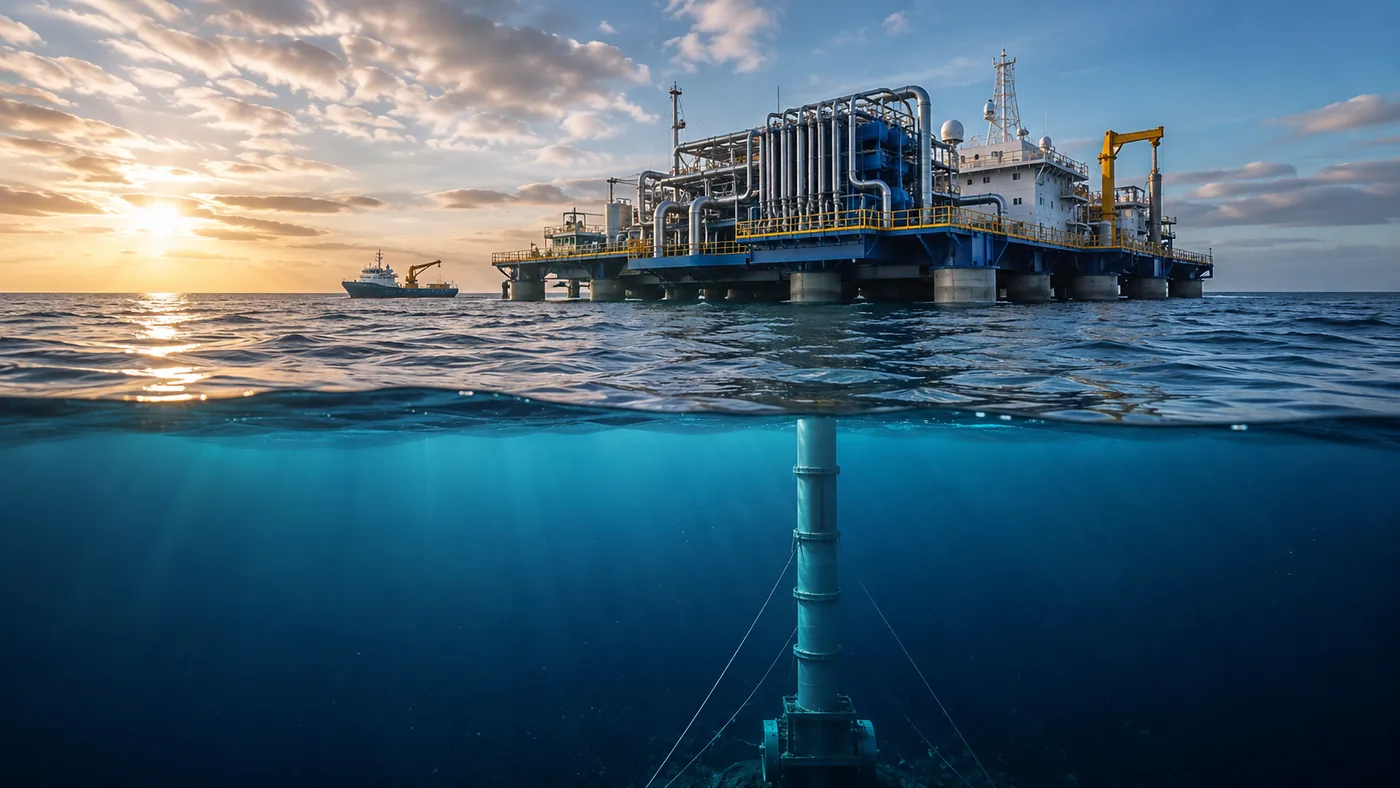
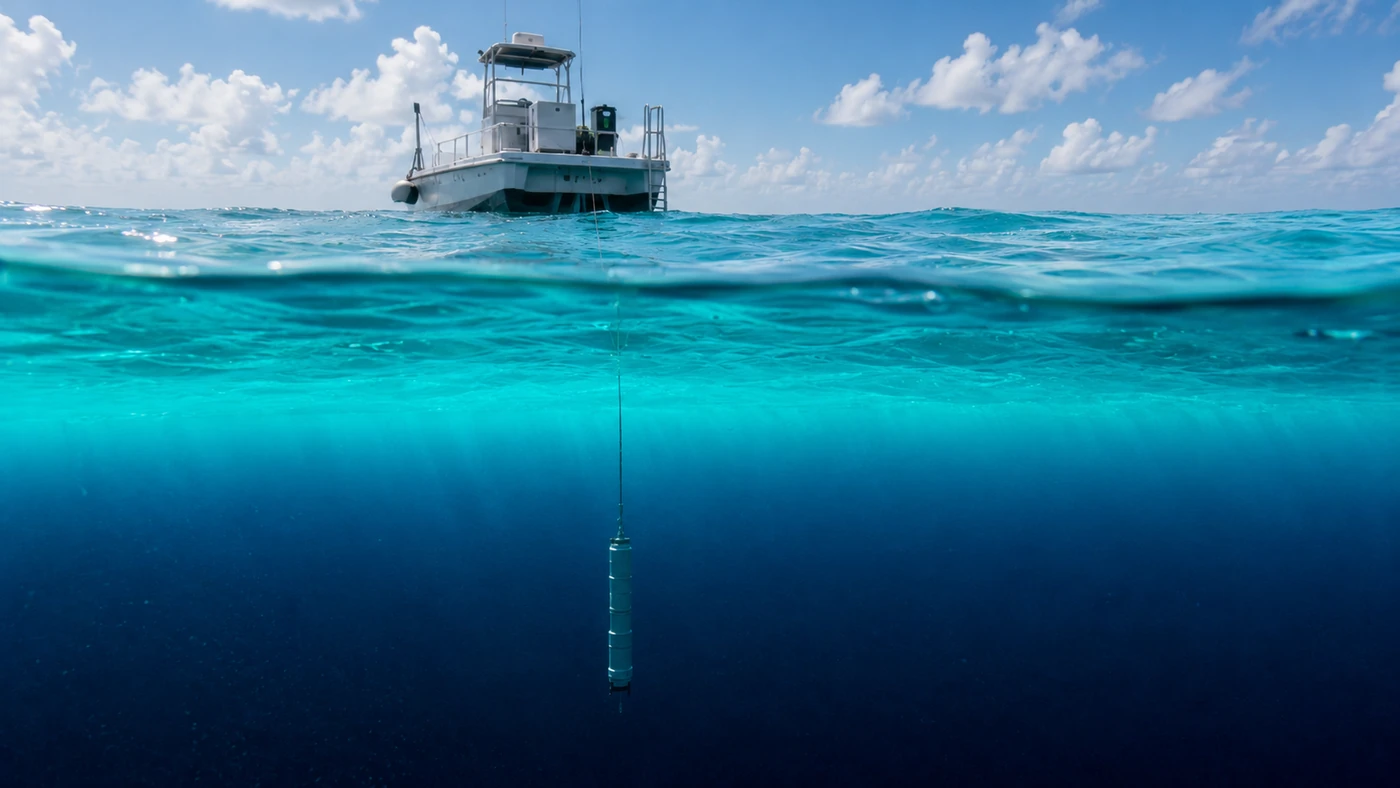
The tropical Pacific surface sits at around 28°C for twelve months of the year. Drop a probe to 800 meters and the reading stabilizes near 4°C. Same water, same location, a 24-degree gap maintained by nothing more than sunlight striking the surface and the ocean’s own mass insulating the cold beneath. That gap has been there since the ocean took its current shape.
An Oceanic Thermal Energy Converter runs a heat engine across that gap. Warm surface water is the boiler. Cold deep water, drawn up from a kilometer below, is the condenser. Every conventional power plant does the same thing with a furnace and an atmosphere. The OTEC converter does it with thermal reservoirs that are free, continuously replenished, and distributed across a hundred million square kilometers of tropical ocean. The question is whether 24 degrees is enough to do useful work at scale. The answer is yes, with caveats that are worth understanding precisely.
The short version: An OTEC converter extracts energy from the temperature difference between warm tropical surface water and cold deep water. Carnot’s law limits maximum efficiency to roughly 8%; real units achieve about 3% net after cold-water pumping losses. A platform drawing 100 m³/s of warm seawater yields around 246 MW continuously, regardless of weather or time of day. Desalinated water and hydrogen emerge as natural byproducts of the same machine.
Key Takeaways
- The tropical ocean surface holds at roughly 28°C year-round while the water at 800-1000 m depth stays near 4°C – that 24°C gap is the entire thermal engine
- Carnot’s law caps efficiency at around 8% for this temperature difference; OTEC units achieve 3% net in practice, which sounds discouraging until you price the fuel at zero
- The converter produces power continuously, 24 hours a day, with no dependence on sunlight, wind, or imported fuel supply chains
- Open-cycle OTEC produces desalinated water directly from the condensation stage; on-platform electrolysis converts surplus power to hydrogen for export by carrier vessel
- The strongest early deployment case is island nations currently running on imported diesel – where the OTEC converter undercuts the fossil fuel alternative on every operational metric except upfront capital
Table of Contents
The Tropical Ocean Has Been a Heat Engine for Millions of Years
There is something easy to overlook in how tropical oceans absorb solar radiation. The warm surface layer heats continuously, day after day, decade after decade, while deep water stays cold because the thermocline – the sharp density boundary between warm and cold layers – acts as a natural insulating barrier. Warm water does not mix down. Cold water does not rise. The gradient persists because the ocean’s own stratification maintains it without external input.
The tropical belt between 20°N and 20°S covers roughly 100 million km². Below it sits water that descended from polar regions centuries ago before settling at depth, carrying cold accumulated over decades of Arctic or Antarctic exposure. The surface above receives between 4 and 6 kWh of solar energy per square meter per day. The ocean holds that heat in a stable warm layer, season after season, with no mechanism to release it spontaneously.
Jacques-Arsène d’Arsonval understood the opportunity in 1881. The proposal was thermodynamically straightforward: draw energy from the thermal gradient the way a steam engine draws energy from the difference between hot steam and cold air. The ocean provides both sides of that equation, one above the other, separated by depth. What d’Arsonval lacked was the engineering to act on it. What the OTEC converter described here has, more than a century later, is exactly that.
The Temperature Divide That Drives Everything
Surface temperatures in the equatorial Pacific and Atlantic run between 26°C and 30°C across the full year. At 800 meters, the reading stabilizes near 4-6°C. At 1000 meters, closer to 3-4°C. The gap used in OTEC calculations is 20-24°C – not because the physics demands exactly that figure, but because that is what the ocean reliably delivers at depth ranges a pipe can reach.
The warm surface water is the heat source. The cold deep water is the heat sink. Any heat engine runs on the difference between a hot reservoir and a cold one; the thermodynamic laws governing this relationship apply whether the hot reservoir is a coal boiler or an equatorial ocean. What changes is that the ocean provides both reservoirs, separated by depth rather than by a furnace.
Carnot Sets the Ceiling, and the Ceiling Is Lower Than You’d Expect
The theoretical maximum efficiency of any heat engine depends only on its reservoir temperatures. The Carnot formula:
η_max = 1 – T_cold / T_hot
Temperatures in Kelvin. For an OTEC converter operating between 28°C (301 K) and 4°C (277 K):
η_max = 1 – 277/301 = 0.0797 ≈ 8%
Eight percent is not a number that impresses engineers accustomed to coal plants at 35-40% or combined-cycle gas turbines at 55%. But neither of those runs on a thermal resource that replenishes itself continuously without any human input. The comparison that matters is not efficiency against coal. It is cost per megawatt-hour against diesel, in locations where diesel arrives by ship at considerable expense and logistical complexity.
How the Oceanic Thermal Energy Converter Actually Works
The machine has one job: run a heat engine between two bodies of water at different temperatures. What distinguishes the three main designs is what fluid does the work in the middle.
Three Cycles and What Makes Each One Different
The closed-cycle OTEC uses a dedicated working fluid – ammonia in current designs – that never contacts the seawater. Ammonia’s low boiling point (-33°C at atmospheric pressure) means it vaporizes readily when warm seawater flows across a heat exchanger at reduced pressure, then condenses back to liquid when cold deep water cools it on the other side. The vapor drives a turbine between those two states, circulating in a sealed loop. Next-generation closed-cycle designs are developing alternatives: CO₂ in transcritical cycles and hydrofluoroolefin compounds that deliver comparable thermal performance with a reduced environmental footprint if containment ever fails.
The open-cycle OTEC system uses seawater itself as the working fluid. Warm surface water enters a low-pressure chamber where flash evaporation occurs at around 26°C. The resulting steam drives a turbine. Cold deep water then condenses it back to liquid. Because the steam was distilled from seawater, the condensate is fresh water. The open-cycle produces electricity and desalinated water in the same thermodynamic process. Turbines must be physically large (low-pressure steam has low density and requires high volumetric flow rates), but the fresh water output can independently justify a platform in water-scarce locations.
The hybrid cycle combines both approaches: warm seawater flash-evaporates in a low-pressure chamber, the steam heats a secondary working fluid through a heat exchanger, and that fluid drives a more compact, efficient turbine. Condensed steam still yields fresh water. The hybrid captures the desalination advantage of the open cycle while running a mechanically superior turbine stage.
The Cold Water Pipe – The Most Counterintuitive Part of the Machine
Strip away the thermodynamics and what an OTEC unit is, mechanically, is a very long pipe. Warm surface water is abundant and accessible. Cold water must be drawn from 800-1000 meters below, continuously, in large volume, against its natural tendency to stay at depth.
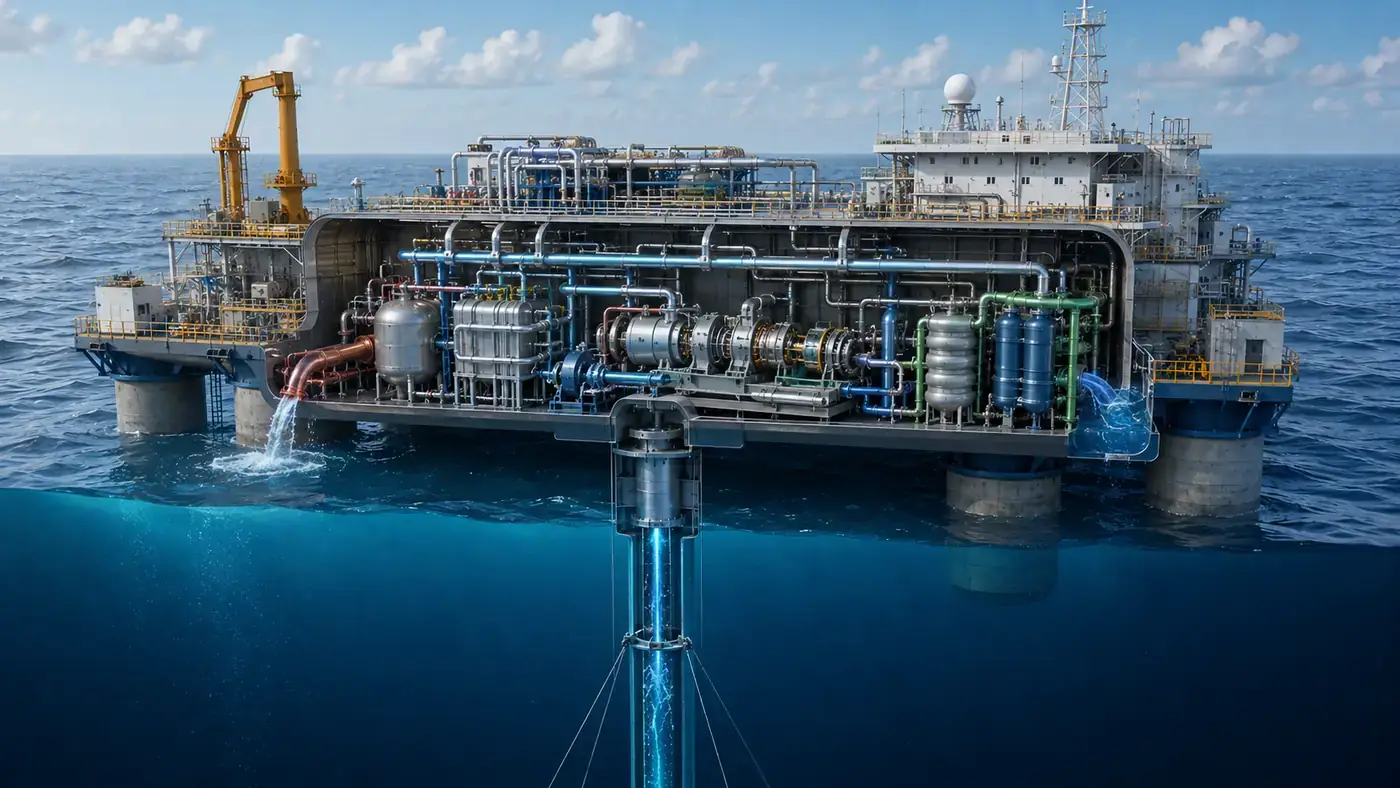
The cold water pipe – typically 5-10 meters in diameter for a utility-scale installation – is the dominant structural element of the device. A continuous pump draws cold water upward against the density gradient. The density difference between warm and cold seawater is small (roughly 3 kg/m³ for a 24°C differential), but pumping losses still consume 20-25% of gross electrical output. That is why net efficiency lands around 3% even when the Carnot ceiling allows 8%.
At 1000 meters, the pipe wall handles roughly 10 MPa of pressure differential between the internal flow and the surrounding ocean. High-density polyethylene and fiber-reinforced composites absorb those loads while remaining flexible enough for a floating platform. The pipe is moored with designed flexibility – a structure that cannot flex under wave and current loading is a structure that eventually fails.
The Energy Arithmetic: What a 24°C Difference Can Actually Move
The thermal power available from a given flow of warm seawater depends on three variables: flow rate, temperature differential, and the specific heat capacity of seawater.
P_thermal = ρ × c_p × Q × ΔT
Where ρ is seawater density (~1025 kg/m³), c_p is specific heat (~3993 J/kg·K), Q is volumetric flow rate, and ΔT is the temperature difference between surface and depth.
For a utility-scale platform processing 100 m³/s of warm surface water with a 20°C differential:
P_thermal = 1025 × 3993 × 100 × 20 ≈ 8.2 GW (thermal)
At 3% net efficiency after pumping losses:
P_net ≈ 8.2 × 0.03 ≈ 246 MW
That is enough to meet the electricity demand of a medium-sized European city, continuously, from a platform anchored in open ocean. No fuel. No weather dependency. No interruption at 3 a.m.
| OTEC Cycle | Working Fluid | Net Efficiency | Fresh Water Output | Primary Use Case |
|---|---|---|---|---|
| Closed-cycle | Ammonia / next-gen HFO | ~3-4% | None | Utility power, compact turbine design |
| Open-cycle | Seawater | ~2-3% | ~2.3 L/kWh | Water-scarce island locations |
| Hybrid | Seawater + secondary fluid | ~3-4% | Moderate | Combined power and water output |
The efficiency column looks discouraging until you price the fuel at zero. A remote Pacific island generating 10 MW on imported diesel burns roughly 2 million liters of fuel per year, at costs that compound shipping, storage, and supply fragility. An OTEC converter producing 10 MW runs on the thermal gradient the surrounding ocean maintains automatically, every day of every year. At some point the arithmetic stops looking discouraging and starts looking obvious.
That 246 MW from a machine running at 3% net efficiency on free ocean heat is the kind of number this archive exists to chase down.
I make all of it alone, with no ads. If it is worth a coffee a month to you, that keeps the next one coming.
Keep it alive →Continuous Power and the Byproducts Nobody Planned For
Solar panels produce power when the sun shines. Wind turbines produce when wind blows. An OTEC converter produces because the ocean’s thermal gradient does not have a daily or seasonal cycle at the relevant latitudes. The warm surface water is warm at 3 a.m. The cold deep water is cold in January. The delta is stable in ways that most renewable sources are not.
Continuous baseload from a renewable source is genuinely rare. Hydropower has it in certain geographies. Geothermal has it at specific geological sites. OTEC has it across the entire tropical ocean wherever depth exceeds 800 meters within pipeline range. The energy storage systems required to stabilize an OTEC-anchored grid are modest compared to what equivalent solar nameplate capacity demands, because there are no gaps to fill at night or during cloud cover.
Fresh Water and the Open Cycle’s Second Job
The open-cycle OTEC does not produce fresh water as an afterthought. It produces fresh water because the thermodynamics require condensation, and condensed seawater vapor is clean. A unit producing 2 MW of net electricity through the open cycle generates roughly 4,600 liters of fresh water per hour as a direct output of the condensation stage. At 10 MW, that is 23,000 liters per hour – around 550 m³ per day.
For an island community of 10,000 people, 550 m³/day covers roughly half the daily fresh water requirement alongside the electricity supply. The platform is not just a power station. Unlike reverse osmosis desalination, the fresh water output here does not require a separate high-pressure pump system drawing additional power from the grid. The condensation stage handles both outputs from the same thermodynamic cycle.
Hydrogen as the Bridge Between Ocean and Continent
For platforms producing 100 MW or more, submarine cable transmission works at distances up to a few hundred kilometers. For platforms further offshore, or producing more power than a local island grid can absorb, hydrogen production changes the export logic entirely.
OTEC electricity drives electrolysis on-platform. The hydrogen is liquefied or converted to ammonia (which is, usefully, already the working fluid in closed-cycle designs) and transported by carrier vessel to destination ports. At those ports, it enters the energy system as fuel or industrial feedstock. The platform becomes a remote production facility whose output is a shippable commodity. How that hydrogen stores and delivers energy at the receiving end depends on the physics of energy storage systems installed in the port infrastructure.
Where the OTEC Converter Belongs and Where It Does Not
Geography is not optional in OTEC deployment. The device requires a sustained temperature differential of at least 20°C between surface water and accessible deep water. That means warm surface temperatures above 25°C year-round and cold deep water below 6°C within reach of a pipe not much longer than a kilometer. Those conditions exist almost entirely within the equatorial band between 20°N and 20°S, where ocean depth exceeds 1000 meters within practical distance from many coastlines.
Outside the tropical belt, the numbers fall apart. At 40°N latitude, surface temperatures drop seasonally to 15°C. The differential shrinks. The Carnot ceiling falls below 4%. Pumping losses consume most of the gross output. The converter stops paying for itself.
The Tropical Belt as the Only Logical Address
The Pacific Basin has the most favorable OTEC geography on Earth. Deep water within 20 km of coastline exists across Micronesia, Polynesia, Hawaii, and portions of Southeast Asia. The Caribbean and equatorial Atlantic offer valid sites. The Indian Ocean tropical zone covers the Maldives, Sri Lanka, and portions of the East African coast. Total deployable potential across these zones runs well above current regional electricity demand in aggregate.
Island Nations: Where the Converter Changes the Conversation

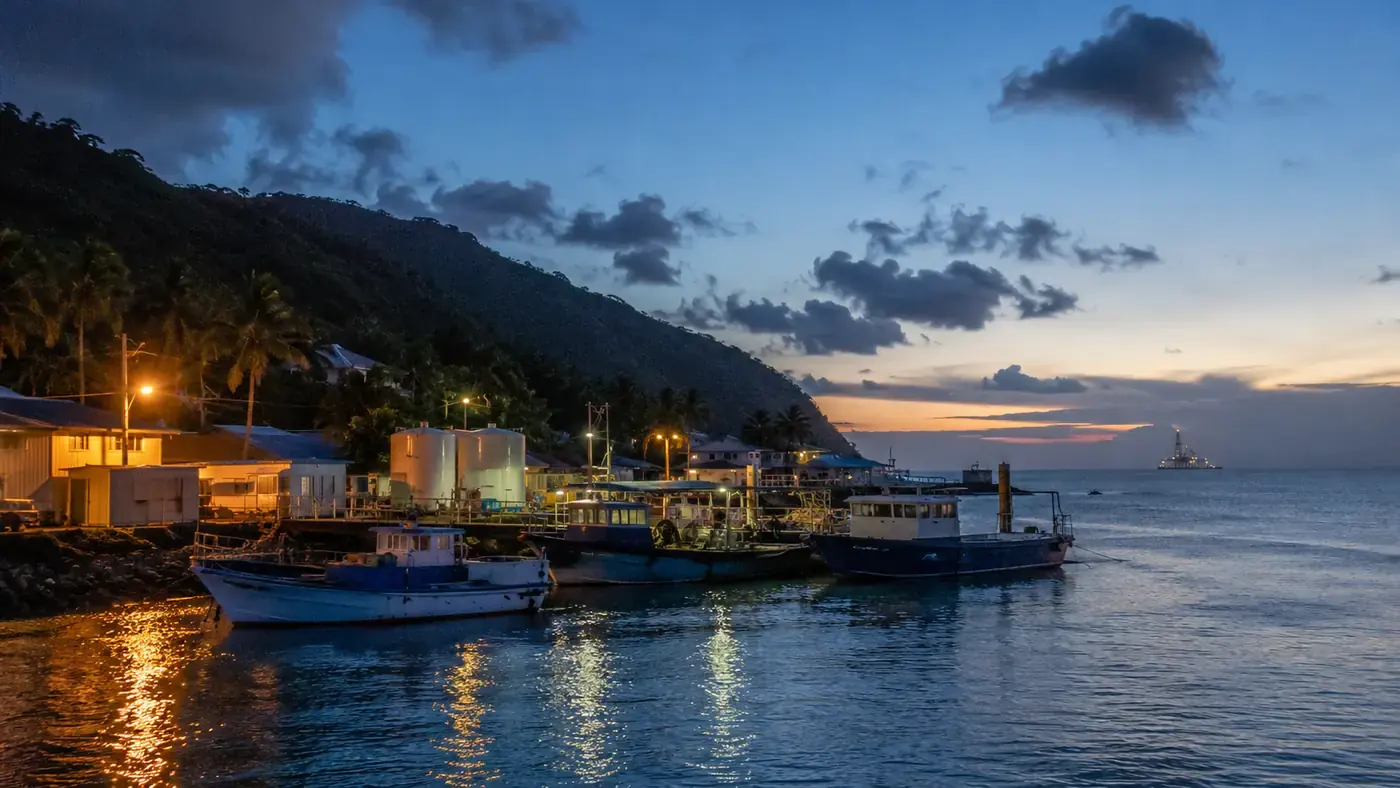
The Maldives imports essentially all its energy as diesel. So do Kiribati, Tuvalu, the Marshall Islands, and most of the Cook Islands. These communities run their entire electrical infrastructure on fuel arriving by ship, expensive by any baseline, vulnerable to supply disruptions with no local backstop.
For these locations, the OTEC converter is not a marginal improvement on an existing system. It is the replacement of a genuinely fragile dependency with a machine that runs on what surrounds them. A unit providing 10 MW of continuous power to an island of 50,000 people, plus 500 m³/day of fresh water, undercuts the diesel alternative on every operational metric. The one barrier is upfront capital cost – a financing problem, not a physics problem, and financing problems are solvable in ways thermodynamics is not.
From a Single Platform to a Thermal Belt Around the Equator
OTEC platforms do not scale down well. The cold water pipe, the mooring system, and the heat exchanger infrastructure all improve with size. A platform designed for 5 MW is not five times simpler than one at 25 MW. The cost curve rewards larger units, which means the first commercially viable installation is not a modest pilot. It is a medium-scale power station at sea, and the evolutionary arc of the technology runs from there outward.
Modular Growth and the Grid-Scale Question
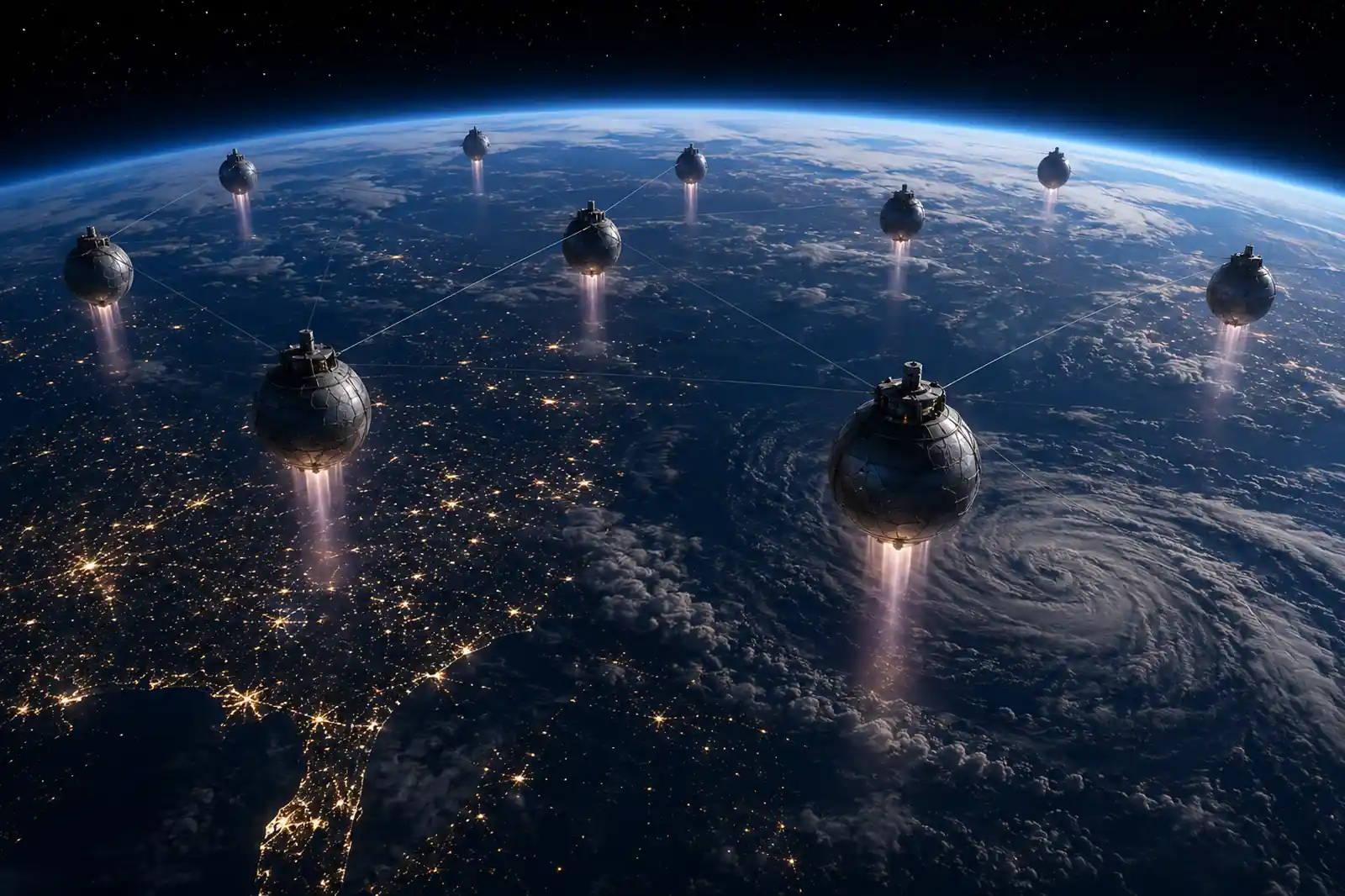
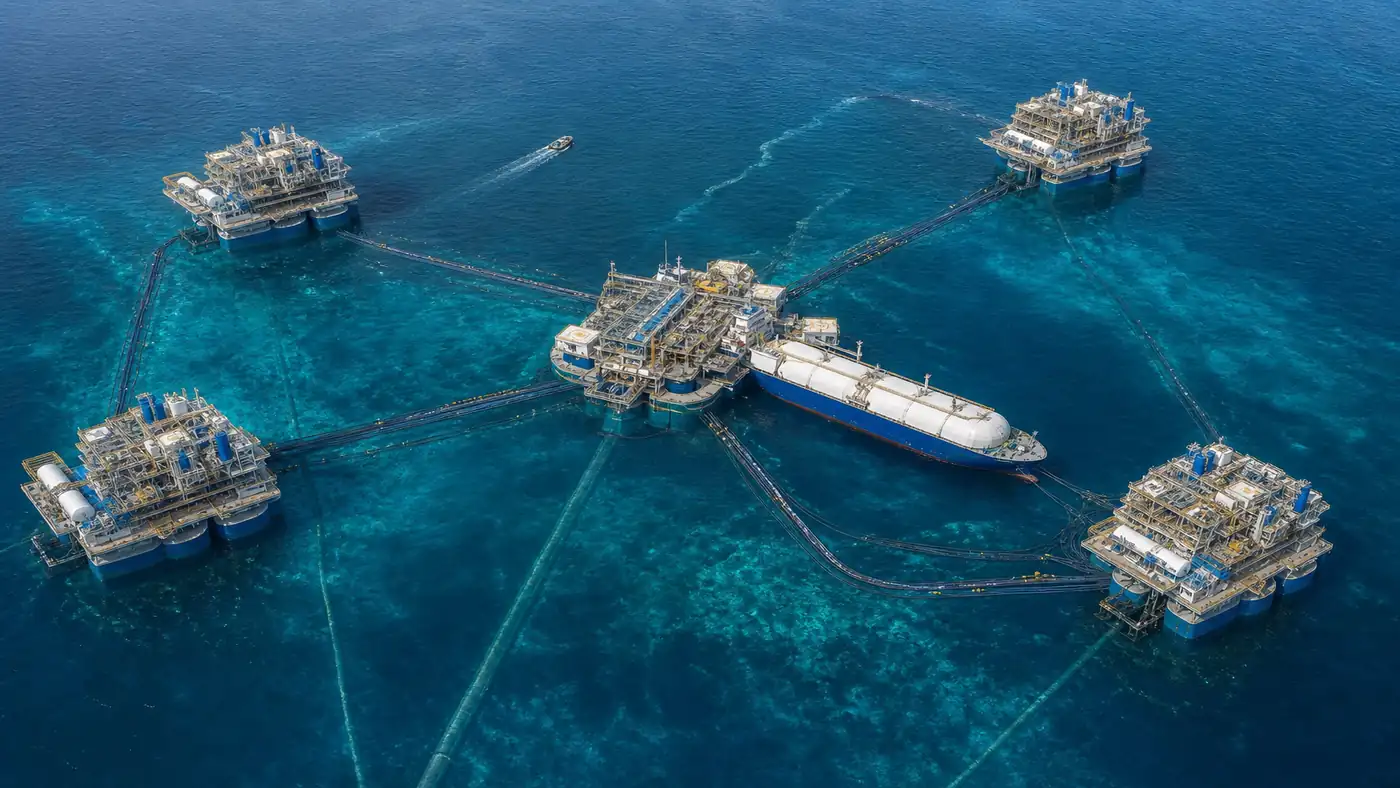
What scales is the number of platforms. A cluster of ten 250 MW units in favorable tropical waters delivers 2.5 GW of firm baseload. Twenty platforms deliver 5 GW. The platforms share maintenance infrastructure, co-locate within a designated marine energy zone, and connect through a shared submarine cable or hydrogen export terminal. Continuous performance data from each platform feeds a centralized management system – the kind of sensor-dense ocean environmental monitoring that modern offshore operations already deploy for oceanographic and weather data – which optimizes flow rates and maintenance intervals across the full array. AI-driven management systems coordinate energy dispatch, predict seasonal thermal gradient variations from deep-water temperature profiles, and adjust platform operations in real time.
Marine Productivity and the Upwelling Side Effect
The cold water pipe moves nutrients alongside cold water. Deep ocean water accumulates dissolved nitrates, phosphates, and silicates over centuries of organic decomposition at depth. Drawing it to the surface creates localized artificial upwelling similar in mechanism to natural upwelling zones off the coasts of Peru, Namibia, and California – among the most biologically productive ocean regions on Earth.
Fish populations concentrate in the nutrient plume near the platform’s cold water discharge. Marine productivity increases in the surrounding area. At the scale of hundreds of platforms across the equatorial belt, the aggregate effect on tropical surface temperature and atmospheric circulation becomes climatologically measurable. The magnitude and regional consequences of that effect are genuinely open questions – ones that careful monitoring would need to track from the first cluster-scale installation. At initial scales, the effect is local and manageable. At multi-terawatt deployment, the question changes character.
The View From NoSuchDevice
I have a specific problem with how OTEC is usually discussed. People reach for the efficiency figure – 3%, sometimes less – and treat it as a verdict. It is a constraint, not a verdict, and the difference matters in ways the framing tends to erase.
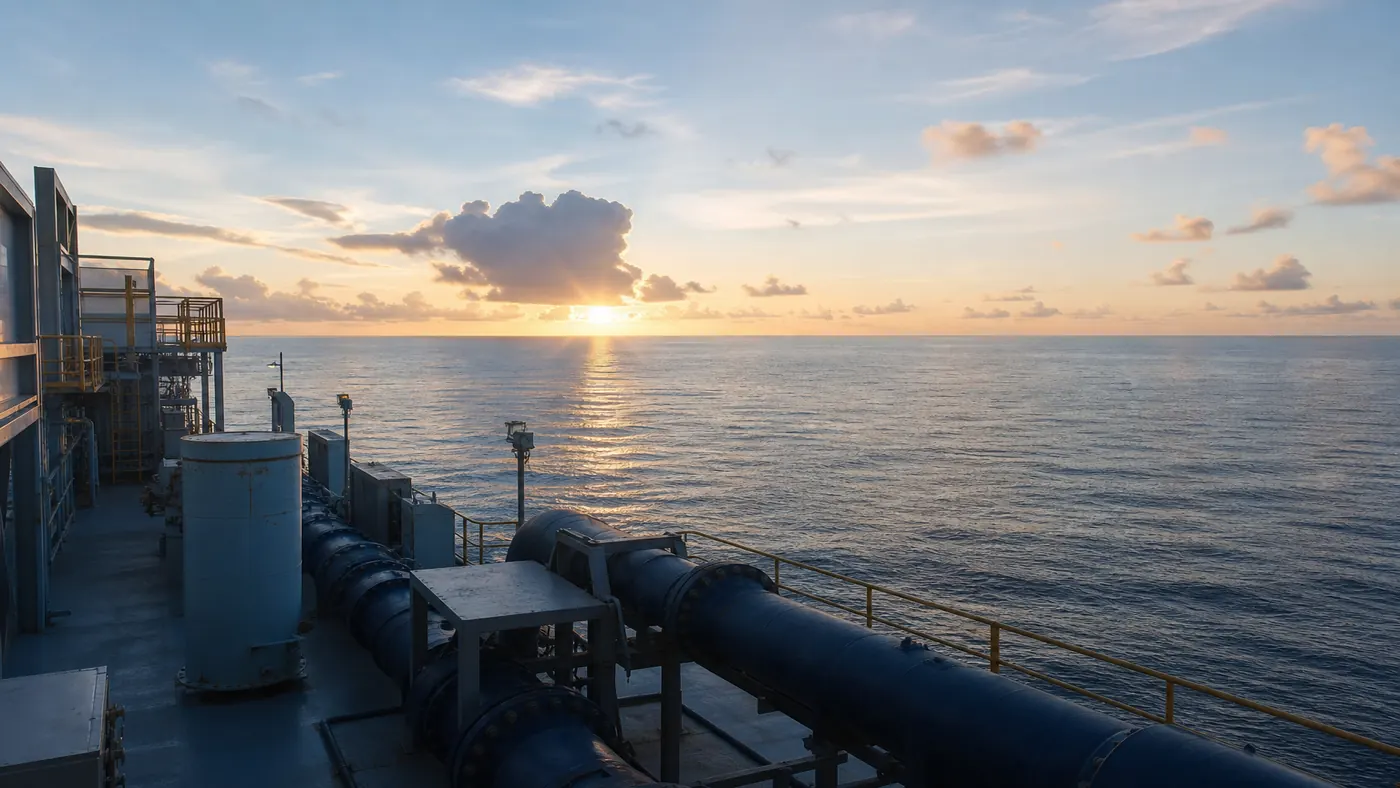
The tropical ocean is the largest passive solar collector on Earth. It has been accumulating heat continuously for geological timescales. The 3% an OTEC unit extracts is 3% of a thermal resource that replenishes itself daily, operates around the clock, and comes with desalinated water and localized marine productivity as side effects. I find it genuinely strange that this does not appear more seriously in energy planning discussions.
What is slowing the field is a geography-capital mismatch. The locations where OTEC makes the strongest case are precisely the locations with least access to the upfront capital a commercial installation requires. The locations with the capital are mostly outside the tropical belt. That is a financing problem, and financing problems yield to the right structure in ways that thermodynamics never does.
The marine productivity effect around a cold water discharge interests me more than it usually gets credit for. A platform producing 250 MW while simultaneously creating a nutrient-rich zone in the surrounding ocean is not just a power station. Whether deployment makes most sense as a power anchor, a water production facility, or an aquaculture catalyst depends entirely on what is most urgent at a given location. The device can lead with whatever argument closes the financing in that specific place.
I do not think OTEC replaces solar or wind. I think it covers what they cannot: continuous baseload from a renewable source, in the exact latitudes where energy poverty and water scarcity tend to coincide with proximity to deep, warm ocean. The gap in the renewable energy portfolio is real. The OTEC converter fits it cleanly and without drama.
You read the whole thing.
That is rarer than it should be. A converter that runs on a temperature gap the tropical ocean has been maintaining for geological timescales is exactly the machine this archive exists to take seriously. I make every piece alone, with no ads and no investor deciding what gets written. If you want the next machine taken apart like this one, you can help me make it.
A coffee a month is enough to keep it free for everyone.
Prefer crypto or a one time gift? Other ways to give →