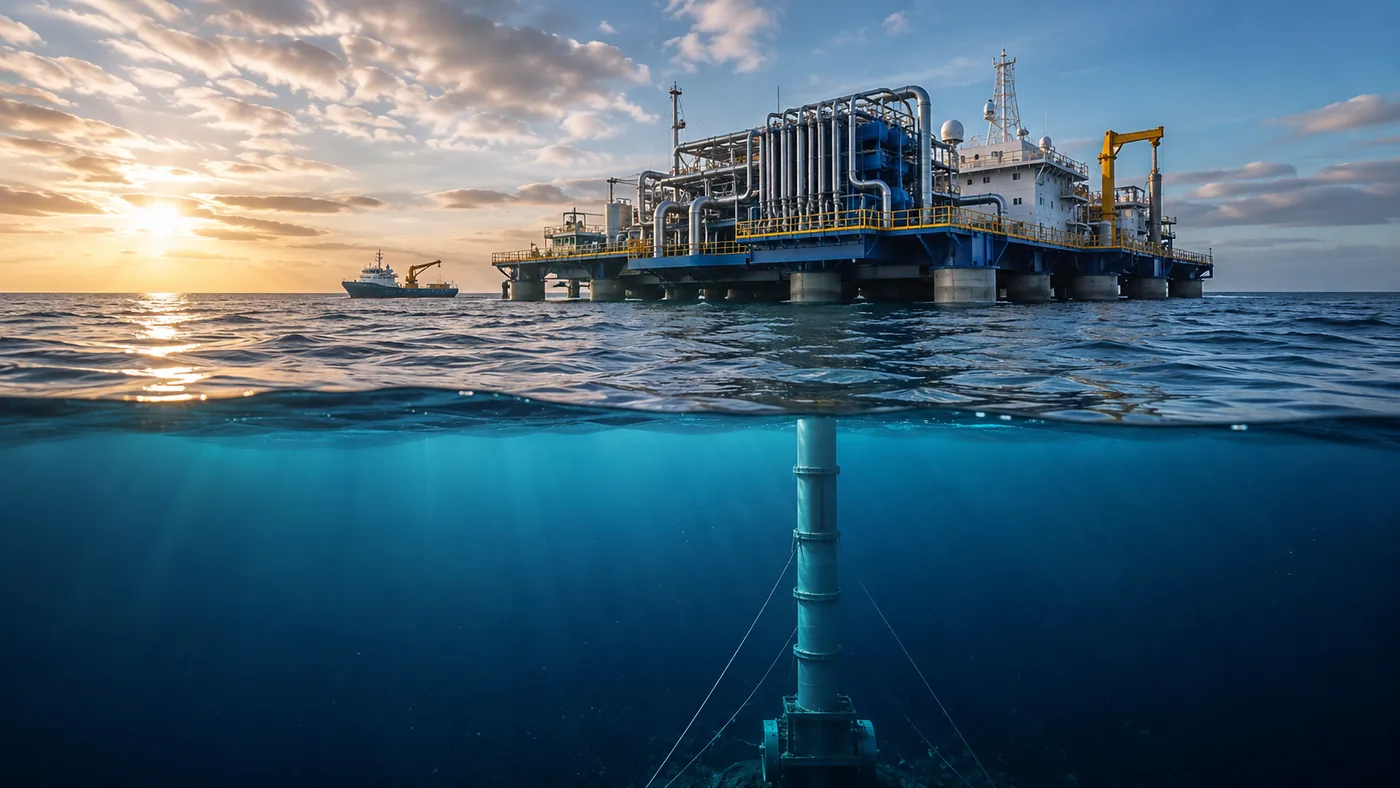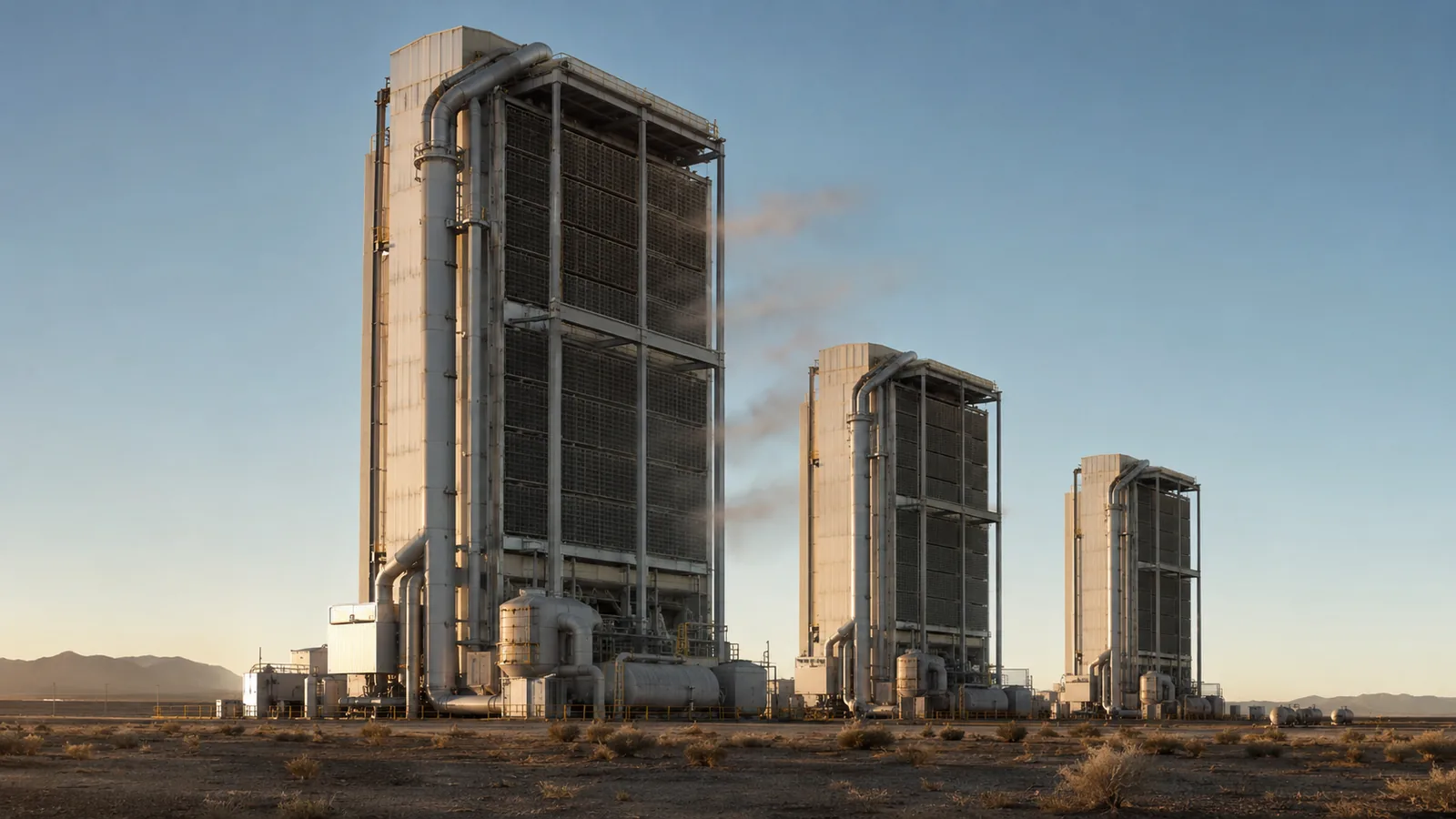



There is a gap in the atmosphere that most people who spend their lives studying climate never mention in public conversation. Between roughly 8 and 13 micrometers of wavelength, the air essentially stops absorbing infrared radiation. Water vapor, carbon dioxide, methane – none of them have significant absorption bands there. Heat radiated at those frequencies by anything on Earth’s surface – a road, a wheat field, an ocean at night – passes straight through the atmosphere and escapes directly to space. The planet has been using this gap to cool itself for four billion years.
Nobody has yet built a machine designed specifically to aim at it.
That is the premise of the Quantum Climate Stabilizer: a device that uses quantum-level control over thermal photon emission to force more of Earth’s own heat through this spectral gap, faster and with more precision than any passive material achieves. Not blocking sunlight. Not scrubbing carbon. Working on the exit, not the entrance.
The short version: A Quantum Climate Stabilizer amplifies Earth’s natural infrared emission through the atmospheric window – the 8-to-13-micrometer spectral band where heat escapes to space without being absorbed by the air. The device behaves as a tunable valve on outgoing thermal flux, not as a generator of cold. A global network operating at full scale could offset roughly 3 to 4 watts per square meter of excess heating – the approximate gap between current warming trajectory and a stable climate – while remaining adjustable by region and, critically, reversible on demand. No other planetary-scale climate intervention currently proposed can claim both those things.
Key Takeaways
- Earth already has a natural heat exit – a spectral gap in the atmosphere where infrared radiation escapes unimpeded to space; the stabilizer amplifies and steers that process rather than creating something new
- The device does not generate cold; it uses quantum-controlled photon emission to increase how much heat leaves the planet through frequencies the air cannot absorb
- Shifting global temperature by 0.1°C requires redirecting approximately 190 terawatts of thermal flux – a number that looks fatal to the concept until the distinction between redirecting energy and generating it becomes clear
- Unlike stratospheric aerosols or space mirrors, a stabilizer network is regionally adjustable and reversible; switching it down returns the system toward its previous state without a rebound spike
- Radiative sky cooling materials already demonstrate the core physics in passive form; the stabilizer is what happens when that principle gets active, coordinated, and scaled to the size of the problem
Table of Contents
Earth Radiates 240 Watts Per Square Meter – and That Number Is the Whole Game
The Sun delivers roughly 1,361 watts per square meter to the top of Earth’s atmosphere. About 30 percent bounces straight back off clouds, ice, and bright surfaces. The rest – approximately 240 W/m² averaged across the entire planet – gets absorbed, runs through the climate system as heat, and must eventually leave as infrared radiation. That exit is not optional. It is the only mechanism keeping the energy budget balanced at a temperature where liquid water exists.
At the moment, the exit is slightly too small. Human emissions since industrialization have added roughly 3 to 4 watts per square meter of what physicists call radiative forcing – extra energy being trapped rather than shed. That is about 1.5 percent of the outgoing flux. The consequences of a 1.5 percent imbalance sustained over two centuries are no longer hypothetical.
Cooling Versus Stabilizing: Two Different Engineering Problems
Most geoengineering proposals target the same variable: incoming solar energy. Stratospheric aerosols scatter sunlight before it reaches the surface. Space mirrors reflect it before it enters the atmosphere. Both approaches essentially try to dim the lamp. A Quantum Climate Stabilizer targets the other side – the emission rate rather than the absorption rate. The engineering question shifts from “how do we reduce what comes in” to “how do we increase what goes out.”
The distinction matters for more than physics reasons. Cooling a planet’s average temperature and stabilizing it with regional precision are genuinely different problems. A device that uniformly lowers the global mean without granular control would shift precipitation patterns, displace crop zones, and impose climatic conditions on populations that had no say in the decision. Precision stabilization requires continuous adjustment – something that responds to conditions, not just something that runs.
The Commitment Trap Every Other Approach Has Built In
Stratospheric aerosol injection has a real precedent in major volcanic eruptions, which measurably cool the planet for a year or two. The engineering pathway is plausible. The structural problem is dependency: once a program is running at scale, stopping it causes rebound warming at rates faster than the original trend. The climate and everything living in it adapts to the modified state, and withdrawal becomes dangerous in its own right. The quantum mechanics underlying the stabilizer operates on the emission side of the budget, where stopping the intervention returns the system toward its prior trajectory proportionally, without a spike. That is a structural difference, not a marginal improvement.
Which brings up the question of what moving the exit actually costs – because the number, when it first appears, is the kind of figure that ends most conversations before they start.
How a Quantum Climate Stabilizer Would Work
The atmospheric window is not a feature someone added. It is a gap in the absorption spectrum of the gases that make up the air – a range of frequencies where none of them happen to have the right molecular structure to absorb radiation. Thermal energy radiated in that band by Earth’s surface simply passes through, undisturbed, and disappears into space. Passive objects near room temperature already radiate some energy there by default. They just do not do it efficiently, selectively, or in any coordinated way.
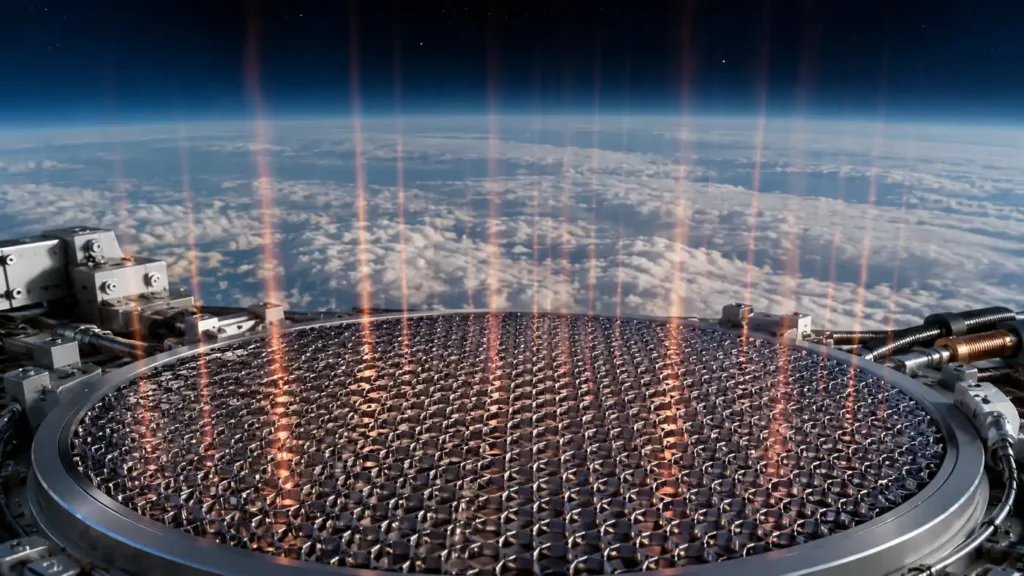
Radiative sky cooling materials have demonstrated what happens when you engineer a surface to emit strongly in the window and weakly everywhere else. Properly designed photonic surfaces can reach temperatures several degrees below ambient air even under direct sunlight – losing heat to space faster than the surrounding air can warm them back up. The technology works and has been verified in the field. A Quantum Climate Stabilizer is what that principle looks like when it stops being passive.
The Quantum Radiator
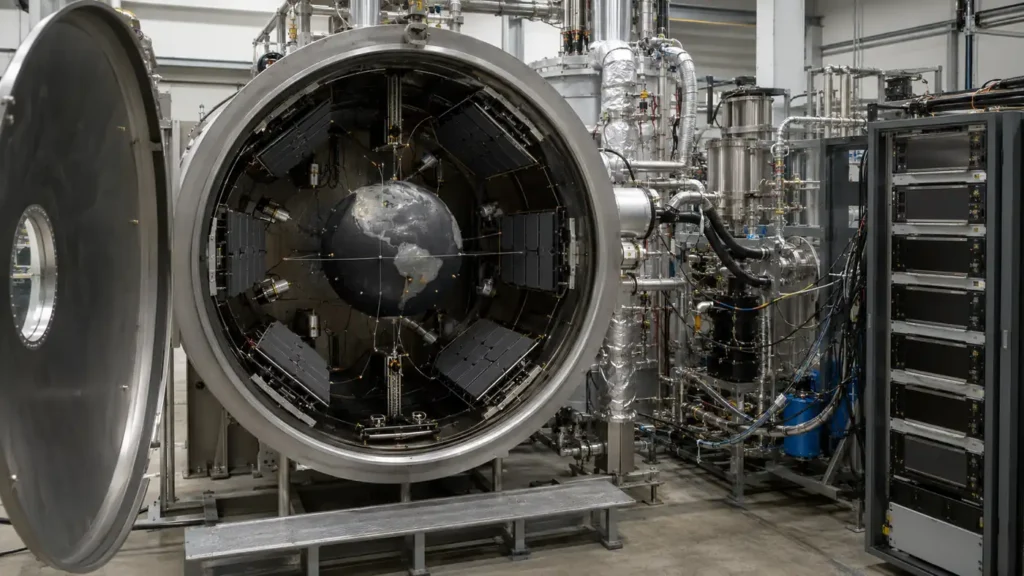
The core of the device is a quantum emitter: a nanostructured surface whose atoms are engineered so the gaps between their internal energy states correspond precisely to frequencies inside the atmospheric window. When those atoms release stored thermal energy as radiation, they emit in the right band – not scattered across the full infrared spectrum as a conventional warm surface would, but concentrated into the precise range where the atmosphere cannot stop it. The emission profile is not fixed in the material at manufacture. It is tunable in real time, adjustable in response to the actual atmospheric column above the device at that moment.
The device decides, in real time, exactly which frequencies of heat to release toward space. The mechanism is quantum: nudging atoms into states engineered to radiate in one narrow band and no other.
The Atmosphere Seen From Below
The air above the device is not a smooth absorber. Each CO₂ molecule, each water vapor molecule, absorbs and emits at specific quantum-defined frequencies – discrete lines, not a continuous band. A stabilizer modelling the real-time absorption profile of the atmosphere above it can steer photon emission into the spectral gaps within the window with a precision no passive or classical instrument approaches.
Quantum coherence – the ability of a quantum system to maintain its internal state before thermal noise scrambles it – does degrade fast in open air, typically on femtosecond to picosecond timescales. The stabilizer does not require coherence across the whole device. It requires it at the individual emitter level, long enough to set each photon on the right spectral trajectory. Recent work on room-temperature quantum emitters suggests this constraint is engineering, not physics. The gap between a laboratory demonstration and a field unit is real. It is not a wall.
The Arithmetic of 0.1 Degrees: The Number That Ends Most Conversations
To shift Earth’s average surface temperature by 0.1°C, the outgoing thermal flux must increase by a calculable amount. The Stefan-Boltzmann law relationship – which connects a surface’s temperature to the power it radiates – applied at Earth’s effective emission temperature of approximately 255 K gives:
ΔP = 4σT³ × ΔT
ΔP = 4 × 5.67 × 10⁻⁸ × (255)³ × 0.1 ≈ 0.38 W/m²
Across Earth’s full surface area of 5.1 × 10¹⁴ square meters:
0.38 × 5.1 × 10¹⁴ ≈ 190 terawatts
Global human energy production is around 20 terawatts. Moving the global mean temperature by a tenth of a degree requires redirecting nearly ten times current world energy output in thermal flux. At this point most analyses stop. The number looks like a reductio ad absurdum.
It is not.
| Parameter | Value |
|---|---|
| Earth’s average outgoing thermal flux | ~240 W/m² |
| Current excess radiative forcing | ~3 to 4 W/m² |
| Flux shift required per 0.1°C correction | ~0.38 W/m² |
| Total flux to redirect for 0.1°C | ~190 terawatts |
| Global energy production (reference) | ~20 terawatts |
| Estimated quantum steering control cost | <1% of redirected flux |
The 190 terawatts is thermal flux being redirected, not energy the network consumes. A quantum emitter does not generate that heat. It acts as a gate determining which direction existing radiation travels. The energy cost of holding a gate open is far smaller than the energy of what passes through it. Efficiency estimates for quantum photonic steering put control power below 1 percent of the redirected flux – which places network power consumption somewhere around 1 to 2 terawatts for a 0.1°C correction.
Still large. Dramatically smaller than the figure that kills most conversations about this concept.
The current excess forcing driving the problem is 3 to 4 W/m². Full correction would require several hundred terawatts of additional emission capacity across a mature global network. Partial corrections applied regionally, beginning where the signal is clearest, buy time without demanding the full infrastructure on day one. Real-time atmospheric monitoring via satellite remote sensing would be essential throughout, verifying corrections as they accumulate.
190 terawatts redirected rather than generated – that is the number that changes what this concept actually is.
I make all of it alone, with no ads. If it is worth a coffee a month to you, that keeps the next one coming.
Keep it alive →Radiative Sky Cooling: The Physics That Already Proves the Principle
The seed technology for the Quantum Climate Stabilizer already works, in passive form, in buildings and test installations. Radiative sky cooling materials – engineered photonic surfaces that emit preferentially in the atmospheric window – achieve something that seems to violate the obvious order of things: they can cool below ambient air temperature with no power input, on a clear day, even under direct sunlight. The physics is not magic. They are simply losing heat to space faster than the surrounding air can replace it.
No moving parts. No refrigerant. No energy consumption. The trick is entirely in the surface structure – a material engineered to glow in the specific frequencies where the atmosphere cannot absorb the radiation and send it back.
What the stabilizer adds to this picture is agency. Instead of a fixed emission profile baked into the material at manufacture, the device adjusts its output in real time. It responds to the actual atmospheric conditions above it. It can be turned up or down remotely. And it can participate in a coordinated network rather than operating as an isolated surface – which is where the concept stops being a better building material and starts being something else entirely.
Quantum Entanglement as a Coordination Layer
A planetary network of stabilizers faces a coordination problem that classical signal architecture handles awkwardly. Each device needs to adjust its emission profile based on atmospheric conditions, temperature data, and the behavior of neighboring nodes – in some cases on timescales of milliseconds, not hours. Round-trip signal latency across continental distances becomes a real constraint when atmospheric dynamics move faster than classical commands can follow.
Quantum entanglement offers a theoretically compelling alternative. Two entangled quantum systems share a correlated state regardless of the distance between them – a measurement on one is instantly reflected in the other. A network whose nodes share entangled states could synchronize emission across hemispheres without classical signal delay. Field-scale demonstrations of entanglement-based coordination in open-air atmospheric conditions have not yet been done. The principle is well-established in controlled laboratory environments. That gap is an engineering problem. It is also, for now, an honest one.
Where Stabilizers Would Go First: The Polar Argument
The Arctic is warming two to four times faster than the global average. Sea ice retreats, dark ocean absorbs more solar energy than the white surface it replaced, and the warming accelerates – a feedback loop that has no internal brake and that planetary models did not fully anticipate twenty years ago. It is the part of the climate system moving fastest, most visibly, and with the clearest set of consequences downstream.
It is also the most useful place to deploy a stabilizer network first.
The signal would be measurable against a background of rapid change. The atmospheric conditions – cold, clear, optically thin – are close to ideal for thermal emission. The sea ice feedback loop is precisely the kind of regional amplifier a well-targeted network could interrupt directly. And the polar regions offer something mid-latitude deployment does not: long windows of darkness where there is no solar input competing with the emission signal, making device performance straightforward to verify.
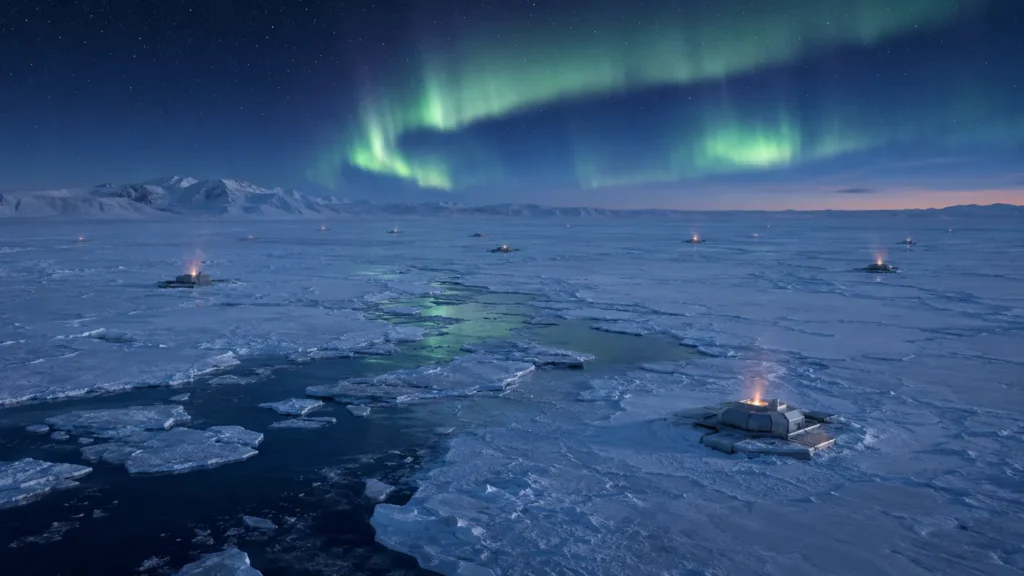
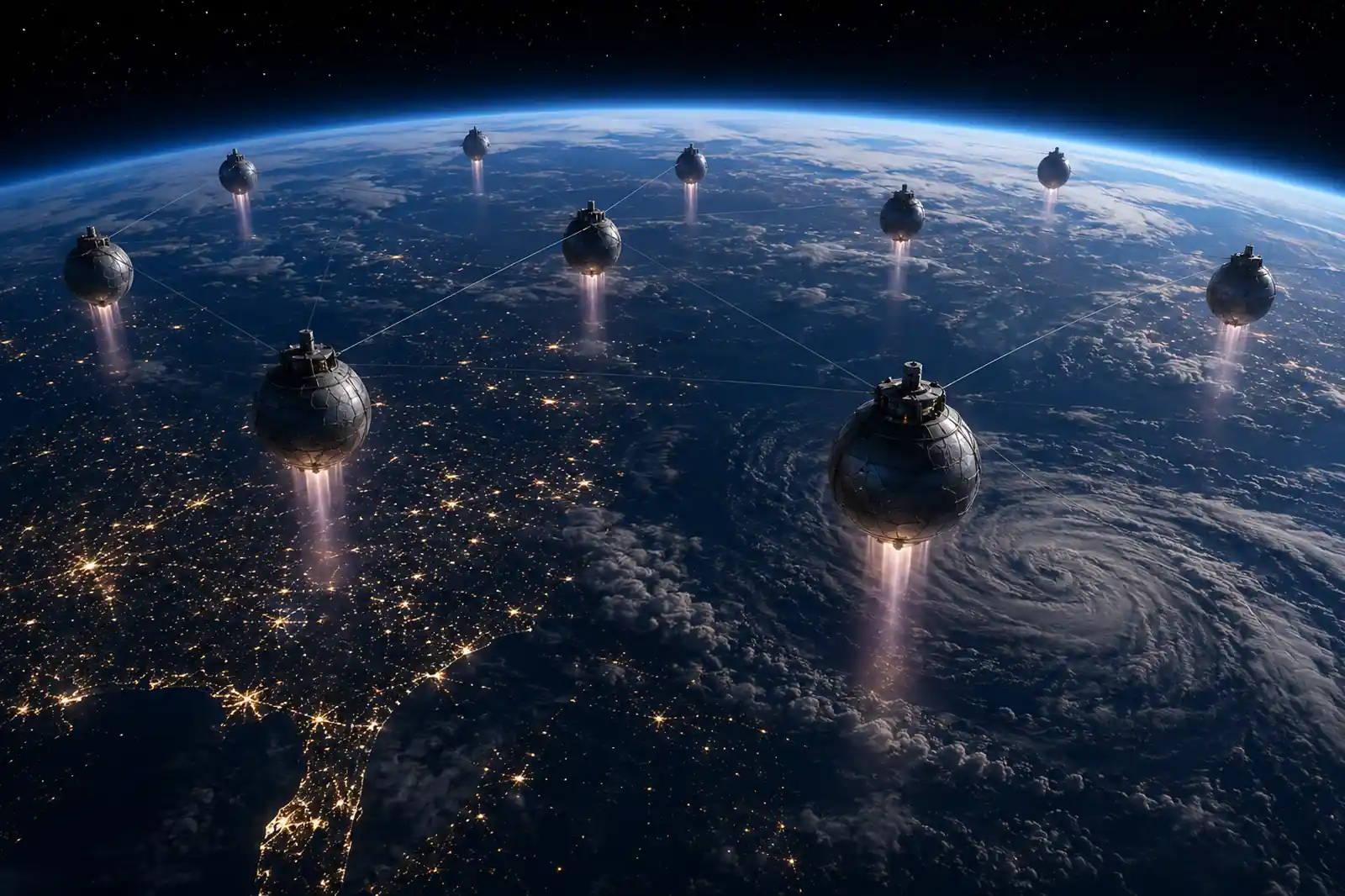
The deployment arc from there extends logically outward. Mid-latitude networks expand as the technology matures. Orbital platforms – emission arrays operating above the atmosphere entirely, eliminating atmospheric absorption from the calculation for their fraction of the flux – supplement ground networks at the outer edge of the build-out. Satellite remote sensing infrastructure would be operating throughout, providing the real-time atmospheric column data each device needs to steer its emission accurately.
But the polar deployment answer raises a question the physics alone cannot settle: what happens to the systems of living things operating underneath a device that is deliberately altering how the planet sheds heat?
Precision, Ecosystem Risk, and the Reversibility Argument
A device that can be switched off is a categorically different kind of intervention than one that cannot. This is not a minor technical footnote. It is the thing that separates every proposal currently in serious discussion from a stabilizer network operating on outgoing thermal flux.
Stratospheric aerosol injection, marine cloud brightening, space mirrors – all of them share a structural problem that does not appear in the physics papers but is visible the moment you ask what happens when the program stops. The climate adapts. Ecosystems recalibrate to the modified conditions. Species distributions, crop zones, monsoon patterns – all of them shift toward whatever the intervention has produced. Stop the intervention and the system does not return gently to its pre-intervention state. It snaps back toward the original warming trend, faster, because the forcing was never removed, only masked. The rebound is the withdrawal problem.
A stabilizer network reducing outgoing emission does not have this structure. Reduce network output and the system drifts back toward its pre-intervention trajectory at approximately the rate it drifted away from it. The correction is proportional. The reversal is proportional. No spike on cessation.
What Regional Precision Would Mean for Living Things
Average global temperature is a poor proxy for what ecosystems experience. Migration timing, breeding seasons, flowering dates – these track seasonal temperature variation, not annual means. A network cooling the global average while preserving seasonal amplitude is biologically different from one that smooths seasonality in the process. The stabilizer, applied with regional granularity, can in principle maintain seasonal patterns while adjusting the baseline – something no stratospheric intervention achieves.
AI-driven monitoring systems would be central here – running real-time biological response models, flagging which regional emission adjustments are causing ecosystem stress before that stress becomes measurable as damage rather than as a signal to act on.
The Ocean Running at a Different Clock Speed
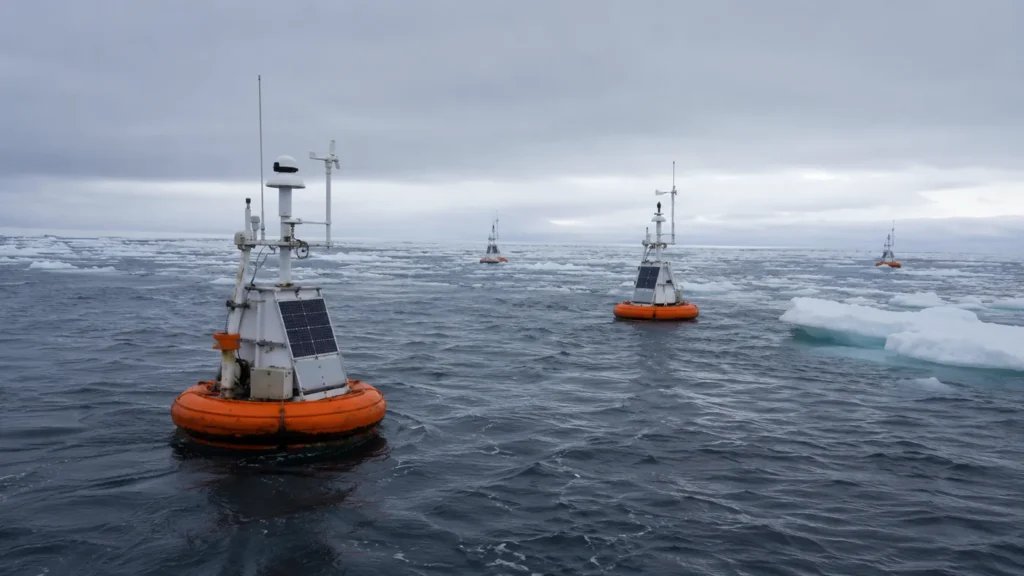
Thermohaline circulation – the global ocean conveyor driven by temperature and salinity gradients across ocean basins – responds to surface temperature changes on timescales of decades to centuries. A stabilizer network altering regional surface temperature distribution, rather than uniformly lowering the whole planet, could perturb circulation patterns in ways that are invisible on short timescales and extremely difficult to reverse on long ones. This is not an argument against the concept. It is the reason deployment should begin at the margins of measurability: small corrections, tightly monitored, where the feedback signal is clearest, before anything approaches the global average by half a degree.
From Single Device to Planetary Web: The Evolutionary Arc
The evolutionary arc of a Quantum Climate Stabilizer does not begin with a planetary network. It begins with a material that performs better than anything passive.
The first milestone is a quantum photonic emitter achieving 80 to 90 percent emission efficiency within the atmospheric window – controlled by engineered quantum energy level structure, not by fixed photonic geometry. Its distinguishing feature over existing radiative cooling materials is real-time adjustability: emission modulated electronically, tunable to atmospheric conditions, verifiable from a remote monitoring station. At this stage the device proves the performance gap between passive and active spectral control, first in the laboratory, then in field trials at high-latitude test installations.
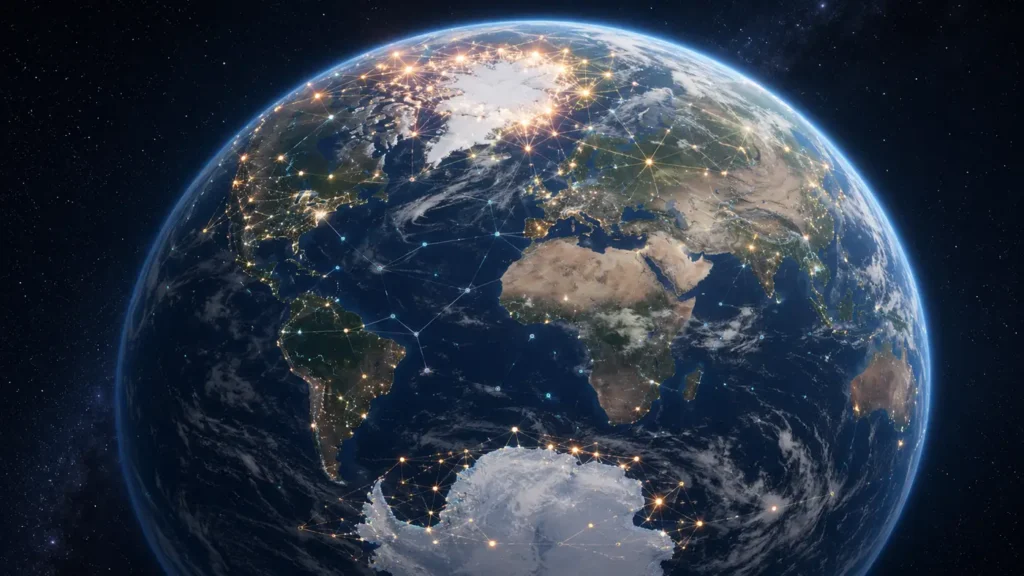
The second generation reaches deployability: weatherproof housing, self-calibrating sensors, a network connection to live atmospheric data feeds. Buildings and infrastructure in polar test regions carry it as a component. Performance data accumulates against a background of real atmospheric variability.
Coordination at scale follows. Individual devices begin operating as nodes in a distributed system rather than as isolated units – linked through classical communication with quantum-optimized emission protocols, or eventually through entanglement-based synchronization if that engineering matures. Regional atmospheric models feed continuously into device behavior. The network starts generating direct evidence of its own effectiveness in the form of measurable local temperature and emission data.
Full planetary deployment is the fourth stage. By this point physics has been validated at intermediate scale, deliberate step-down tests have demonstrated proportional and stable reversal behavior, and the engineering question has been answered. What remains – and what no amount of physics can settle in advance – is the governance question: who decides the global correction setpoint, which regions bear which adjustments, and under what authority. That question is not an engineering problem. It is worth knowing it is coming before the engineering is finished.
The View From NoSuchDevice
I find this concept more rigorous than it looks at first encounter, and less complete than it needs to be before anyone should act on it at meaningful scale.
The physics holds together. The atmospheric window is real, measured, and well-characterized. Quantum emitters demonstrating active spectral control exist in the laboratory. The arithmetic, which at first appears to kill the concept, turns out to be distinguishing it from every approach that came before – 190 terawatts redirected is a fundamentally different problem than 190 terawatts generated, and that distinction matters as much as any single number in the engineering literature on this subject.
What I do not see clearly is the gap between planetary ambition and biological tolerance. The climate is not a thermostat with a setpoint you can dial. It is a web of interdependent cycles running at different timescales, and the confidence required to tune it from the outside should be proportional to how well those cycles are understood. They are not well enough understood yet for anything beyond cautious, carefully monitored regional trials.
The reversibility argument is the strongest card this concept holds, and I think it is underweighted in most geoengineering discussions. The literature tends to treat all large-scale climate interventions as equivalent in risk when they are clearly not. A system you can reduce and observe reversing proportionally is in a different risk category than a system whose cessation triggers a rebound. That distinction should be at the center of any honest comparison between approaches.
If this device arrives in a form worth deploying, it will arrive slowly. Small corrections at the poles. Every step verified against prediction before the next one is applied. A decade of real-world performance data before any expansion. Whether the gap between the seed technology and a functioning planetary network closes on a timescale where it still matters probably depends on whether quantum photonic engineering matures fast enough – and on whether the people making decisions about climate have patience for a device that asks to start small and prove itself, rather than promising to fix everything at once. The second condition worries me more than the first.
You read the whole thing.
That is rarer than it should be. A machine that aims at the gap in Earth’s atmosphere where heat escapes to space – and asks whether someone can widen that exit on purpose – is exactly the kind of device this archive was built to examine seriously. I make every piece alone, with no ads and no investor deciding what gets written. If you want the next machine taken apart like this one, you can help me make it.
A coffee a month is enough to keep it free for everyone.
Prefer crypto or a one time gift? Other ways to give →