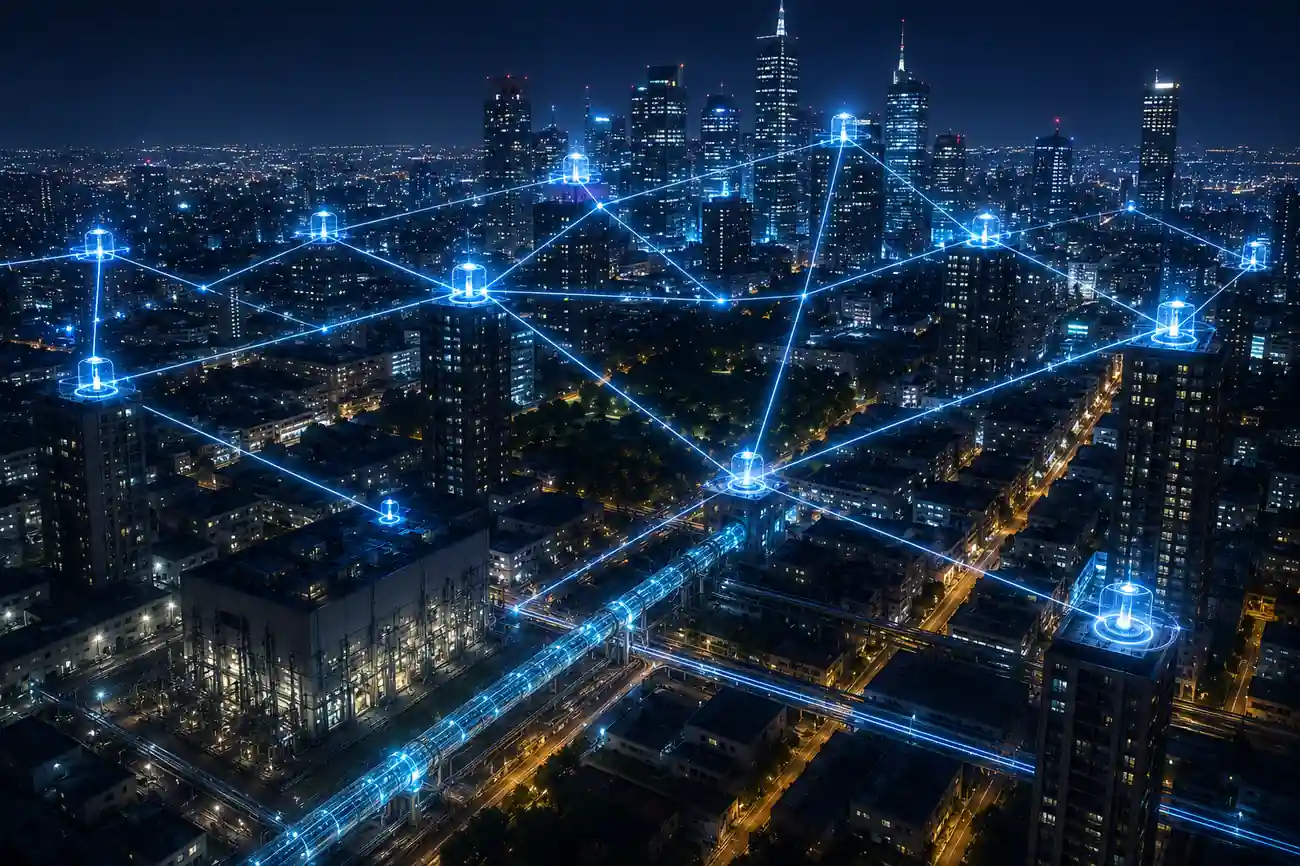
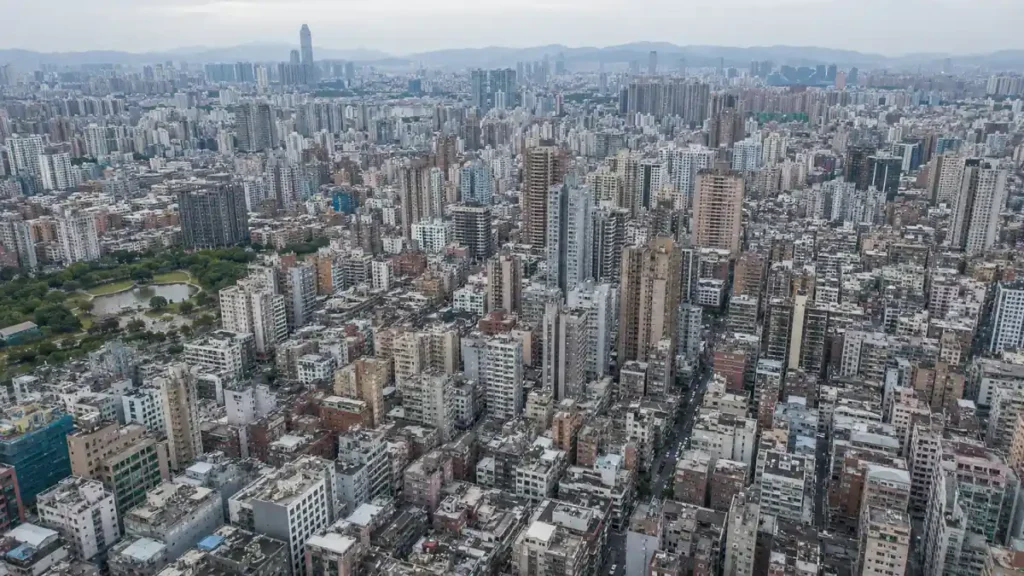
Walk through central Seoul on a summer afternoon and the numbers are visible in the layout. Green space per resident in the central districts: 1.6 square meters. The WHO minimum recommendation: 9. That gap does not close through better urban planning or smarter landscaping. The horizontal surface ran out decades ago. What remains is height – the same height city buildings occupy, floor after floor, without a square meter of soil between them.
The question this archive examines is whether height can become park space. Not planting boxes on facades, not ornamental strips on rooftops, but park space – places with full soil profiles, tree canopy, biodiversity, and room to walk under trees that are not miniature. To do that, the device described here makes one specific change to how gravity works inside its enclosures.
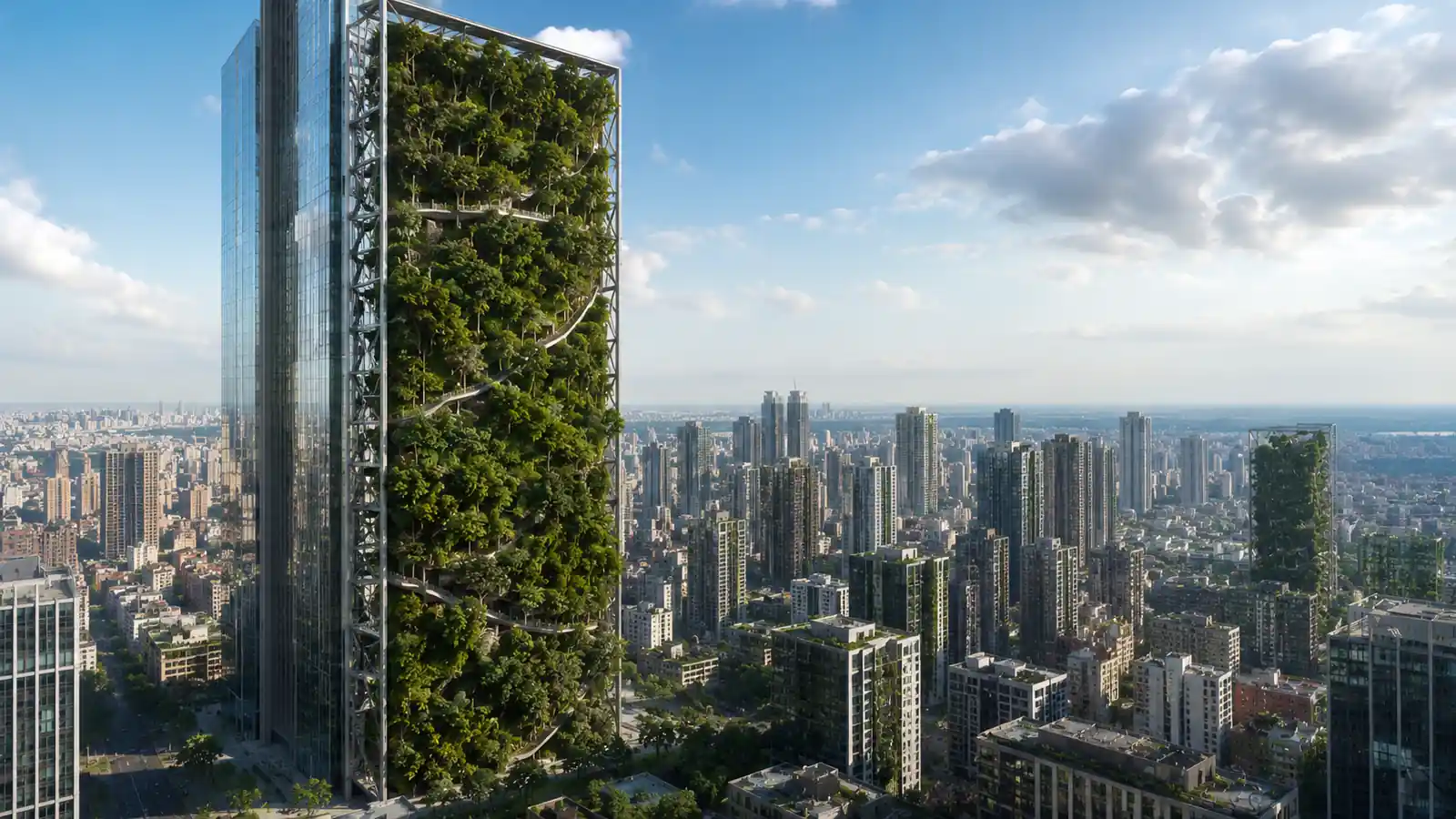
The short version: A gravity-defying vertical park attaches enclosed platform volumes to building facades and uses a localized gravitational field generator to rotate the effective gravity vector 90 degrees inside each platform. Soil, trees, and water all behave as they would on flat ground. From outside, the trees appear to grow sideways from the building face. The device converts a building’s vertical surface into a stack of functional park spaces – and the energy cost of running the field generator is the number everything else depends on.
Key Takeaways
- The gravity vector inside each platform points toward the platform floor, not toward Earth’s core. Trees grow upward, water drains normally, soil stays put, and the park’s internal physics is ordinary. The external view is not.
- Unlike green walls or green roofs, this device supports soil profiles up to 2.5 meters deep, making genuine tree canopy and multi-layer habitat possible on a vertical surface for the first time.
- The energy arithmetic is the article’s central tension. At mid-range field efficiency, one 10-platform building emits approximately 150 tonnes of CO₂ from field maintenance for every 2 tonnes the ecosystem absorbs.
- Deployed across a district of 50 buildings, the device introduces the equivalent of 4 hectares of new urban canopy without acquiring or converting a single square meter of land.
- If the technology matures alongside the energy transition, stacked park layers could become standard urban infrastructure – changing how density is designed at a scale ground-level parks inside dense cores can never reach.
Table of Contents
The Green Space Arithmetic That Urban Planning Has No Good Answer For
Every city that grows upward eventually faces the same pressure. Horizontal land in dense urban centers is finite, expensive, and competed for by uses that return more per square meter than grass and trees do. Green space retreats to the periphery, shrinks under rezoning pressure, and becomes a feature residents commute to rather than inhabit daily.
The solutions available today are honest improvements. Green roofs add ecological function to surfaces that would otherwise be thermally inert. Green walls introduce plant material to facades that would otherwise be bare concrete. Both produce measurable benefits in air quality, temperature moderation, and visual texture. Neither creates park space – because park space requires volume, and surface planting does not provide it.
A green wall holds 15 to 20 centimeters of growing medium. A mature urban tree roots to 1.8 to 2.5 meters of depth. The geometry does not accommodate trees regardless of how efficiently the panels are arranged or how many walls are covered. What exists on city facades today is a surface response to a volumetric problem, and the ceiling on what a surface response can achieve is visible from the street.
How a Rotated Gravity Vector Turns a Building Face Into a Park
The device makes a single change to the physics inside its enclosure: it redirects the effective gravitational field vector. Within each park platform, gravity does not pull toward Earth’s center. It pulls toward the platform’s floor – the inner surface closest to the building – at the same magnitude as standard surface gravity.
What the Field Generator Is Doing
From inside the platform, the physics is unremarkable. The floor is the floor. Soil piled on it stays there. A tree planted in that soil grows upward, toward the open outer end of the platform – which, from the platform’s internal reference frame, is simply up. Water drains toward the floor. A person walking inside does so with ordinary gait. The ecosystem does not experience the redirection as unusual, because within the defined volume, nothing is unusual.
Outside, the picture inverts. The trees grow sideways from the building face. The walking path is a vertical strip visible from the street. The soil is a horizontal band extending outward from the facade. The park looks, from below, like a physical argument with structural engineering – and structural engineering is losing.
The field generator sits within the structural shell surrounding the platform. It maintains a continuous synthetic gravitational geometry within the enclosed volume. The theoretical basis comes from the relationship between spacetime curvature and gravitational force described by general relativity – the same framework that predicts gravitational lensing and explains why time runs differently near a massive body. How to engineer a compact device that achieves this at practical scale remains the long-horizon problem, sitting within the domain of quantum field coupling between vacuum energy states and macroscopic gravitational geometry. The mathematics permits it. The engineering remains a future development.
The Sharp Boundary and Why It Matters
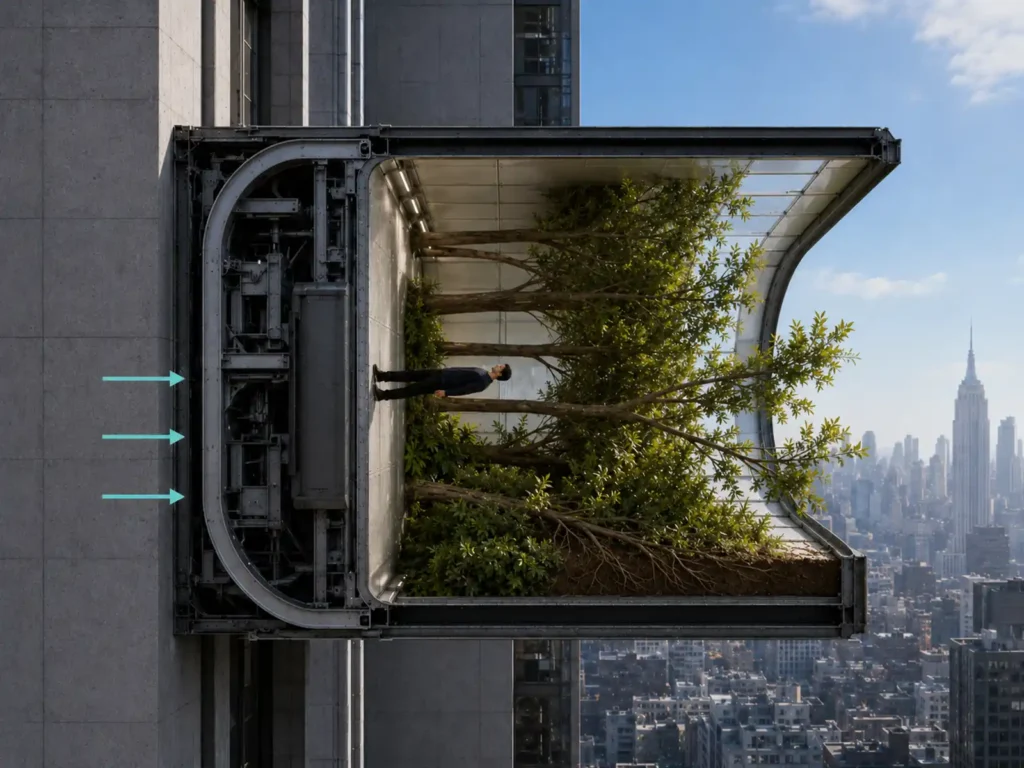
The modified gravitational field terminates at the platform perimeter. Step off the edge and normal Earth gravity applies immediately – the transition is a spatial boundary, not a gradient, coinciding with the structural enclosure wall.
This has one direct consequence for design: the perimeter serves simultaneously as the edge of the gravitational volume and as the safety barrier. Glass, perforated metal, or a dense planted hedge can function here. Each platform operates as an independent gravitational environment, and adjacent platforms on the same facade can be individually shut down for maintenance without affecting their neighbors.
What Happens to Soil, Roots, and Water When Gravity Points Sideways
Inside the modified gravitational field, the platform is not a reduced-gravity environment. Gravity acts at its full familiar magnitude – 9.8 m/s² – in the new orientation. Soil compacts normally. Roots grow downward through the profile, toward the platform floor. Water falls downward through the soil column and collects at the drainage layer near the floor surface.
The Soil Column Gets Its Depth Back
A standard urban tree needs 1.8 to 2.5 meters of rooting depth to establish properly and persist without early structural decline. A green wall panel provides perhaps one-tenth of that. A platform with a floor that behaves as flat ground can accommodate the full profile, limited only by how far from the building face the platform is designed to extend. A 2.5-meter-deep platform extends 2.5 meters outward from the building – appearing from the street as a horizontal distance, not a vertical height. That is enough for mature tree root systems.
The structural logic shifts along with the geometry. The material requirements for the platform floor and shell are demanding – the platform must resist the full gravitational load of its soil and plant mass pressing toward the floor surface – but the engineering problem is geometrically conventional. The field generator handles spatial redirection. The platform structure handles the resulting load, which behaves no differently from the load on any flat floor.
Water Moves Exactly as Expected
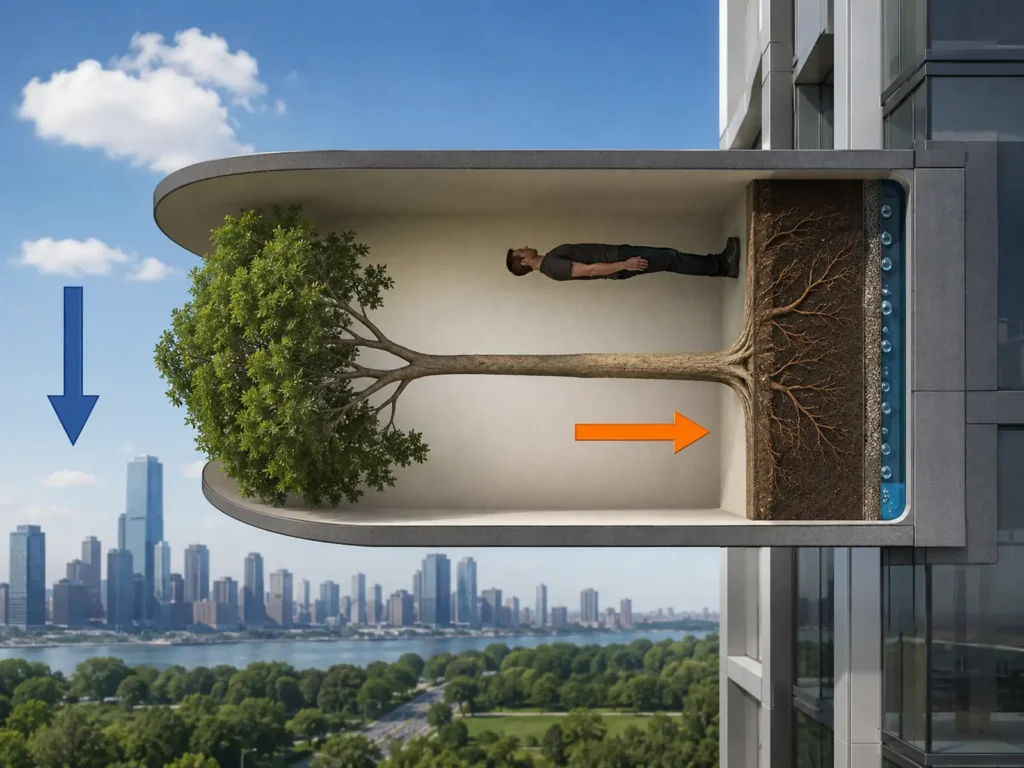
Irrigation within the platform follows standard hydraulics. Water introduced at the outer end of the platform – furthest from the building face, which is the topographically high end in the redirected gravitational frame – moves down through the soil profile toward the drainage layer at the floor. Captured drainage cycles back through a closed-loop system integrated into the shell.
Rainwater arriving at the open outer face of the platform has not yet entered the modified gravitational volume. It falls with normal Earth gravity, reaches the platform perimeter, and gets channeled into the irrigation loop or directed away from the structure. The system requires no pumps working against gravity anywhere inside its interior. This is one of the less obvious consequences of the gravity rotation: the irrigation problem that makes conventional green walls expensive and maintenance-heavy simply does not exist inside the platform.
The Energy Arithmetic Behind a Localized Gravitational Field
A localized gravitational field produced by mass – the kind planets produce – requires no energy to maintain. It is geometry, not a mechanism. The vertical park’s field generator is an active system continuously maintaining a synthetic gravitational geometry within a defined volume, and sustaining that geometry consumes power. How much power is the question the device’s entire environmental case depends on.
Running the Numbers on a Single Platform
Consider a platform 20 meters wide, 4 meters deep, and 3 meters tall. Enclosed field volume: 240 cubic meters.
At a mid-range estimate of 50 watts per cubic meter of maintained field volume:
Power = 50 W/m³ × 240 m³ = 12,000 W = 12 kW per platform
Annual energy per platform: 12 kW × 8,760 hours = 105,120 kWh
A building with 10 such platforms draws roughly 1,050 MWh per year from field maintenance alone. At EU average grid carbon intensity (0.28 kg CO₂ per kWh), the annual carbon emission from operation is approximately 294 tonnes CO₂.
The 10 platforms produce roughly 800 square meters of functional park. Urban trees in temperate climates absorb 1 to 2.5 kg CO₂ per square meter of canopy per year. At 800 m² of mixed canopy: 0.8 to 2 tonnes CO₂ absorbed per year.
The ratio lands at approximately 150 to 1 against the ecosystem. At grid electricity, the device emits 150 times more carbon than the plants can absorb. Whether the device is environmentally defensible depends entirely on one variable: where the electricity comes from.
The Two Conditions That Change the Arithmetic
At the optimistic end of field efficiency – around 5 W/m³, achievable if superconducting elements eliminate most resistive losses and the mechanism approaches its theoretical minimum energy density – the same 10-platform building draws approximately 105 MWh per year. A building facade with 600 square meters of photovoltaic surface generates 130 to 200 MWh per year in a northern European city. At that efficiency level, the solar facade covers the field energy demand entirely. The device is not inherently energy-hungry. It is efficiency-sensitive in a way that makes the generator mechanism the engineering priority, not the park design.
A ratio of 150 tonnes emitted to every 2 tonnes absorbed is exactly the kind of uncomfortable number this archive exists to track down.
I make all of it alone, with no ads. If it is worth a coffee a month to you, that keeps the next one coming.
Keep it alive →What Existing Vertical Greening Gets Wrong and What This Device Changes
Green walls and green roofs are correct responses to the geometry available to them. Given conventional construction, surface planting is the maximum achievable – not a design failure, a physical constraint. A surface accommodates surface-adapted species. A park accommodates species that require volume, depth, and the layered habitat structure that emerges when multiple canopy levels coexist.
| Feature | Green Wall | Intensive Green Roof | Gravity-Defying Vertical Park |
|---|---|---|---|
| Max growing medium depth | 20 cm | 60 cm | 250 cm |
| Mature tree canopy possible | No | Dwarf species only | Yes, standard urban species |
| Human walkable access | No | Sometimes | Yes, walking path designed in |
| Biodiversity ceiling | Low | Medium | High – multi-layer habitat |
| Water movement | Requires pumping against gravity | Normal drainage | Normal drainage within platform |
| Structural load on building | Low | 300 to 500 kg/m² | Contained within field volume |
The argument here is not that green walls are pointless – a facade with surface planting is better than the same facade without it. The argument is about the ceiling. Green walls at their best remain surface treatments. The vertical park, at its smallest deployment, is a place a person enters under tree canopy. The difference between those two things is not incremental.
Where Gravity-Defying Vertical Parks Make Sense and Where They Do Not
Not every building justifies the energy infrastructure for field maintenance. The strongest case sits at the intersection of three conditions: green space below 5 square meters per resident, land values above approximately €5,000 per square meter, and access to renewable electricity. Dense central districts of Seoul, Singapore, Hong Kong, inner Tokyo, and parts of London and Paris currently meet all three. Most cities do not.
The Modular Deployment Path
Platforms are added to existing structures one at a time. Each platform’s field generator is self-contained and independently operated. A building can open with a single demonstration platform at the second or third floor, monitor energy consumption and ecological development over two full growing seasons, and add further units only where the performance justifies it. The principles of modular sustainable design apply directly: scale with demonstrated results, not with projected ones. Existing buildings can be retrofitted provided the facade accommodates structural attachment and electrical supply. Purpose-built structures integrate generator housings more cleanly, but the device is not restricted to new construction.
Economics in Brief
Urban parkland in central London trades at £10,000 to £50,000 per square meter. A 10-platform installation creating 800 square meters of park represents a land-equivalent value of £8 to £40 million, without purchasing any land. At €0.15 per kWh for field energy at the mid-range consumption estimate, annual operating cost is roughly €157,500. Against an avoided land acquisition of £8 million, that cost is repaid in 5 to 25 years depending on location. The numbers require renewable electricity to be defensible on carbon grounds, and high land values to be defensible on economic grounds. In dense city cores, both conditions tend to exist.
From One Platform to a City Layer of Living Ecosystems
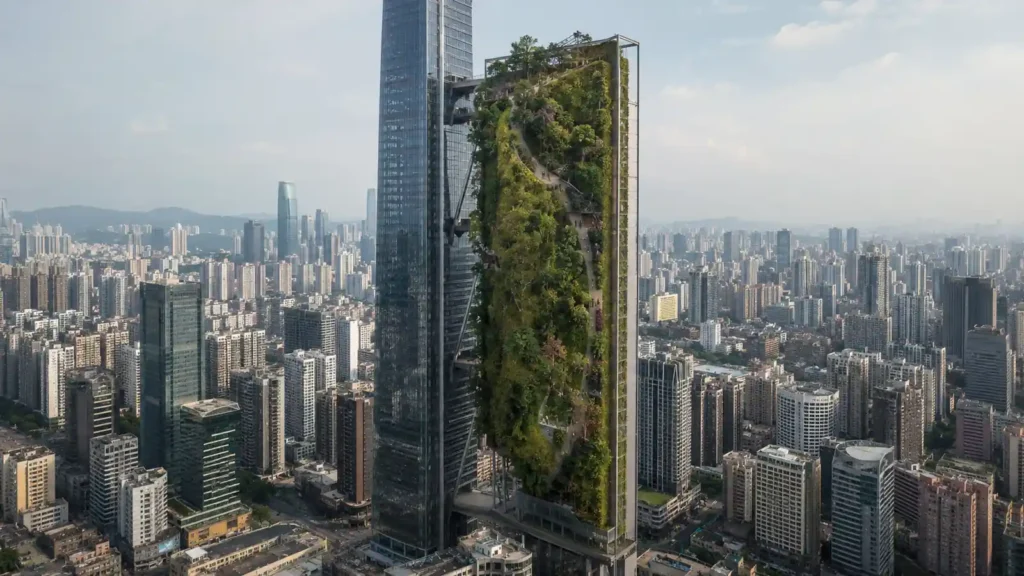
A single platform is a demonstration. The properties that matter for cities emerge at district scale – when enough buildings carry enough platforms that the combined canopy forms a coherent layer operating at building height across a neighborhood.
The Heat Island and CO₂ Picture at Scale
Urban heat islands form because impervious surfaces absorb and retain solar radiation. Vegetation interrupts that absorption through evapotranspiration, releasing latent heat as water vapor and cooling the surrounding air measurably. A mature urban tree transpires 100 to 200 liters of water per day. Districts with high canopy cover run 2 to 4°C cooler at peak summer than equivalent unplanted areas in documented studies across European and East Asian cities.
A district of 50 buildings with 10 platforms each, at 80 m² per platform, adds 40,000 m² of new canopy – 4 hectares – without converting any ground-level surface. At conservative evapotranspiration rates, that means 4 to 8 million liters of cooling water vapor per day during peak summer heat. CO₂ absorption at that scale: 40,000 m² × 1.5 kg/m² per year = 60 tonnes annually. Modest against the energy cost at grid carbon intensity. Real and non-trivial on renewable supply.
Biodiversity Arrives When the Habitat Network Forms
A single platform does not sustain a pollinator population. A network of platforms within short inter-building distances does. Invertebrate colonization of green roofs has been documented within 2 to 3 growing seasons in studies across multiple European cities. Stacked platforms at varying heights create vertical habitat gradients that do not exist in ground-level parks and may support species using different altitude bands across their life cycles.
Urban swifts, house martins, and several bat species already forage at building height. A vertical park ecosystem at 30 to 50 meters provides foraging habitat and nesting opportunity at exactly the elevations these species use. Monitoring species presence, canopy health, and thermal differentials across a deployed network sits within the capabilities of environmental remote sensing integrated with urban infrastructure – without requiring physical access to each platform.
From Demonstration to Urban Infrastructure: The Evolutionary Arc
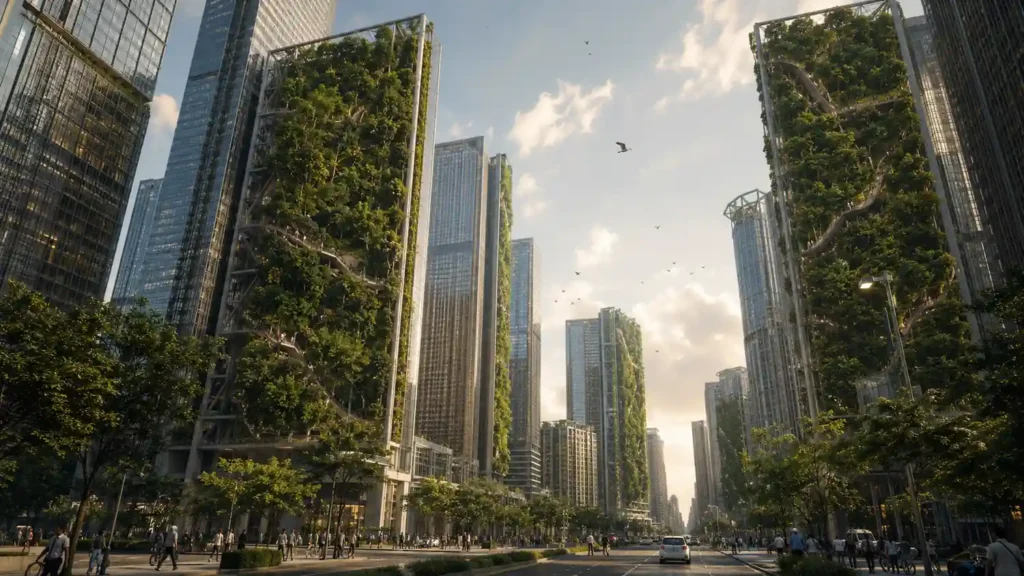
The first-generation form is a single platform on a demonstration building – proof that localized gravity modification sustains a terrestrial ecosystem at height across multiple growing seasons. The mature-generation form is building-scale deployment paired with dedicated renewable energy, automated field monitoring, and modular generators sized to each platform volume. At that stage, vertical parks appear on new construction the way elevators and fire suppression systems do – as standard specification, not as exceptional features.
The long-horizon form is more consequential. Cities designed from the start with vertical canopy layers as structural components – where park access is distributed through dense cores at multiple altitude bands simultaneously, where biodiversity corridors exist at height, and where the ecological layer of a city is no longer a ground-level feature competing with transport and density for the same square meters. At that scale, the gravity-defying vertical park stops being a device and becomes part of what urban density means.
The View From NoSuchDevice
What I find difficult to dismiss about this device is the reframe it introduces. Cities have not run out of space for nature as an abstract resource – they have run out of horizontal space. The vertical park does not ask for more ground. It asks for a column of air the building already occupies and proposes to make that column biologically useful.
The energy arithmetic is the honest difficulty, and I am not going to soften it. A 10-platform building at current grid carbon intensity emits roughly 294 tonnes of CO₂ annually while the parks absorb about 2 tonnes. By the narrow standard of carbon accounting, that is a liability. I find the narrow standard insufficient for this device in the same way I find it insufficient for most urban infrastructure – water pumps, heated public spaces, underground transit. The question is whether the value delivered justifies the energy consumed, and urban heat reduction, measurable biodiversity gain, acoustic buffering, and daily access to tree canopy for people who otherwise have none are not marginal benefits. They change how livable a dense city is in ways that do not appear in carbon balance sheets but do appear in health outcomes and summer mortality data.
The condition I would set is non-negotiable: renewable energy pairing. A vertical park on fossil-grid electricity is a difficult argument. The same park on solar or wind changes the calculation entirely. A building that deploys 10 park platforms while installing 600 square meters of photovoltaic facade is making a coherent decision about its available surfaces – arguably the most coherent one a dense urban building can make with the height it has.
I think this device belongs in the category of infrastructure that only makes full environmental sense once the energy transition is substantially further along. Building vertical parks before the grid is clean is doing something visually striking and ecologically confused. Building them after – in a dense city with a documented green space deficit, on renewable supply – is using height the way cities have always used the resource that happened to be left: intelligently, because it was all that remained.
The park is already there in the mathematics. What requires building is the machine that makes the wall a floor.
You read the whole thing.
That is rarer than it should be. A park where gravity points sideways and water still flows downhill is exactly the machine I built this archive to examine. I make every piece alone, with no ads and no investor deciding what gets written. If you want the next machine taken apart like this one, you can help me make it.
A coffee a month is enough to keep it free for everyone.
Prefer crypto or a one time gift? Other ways to give →