



What Is Förster Type Interactions?
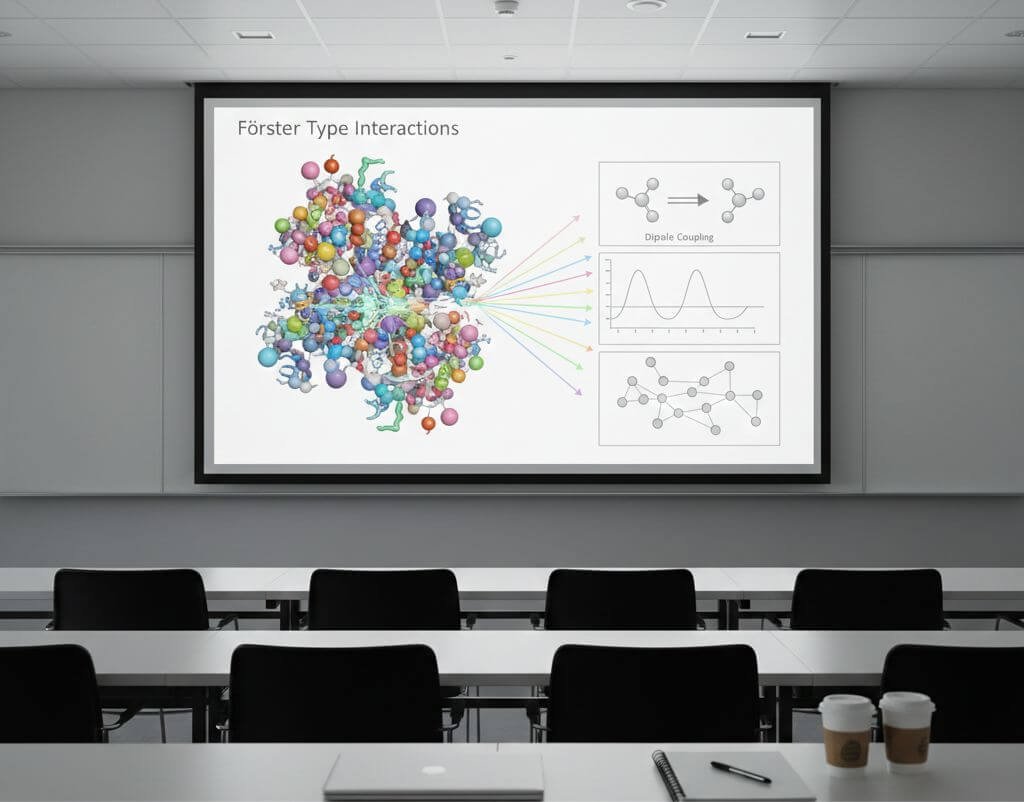
Förster type interactions describe long-range energy transfer between molecular chromophores mediated by dipole-dipole coupling rather than direct electron exchange. They allow excitation energy to move across nanometer-scale distances with high directionality, making them central to many photophysical and biochemical systems.
Their efficiency depends on spectral overlap, spatial orientation, and molecular separation, which shape how energy migrates inside dense pigment networks. In advanced cellular energy architectures, Förster type interactions guide excitation flow toward reaction centers where energy is converted into stable chemical form.
Example:
Förster type interactions enable rapid excitation transport through tightly packed light-absorbing molecules.
Related Concepts:
- Exciton migration
- Dipole-dipole coupling
- Energy transfer networks
NoSuchDevice is a free archive of machines that do not exist yet but already have a shadow in physics. I research and write every entry alone, with no ads. Take a look around the archive, or help keep it free.