





What Is Airfoil?
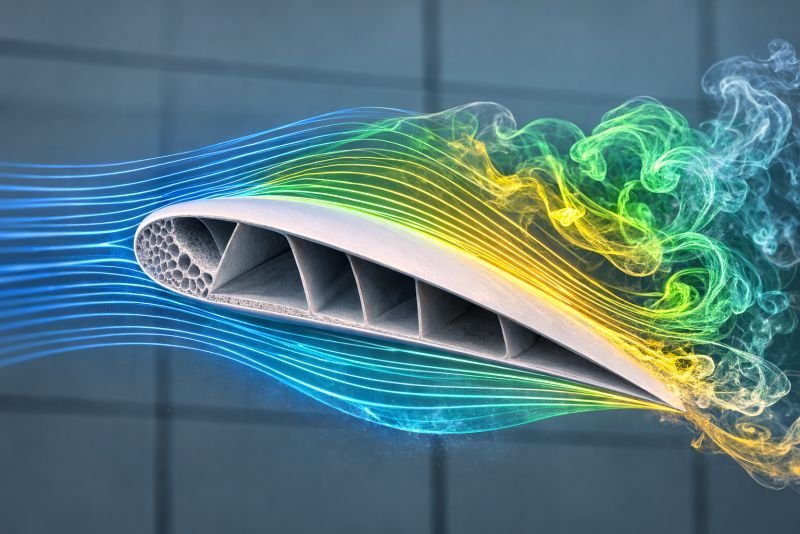
An airfoil is a shaped surface that produces lift when fluid flows around it, and wind turbine blades use this geometry to convert moving air into rotational force. Its rounded leading edge and tapered trailing edge guide airflow so pressure drops on one side while staying higher on the other. That pressure difference creates a force component perpendicular to the local flow, which is the primary mechanism that drives modern lift-based rotors.
In operating turbines, each blade section behaves like a local airfoil with its own relative wind and loading conditions. Engineers tune camber, thickness, and surface smoothness so lift remains high while drag stays low across expected wind speeds. Performance also depends on maintaining proper Angle Of Attack, because excessive incidence causes flow separation and reduces useful force.
Airfoil design matters because it sets the upper range of aerodynamic efficiency before mechanical and electrical losses are considered. In wind energy conversion aerodynamics, improved airfoil behavior increases annual energy yield, lowers fatigue loads, and supports longer blades that sweep larger rotor areas without proportional structural penalties. It also widens the stable operating window across seasonal shifts in density, turbulence, and inflow shear.
Example:
A utility-scale turbine blade uses thicker root airfoils for load transfer and thinner tip airfoils for higher lift-to-drag efficiency at elevated local speed.
Related Concepts:
- Lift Coefficient
- Boundary Layer Separation
- Angle Of Attack
NoSuchDevice is a free archive of machines that do not exist yet but already have a shadow in physics. I research and write every entry alone, with no ads. Take a look around the archive, or help keep it free.