



What Is Bow shock?
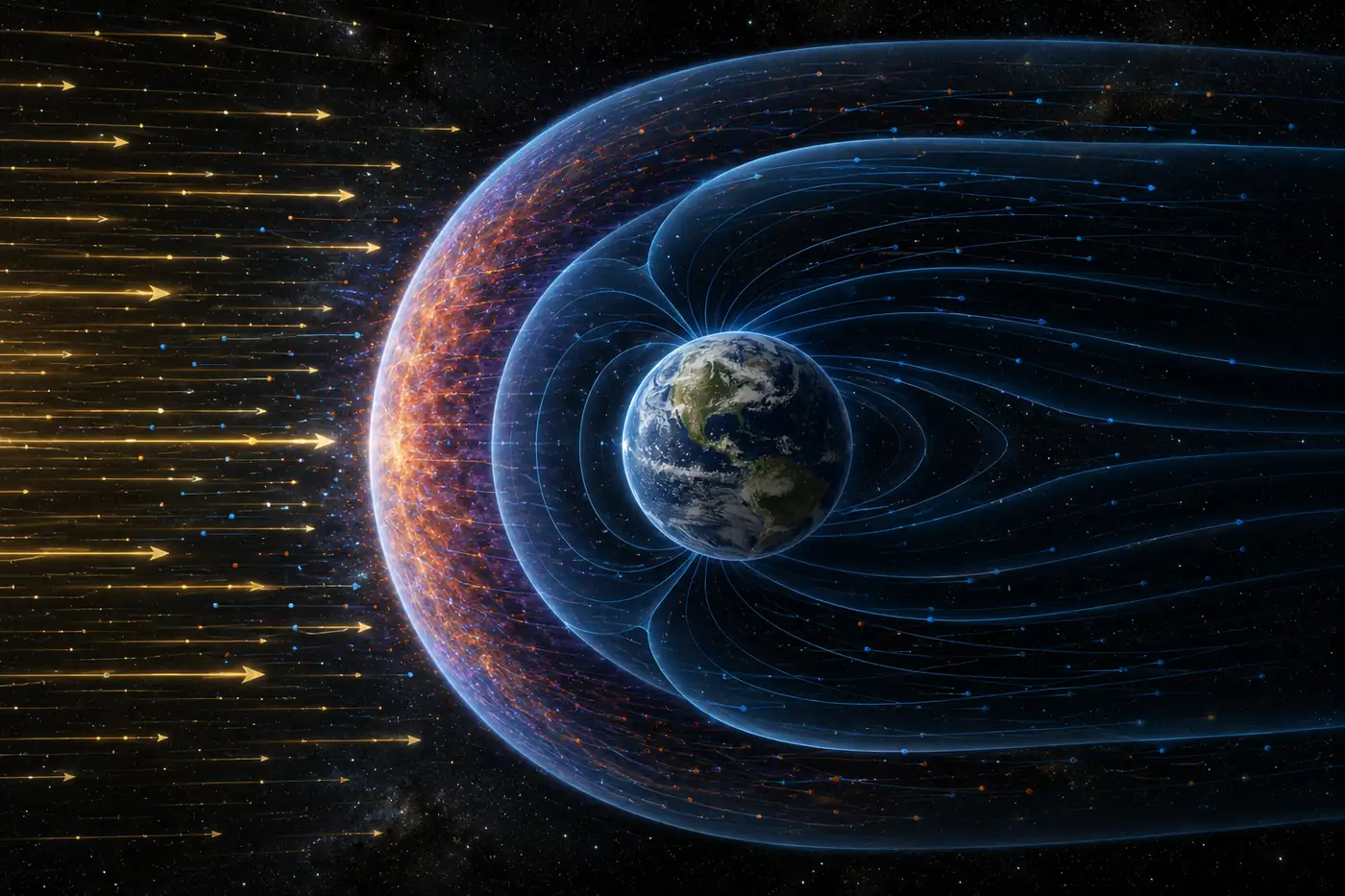
Bow shock is a curved shock front that forms when a supersonic or super-Alfvenic flow meets an obstacle and must slow, heat, and divert around it. In space plasma physics, it appears where the solar wind first reacts to a planetary magnetic field. A useful condition is M_A > 1, where the Alfven Mach number exceeds one.
In real plasmas, a bow shock is not a solid surface but a collisionless transition where electromagnetic fields scatter particles. Density, temperature, turbulence, and magnetic-field direction can change sharply across it. Used in devices include spacecraft plasma instruments, shock monitors, magnetic probes, and simulation testbeds for high-speed plasma interaction.
The concept matters because bow shocks convert directed flow energy into heat, waves, and particle acceleration. In solar wind interaction physics, the same process marks where a flowing plasma begins to surrender momentum to a magnetic obstacle. Bow shocks also occur around comets, planetary magnetospheres, and fast-moving astrophysical objects.
Researchers locate bow shocks by measuring jumps in magnetic field strength, ion temperature, plasma velocity, and wave activity. Their shape reveals the balance between flow pressure, magnetic pressure, and obstacle size.
Example:
A spacecraft crossing Earth’s dayside bow shock can record a sudden drop in solar wind speed and a rise in plasma turbulence.
Related Terms:
NoSuchDevice is a free archive of machines that do not exist yet but already have a shadow in physics. I research and write every entry alone, with no ads. Take a look around the archive, or help keep it free.