



What Is Magnetosphere?
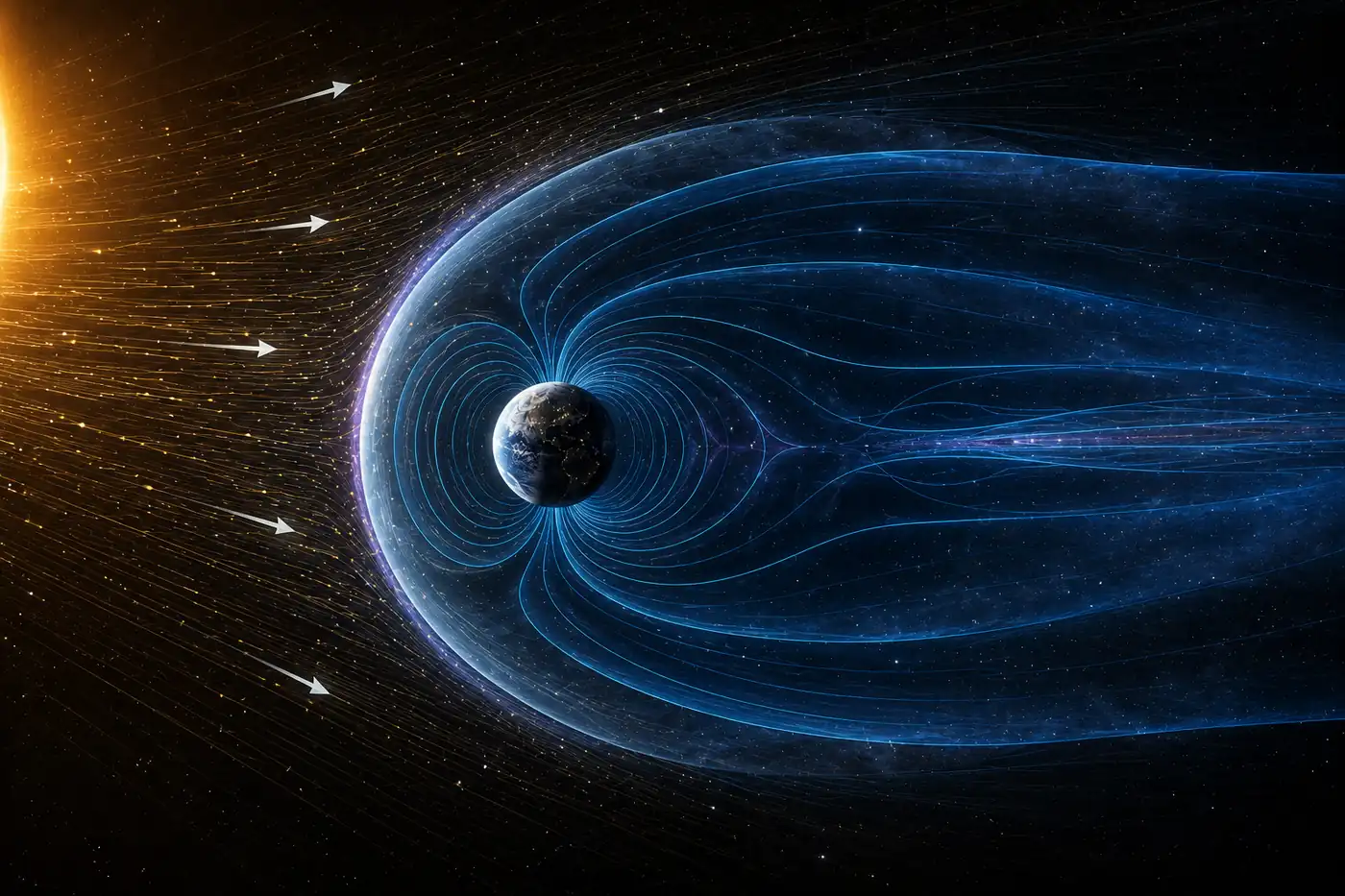
Magnetosphere is the region around a planet, moon, or star where its magnetic field controls the motion of charged particles more strongly than the surrounding space environment. The principle is electromagnetic deflection: moving ions and electrons feel the Lorentz force, F = q(v x B), so their paths curve around magnetic field lines instead of traveling in straight lines.
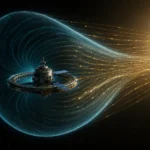
In real space plasmas, a magnetosphere is compressed on the side facing the solar wind and stretched into a long tail downstream. Its size changes with magnetic field strength, particle density, and flow speed. Used in devices include plasma analyzers, magnetic-field probes, radiation monitors, and proposed magnetic-sail power systems.
The concept matters because magnetospheres shape radiation exposure, atmospheric loss, satellite charging, and particle transport. In space plasma energy systems, the same field-particle interaction can protect hardware or redirect a useful particle stream. It also explains why Earth receives sunlight directly while most solar wind particles are diverted around the planet.
Scientists measure magnetospheres with magnetometers, plasma detectors, energetic-particle sensors, and radio observations. Boundary locations such as the magnetopause and plasma sheet reveal how strongly a magnetic field couples to the surrounding flow.
Example:
Earth’s magnetosphere guides many incoming solar wind particles around the planet before they can reach the upper atmosphere.
Related Terms:
NoSuchDevice is a free archive of machines that do not exist yet but already have a shadow in physics. I research and write every entry alone, with no ads. Take a look around the archive, or help keep it free.