




What Is Cryogenic Distillation?
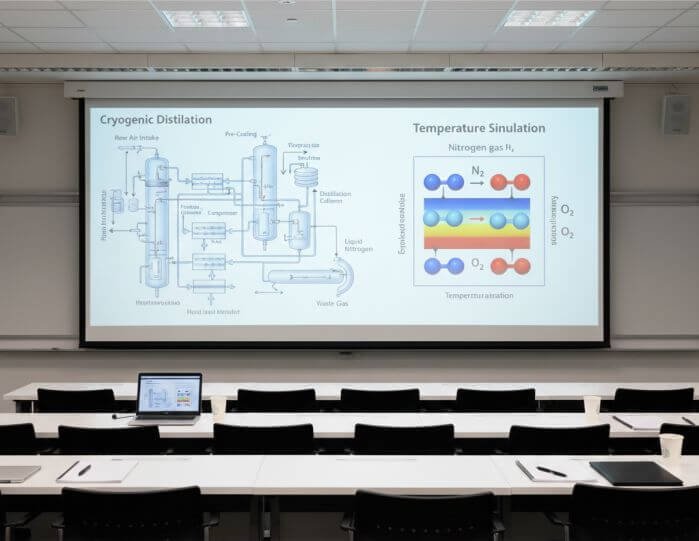
Cryogenic distillation is a separation method that cools gas mixtures to extremely low temperatures until components condense or liquefy at different points. The process exploits distinct boiling ranges to draw high purity streams from otherwise dilute or complex feedstocks.
It plays a major role in atmospheric conditioning pipelines, since air must be separated into stable, predictable fractions before entering high energy systems. In many designs, cryogenic units form the backbone of atmospheric fuel-processing models, where cold-stage separation sets the quality of reactants delivered to downstream reactors.
The method remains attractive because it scales well, supports high throughput, and generates clean streams suitable for processes that cannot tolerate moisture, particulates, or trace chemical noise.
Example:
Engineers may route intake air through a cryogenic column to isolate nitrogen at a purity level required for high temperature plasma systems.
Related Concepts:
- Fractional liquefaction
- Pressure swing adsorption
- Low temperature phase behaviour
NoSuchDevice is a free archive of machines that do not exist yet but already have a shadow in physics. I research and write every entry alone, with no ads. Take a look around the archive, or help keep it free.