





What Is electrochemical oxidation?
Electrochemical oxidation is a redox half-reaction in which a species loses electrons at an electrode surface and transfers that charge into an external circuit. Unlike direct combustion, the reaction is spatially separated from reduction at another electrode, so electrical energy can be extracted with controlled potential and current. Reaction rate depends on catalyst activity, reactant concentration, temperature, and local overpotential at the interface.
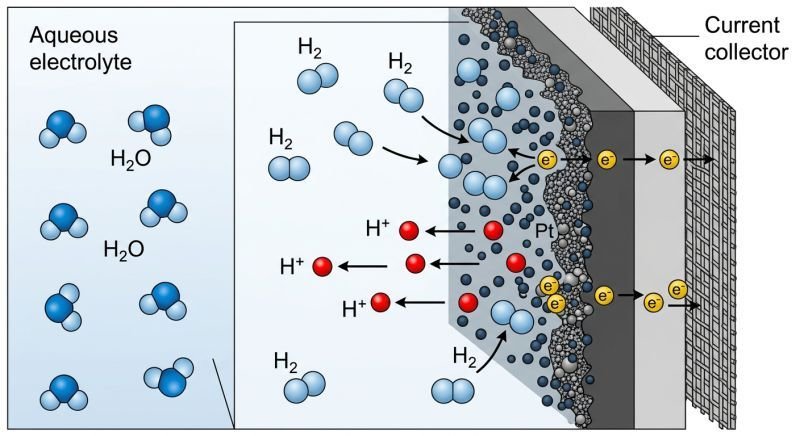
In hydrogen fuel cells, electrochemical oxidation occurs at the anode where hydrogen molecules split into protons and electrons. Protons pass through the electrolyte, while electrons move through the load, producing usable power before returning to the cathode. Electrode microstructure and catalyst dispersion influence how effectively gas reaches active sites and how quickly charge-transfer steps proceed. Within fuel cell electrode kinetics, this anodic process is coupled to transport losses and ohmic resistance across the membrane-electrode assembly.
The concept matters because anodic oxidation performance helps determine stack voltage, efficiency, and controllability across changing demand. Understanding oxidation mechanisms supports catalyst optimization, contamination tolerance strategies, and degradation mitigation in both mobility and stationary electrochemical power systems.
Example:
During startup of a proton-exchange stack, hydrogen electrochemical oxidation at the anode begins current generation as soon as reactants reach catalyst sites.
Related Concepts:
- Anodic Overpotential
- Charge Transfer Kinetics
- Electrode Catalysis
NoSuchDevice is a free archive of machines that do not exist yet but already have a shadow in physics. I research and write every entry alone, with no ads. Take a look around the archive, or help keep it free.