




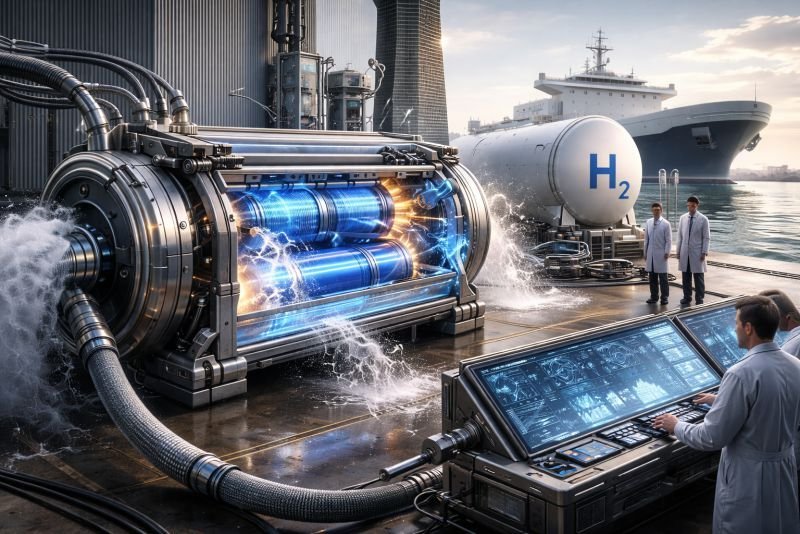
At the port of Yokohama, a vessel the length of two football fields sits at a demonstration berth. This is the Suiso Frontier, the world’s first purpose-built liquid hydrogen carrier, developed as part of Japan’s Hydrogen Energy Supply Chain project. A technician connects a hose from a cryogenic tank, liquid hydrogen flows into the ship’s onboard system, and within minutes the only thing coming out of the exhaust is warm water vapor.
There is no carbon dioxide. No nitrogen oxides. No soot. The hydrogen fuel cell system converts hydrogen directly into electricity through an electrochemical reaction, releasing water and heat as the only byproducts. The heat is managed within the system. The water vapor disperses. Yokohama is a demonstration project, not a commercial hub, but what is being demonstrated here is real: a working alternative to the marine diesel engine that has powered global shipping for over a century.
A fuel cell extracts electricity directly from a reaction between hydrogen and oxygen. The reaction produces water and releases energy, and the fuel cell captures that energy as electrical current before it has a chance to become heat. Efficiency reaches 60 to 70 percent, roughly double what a combustion engine achieves on the same fuel. That single fact explains why the technology keeps attracting serious engineering investment.
Table of Contents
How a Hydrogen Fuel Cell Converts Hydrogen to Electricity
Think about what happens every time a petrol engine runs. Fuel burns, heat builds up, a piston moves, a shaft turns, and somewhere at the end of that chain, electricity appears. Every step in that sequence leaks energy. By the time you get to the output, you have kept maybe a third of what you started with.
A fuel cell takes a completely different path. It extracts the energy locked inside a hydrogen molecule directly, as electrical current, without any of those intermediate steps. Feed it hydrogen, and it generates electricity. The only thing coming out the other end is water.
The reaction begins at the anode, the negative electrode where hydrogen enters the cell. A platinum catalyst breaks each hydrogen molecule into two protons and two electrons. The electrons cannot pass through the membrane ahead of them, so they travel through the external circuit instead. That movement is the electrical current. It powers whatever is connected to the cell, then arrives at the other side ready to complete the reaction.
The hydrogen fuel cell does not store energy. Stop the hydrogen and it stops. This is what separates it from a battery, which holds a fixed charge and exhausts it.
Proton Transport Through the Proton Exchange Membrane
Here is where it gets interesting. The membrane between the two electrodes has one job: let protons through, block electrons completely. Those two particles, forced to take different paths, are what create the circuit.
The most widely used membrane material is Nafion, a fluorinated polymer whose molecular structure forms water-filled channels just wide enough for protons to squeeze through. Protons move in a relay, bonding briefly to water molecules and releasing again on the other side. Fast, continuous, and entirely dependent on the membrane staying wet.
Dry membrane means poor conductivity. Engineers humidify the hydrogen feed gas specifically to keep the proton exchange membrane in working condition. Too dry and performance falls. Too wet and the electrodes flood. It is a narrow window, and holding the cell inside it is one of the central challenges of the entire design.
The Oxygen Reduction Reaction at the Fuel Cell Cathode
On the other side of the membrane, three things arrive at the cathode at the same time: the protons that crossed through, the electrons that traveled the external circuit, and oxygen drawn from the surrounding air. The oxygen reduction reaction brings them together:
O2 + 4H+ + 4e- -> 2H2O
Four protons and four electrons meet one oxygen molecule and produce two molecules of water. On paper it looks tidy. In practice, this reaction is frustratingly slow, and the entire engineering effort around the cathode is essentially one long attempt to speed it up enough to be useful.
Water is the only product, which sounds ideal until you realize that water accumulating inside a running fuel cell is a serious problem. It floods the electrode, cuts off oxygen access to the catalyst, and starves the reaction. The gas diffusion layers flanking the membrane are there specifically to drain water continuously while keeping gases in contact with the catalyst. Get that balance wrong and the cell chokes itself.
Gibbs Free Energy and the Efficiency Ceiling of Hydrogen Fuel Cells
How much electrical energy can a fuel cell actually extract from hydrogen? Not as much as the chemistry theoretically allows, but considerably more than any combustion engine manages. The answer starts with the Gibbs free energy equation:
Delta G = Delta H – T * Delta S
Delta G is the maximum useful work the reaction can deliver. Delta H is the total energy released, the enthalpy change. T is the absolute temperature in Kelvin. Delta S measures how molecular disorder shifts as the reaction proceeds.
For hydrogen oxidation at 25 degrees Celsius (298 K), Delta H equals -286 kilojoules per mole of water produced. Subtract T times Delta S, roughly 49 kilojoules, and you get a Delta G of -237 kilojoules per mole. That is the ceiling: 237 kilojoules of electrical energy theoretically available from one mole of hydrogen.
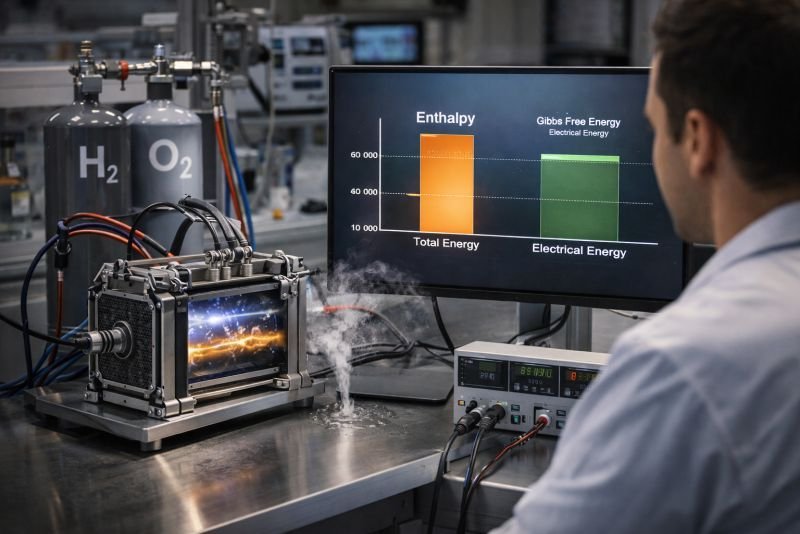
Real cells capture 60 to 70 percent of that. A petrol engine working on equivalent energy captures 25 to 35 percent. The fuel cell does not win through exotic materials or clever engineering tricks. It wins because it never converts chemical energy into heat in the first place, and heat is where most of the losses in a combustion engine live.
Why Hydrogen Fuel Cell Voltage Drops Under Load
A single fuel cell has a theoretical open-circuit voltage of 1.23 volts. The moment current begins to flow, that number drops. Push the cell harder, demand more current, and it drops further. Three distinct mechanisms are responsible, each dominating at a different point in the operating range.
| Loss Type | Cause | Where It Appears | Effect |
|---|---|---|---|
| Activation loss | Slow reaction kinetics at electrodes | Low current | Sharp initial voltage drop |
| Ohmic loss | Resistance in membrane and contacts | Mid current | Gradual linear decline |
| Concentration loss | Reactant starvation at catalyst surface | High current | Steep voltage collapse |
| Mixed potential | Hydrogen crossover through membrane | All current levels | Lowers the starting baseline |
Under normal operation each cell delivers around 0.6 to 0.8 volts. That is nowhere near enough to drive a motor. So engineers stack hundreds of cells in series. A hydrogen fuel cell vehicle typically uses 300 to 400 cells to reach the 200 to 300 volts the drivetrain requires. Managing that many cells consistently, across thousands of hours of use, is where much of the real engineering difficulty lives.
Everything here is free. Readers are the reason it stays that way.
I make all of it alone, with no ads. If it is worth a coffee a month to you, that keeps the next one coming.
Keep it alive →How Hydrogen Fuel Cells Compare to Batteries
People often ask whether hydrogen fuel cells will replace batteries, or whether batteries will make fuel cells irrelevant. The answer is neither. They solve different problems, and the numbers make that clear.
| Hydrogen Fuel Cell | Lithium-Ion Battery | |
|---|---|---|
| Energy storage | Generates continuously from fuel | Stores fixed charge internally |
| Energy density | ~33 kWh per kg of hydrogen | ~0.25 kWh per kg of pack |
| Refuel / recharge time | 3 to 5 minutes | 20 to 40 min (fast charge to 80%) |
| Degradation | Tied to operating hours | Tied to charge cycles (~80% capacity after 1,000 cycles) |
| Scales by | Tank size | Battery pack size and weight |
The smarter question is not which technology wins, but which one fits the job. Hydrogen fuel cells have the advantage where range, weight, and refueling speed matter:
- Heavy transport and long-haul trucking
- Maritime shipping and aviation
- Grid storage across weeks or months
Batteries have the advantage where charging infrastructure exists and range demands are modest: city cars, consumer electronics, short-range urban transport. The two technologies are more complementary than competitive, and most serious energy transition scenarios deploy both.
Temperature, Pressure, and the Fuel Cell Operating Window
PEM fuel cells run between 60 and 90 degrees Celsius. That range allows fast startup, which matters enormously for vehicles, but it limits how fast the reactions can run compared to higher-temperature designs.
Pressure matters more than you might expect. Raise the pressure at the electrodes and you increase the concentration of reactant molecules arriving at the catalyst surface. More molecules per unit time means faster reactions and more power per unit area. Some automotive stacks run above two atmospheres for this reason, accepting the weight and energy cost of a compressor in exchange for better output.
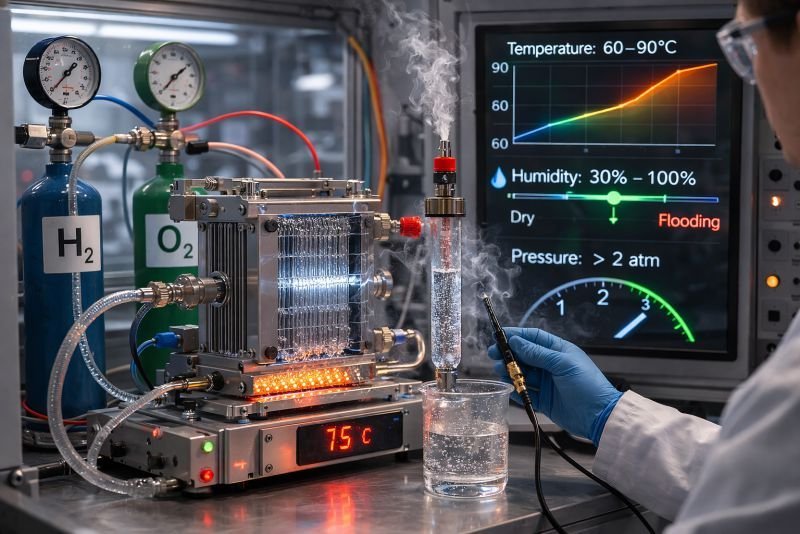
Humidity sits alongside temperature as a variable that cannot be ignored. Below about 30 percent relative humidity inside the membrane, proton exchange membrane conductivity drops and performance degrades noticeably. Above saturation, flooding sets in and blocks the electrodes. Engineers hold the cell inside this narrow band using temperature gradients, hydrophobic surface coatings, and carefully controlled gas flow rates. It sounds complicated because it is.
Platinum, Cost, and the Catalyst Problem in Fuel Cells
Here is the uncomfortable truth about fuel cells: the thing that makes them work well is also the thing that makes them expensive. Platinum catalyzes the reactions at both electrodes. Current automotive stacks require between 0.1 and 0.2 grams of platinum per kilowatt of output. A 100-kilowatt vehicle stack contains roughly 10 to 20 grams of the metal. Global platinum production runs around 180 metric tonnes per year. The arithmetic gets awkward quickly at the scale of millions of vehicles.
The cathode carries more platinum than the anode. The oxygen reduction reaction is roughly 100 times slower than hydrogen oxidation and needs proportionally more catalyst surface to run at a useful rate. Most research concentrates there.
Platinum-cobalt alloys deliver higher activity per gram than pure platinum. Platinum-nickel nanoframe catalysts, developed over the past decade, offer surface areas several times larger than conventional particles at the same mass. The direction is clear even if the destination is not yet reached: less platinum, same performance, lower cost per kilowatt.
How Solid Oxide Fuel Cells Work at High Temperature
Polymer membranes are not the only option, and for many applications they are not even the best one. Solid oxide fuel cells operate between 700 and 1000 degrees Celsius using a ceramic electrolyte made from yttria-stabilized zirconia, a material that conducts oxygen ions rather than protons.
At these temperatures, oxygen at the cathode picks up electrons and becomes an O2- ion, which migrates through the ceramic lattice to the anode. There it meets hydrogen, reacts, and releases electrons back into the circuit. The electrochemical oxidation follows the same underlying logic as in a PEM cell, just with a different charge carrier and a very different temperature regime.
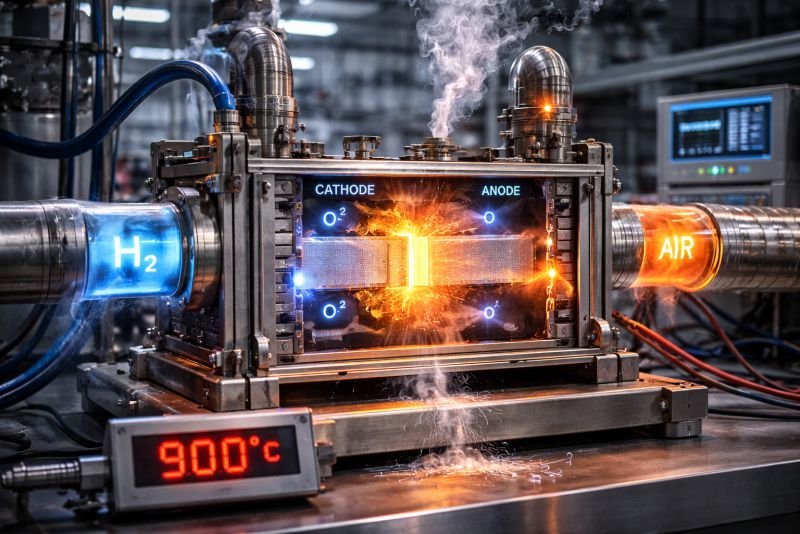
No platinum required. Nickel-based cermets handle the anode, and perovskite oxides work at the cathode. Natural gas can reform directly inside the cell, releasing hydrogen without a separate processing step. The tradeoff is startup time: reaching operating temperature from cold takes 30 to 60 minutes. That rules out vehicles entirely. For a data center, an industrial plant, or a residential building running continuously, it is not a problem at all. Japan and South Korea have deployed these units in the tens of thousands for exactly these applications.
Hydrogen Fuel Cell Durability and Long-Term Degradation
A fuel cell stack has no pistons, no oil, nothing that rubs against anything else. You might expect it to last forever. It does not.
Platinum particles agglomerate over time. They grow larger, lose surface area, and the reaction slows. The carbon supports holding the platinum can oxidize during high-voltage transients, causing particles to detach entirely. The membrane faces a separate attack: hydrogen peroxide, a byproduct of the oxygen reduction reaction, generates radicals that eat into Nafion chemically. Over thousands of hours the membrane thins, and eventually pinholes form.
Engineers add cerium or manganese compounds as radical scavengers to slow membrane degradation without reducing proton conductivity. Current automotive stacks are rated for 5,000 to 8,000 hours of operation, roughly 150,000 kilometers. Stationary systems, running more steadily and without the thermal cycling of vehicle use, reach 40,000 to 80,000 hours. Closing the gap between those numbers and the service life of conventional equipment is one of the field’s main engineering targets right now.
H ydrogen Fuel Cells in Homes, Ships, and the Energy Grid
Japan has deployed over 300,000 residential fuel cell units under the Ene-Farm program. Each unit takes piped natural gas, reforms it internally to extract hydrogen, and generates both electricity and heat for a single household. Combined efficiency, counting both thermal and electrical output, exceeds 90 percent. Try finding another technology that matches that figure at residential scale.
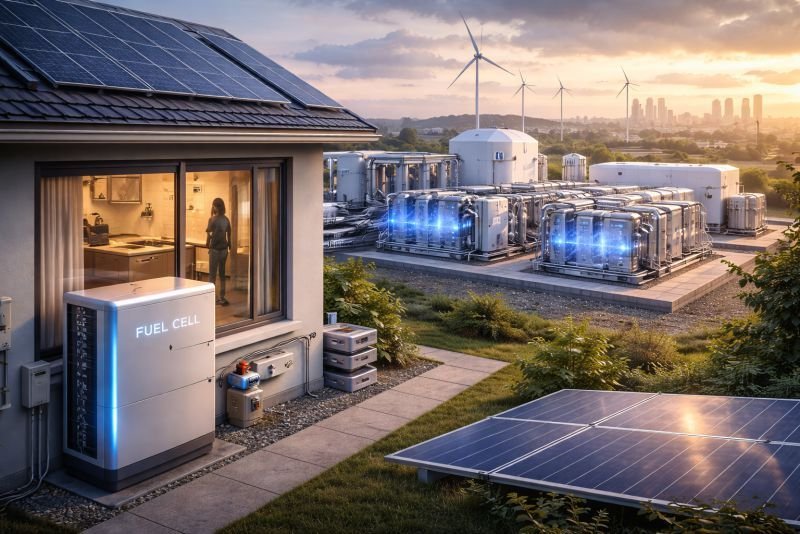
At grid level the opportunity shifts but the principle holds. Surplus electricity from wind and solar runs electrolyzers to produce hydrogen, which goes into storage. When demand rises and renewable generation falls, fuel cells convert it back. Lithium-ion batteries handle hours of storage efficiently. Hydrogen handles weeks or months. They are not competing technologies. They solve different parts of the same problem.
The chemistry behind all of it is the same reaction powering the vessel in Yokohama harbor. Protons cross a membrane, electrons flow through a circuit, and water comes out the other end. What changes across applications is scale, temperature, and the engineering wrapped around the reaction. The reaction itself has not changed since the first hydrogen fuel cell was demonstrated in 1839. Engineers have spent the 180 years since then figuring out how to make it useful.
You read the whole thing.
That is rarer than it should be, and it is the exact kind of attention I built this archive for. I make every piece alone, with no ads and no investor deciding what gets written. If you want the next machine taken apart like this one, you can help me make it.
A coffee a month is enough to keep it free for everyone.
Prefer crypto or a one time gift? Other ways to give →
Technologies Related to This Concept
| Technology | Concept |
|---|---|
| Hydrogen Fuel Cells for Smartphones: A New Era of Battery Life | Integrating hydrogen fuel cells into smartphones to dramatically extend usage time. |
| Bio-Reactors for Hydrogen Production | Producing hydrogen gas from organic waste for fuel cells. |
| Home Bio-Reactors with Multi-Fuel Outputs | Systems that produce electricity, heat, and biofuels simultaneously. |
| Portable Hydrogen Chargers for Laptops | Compact hydrogen fuel cell units that recharge laptops anywhere. |
| Microbial Fuel Cells for Home Waste Management | Using microbial fuel cells in home bio-reactors to convert kitchen waste into electricity. |