



What Is Electrostatic precipitator?
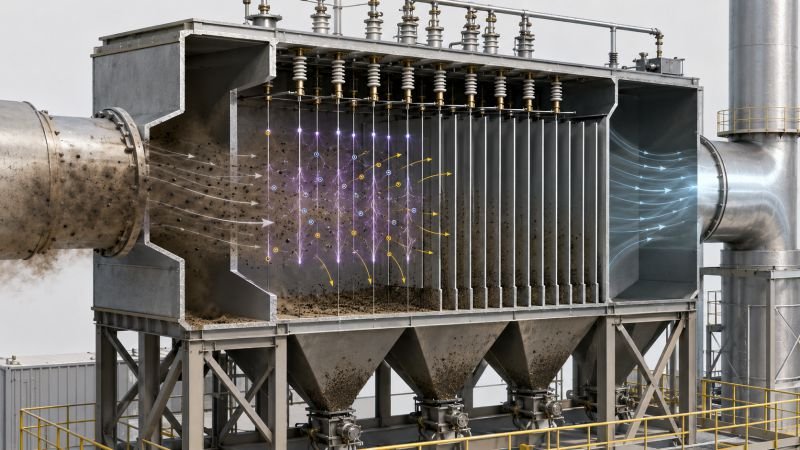
Electrostatic precipitator is an air-pollution control device that removes suspended particles from a gas stream by charging them and driving them toward collection surfaces. Particle motion follows the electric-force relation F = qE, so a stronger field or larger charge increases migration toward grounded plates. The method works best for high-volume exhaust where solids or liquid droplets must be separated before release.
In real systems, discharge electrodes create a corona that ionizes the gas, particles acquire charge, and periodic rapping drops the collected dust into hoppers. It is widely applied in industrial particulate control for power plants, kilns, smelters, and large process vents. Used in devices include boiler exhaust cleaners, cement kiln collectors, metallurgical fume controls, and waste-incineration gas treatment units.
The concept matters because it allows large stationary sources to cut particulate emissions with relatively low pressure drop while handling hot, dirty flows that strain many filter media. Performance still depends on particle size, resistivity, gas velocity, and maintenance quality, which is why ultrafine aerosols remain harder and more costly to capture than larger dust fractions. Gas conditioning can also improve collection efficiency.
Example:
A coal-fired boiler can route flue gas through an electrostatic precipitator before the stack so ash particles settle onto collection plates instead of leaving with the exhaust.
Related Terms:
- Corona Discharge
- Fine Particulate Matter
- Fly Ash
NoSuchDevice is a free archive of machines that do not exist yet but already have a shadow in physics. I research and write every entry alone, with no ads. Take a look around the archive, or help keep it free.