






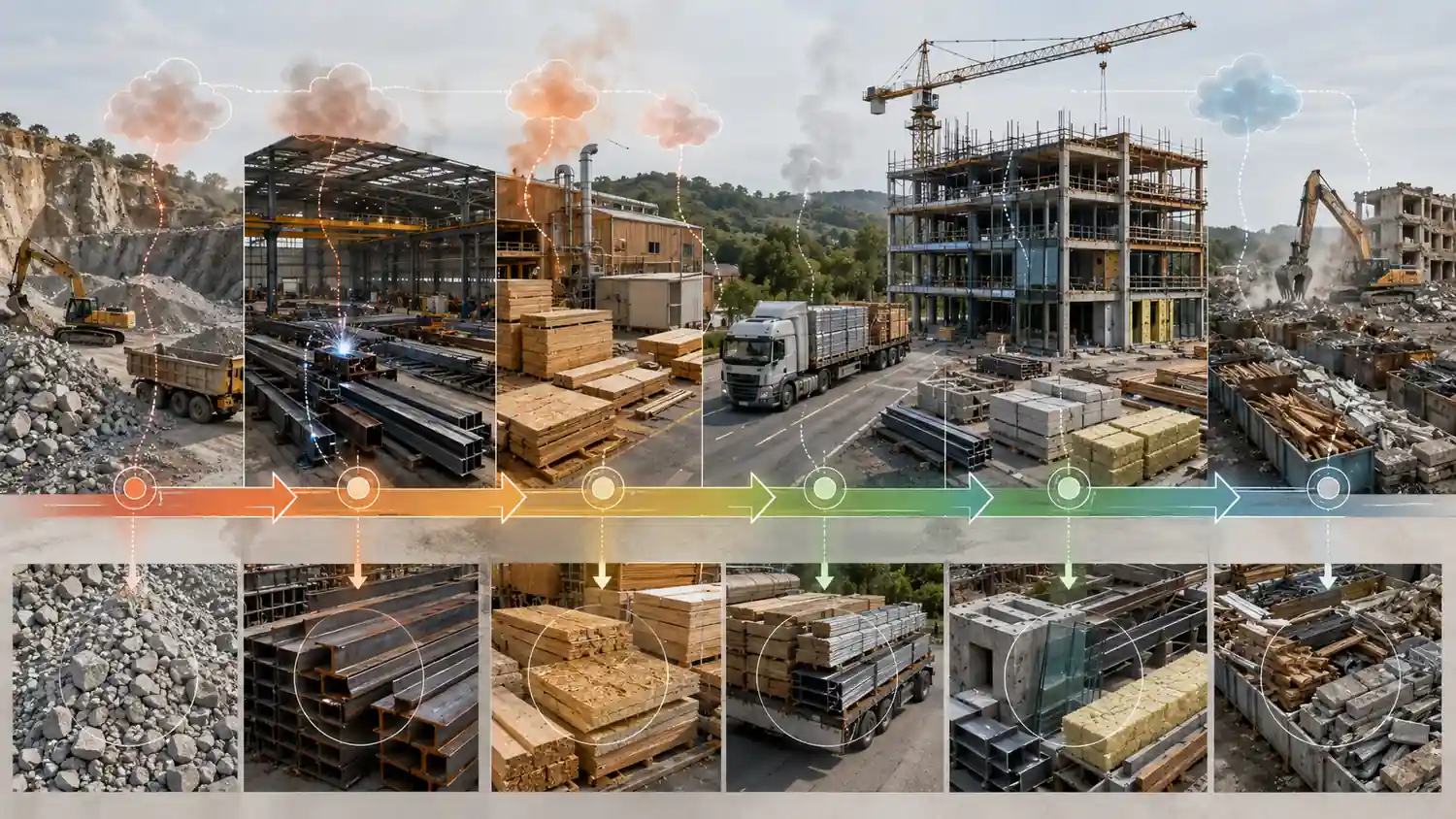
What Is Embodied carbon?
Embodied carbon is the total greenhouse-gas emission associated with making, transporting, installing, maintaining, and disposing of a material, product, or building. It is usually reported as carbon dioxide equivalent, so gases with different warming effects can be compared in one unit. A common relation is CO2e_total = sum(m_i x EF_i), where mass is multiplied by an emission factor for each material or process.
In real projects, embodied carbon accumulates before operation begins: ore extraction, cement chemistry, smelting, kiln firing, polymer production, freight, and site work all add to the ledger. In lifecycle carbon accounting, the result is compared with operational savings to estimate whether a design pays back its initial carbon cost over its service life.
The concept matters because low-energy operation can hide high material emissions if only utility bills are counted. Used in devices include building envelopes, structural frames, solar modules, battery packs, electronic hardware, and heat-pump systems. Designers reduce embodied carbon by using less material, selecting lower-emission suppliers, reusing existing structures, designing for repair, and planning end-of-life recovery before fabrication starts. It turns material choice into a measurable engineering decision.
Example:
A timber beam may store biogenic carbon, but its final embodied carbon also depends on drying energy, adhesives, transport distance, and reuse or disposal.
Related Terms:
- Lifecycle Assessment
- Carbon Payback Period
- Cradle-To-Cradle Design
NoSuchDevice is a free archive of machines that do not exist yet but already have a shadow in physics. I research and write every entry alone, with no ads. Take a look around the archive, or help keep it free.