






What Is Entropy?
Entropy is a thermodynamic state quantity that measures how energy is dispersed among the possible microscopic arrangements of a system. In classical thermodynamics it tracks how much energy becomes unavailable for useful work during real processes. A common relation is DeltaS = Q_rev/T, which defines entropy change for reversible heat transfer at absolute temperature T.
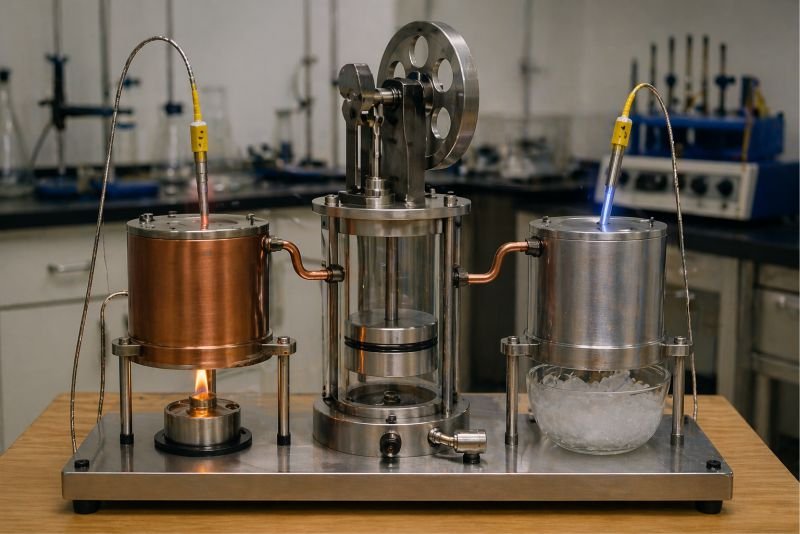
In real systems, entropy rises when heat flows across a temperature difference, when fluids mix, or when friction turns ordered motion into random molecular motion. Engineers use it to trace irreversibility in turbines, refrigerators, and chemical plants. In thermal power engineering, entropy helps compare ideal cycles with real hardware that loses work through combustion, leakage, and heat rejection.
This quantity matters because efficiency limits are easier to understand when entropy generation is explicit. High entropy generation signals lost work potential even though total energy is conserved. Used in devices include steam turbines, cryogenic liquefiers, batteries, and heat pumps. Scientists also use entropy in statistical physics to connect large-scale measurements with microscopic probability distributions and to distinguish likely states from highly ordered ones in gases, solids, and information-bearing systems.
Example:
During steam expansion through a real turbine stage, entropy increases because friction and heat loss make the process irreversible.
Related Terms:
- Kelvin Scale
- Carnot Efficiency
- Enthalpy
NoSuchDevice is a free archive of machines that do not exist yet but already have a shadow in physics. I research and write every entry alone, with no ads. Take a look around the archive, or help keep it free.