

What Is Evapotranspiration?
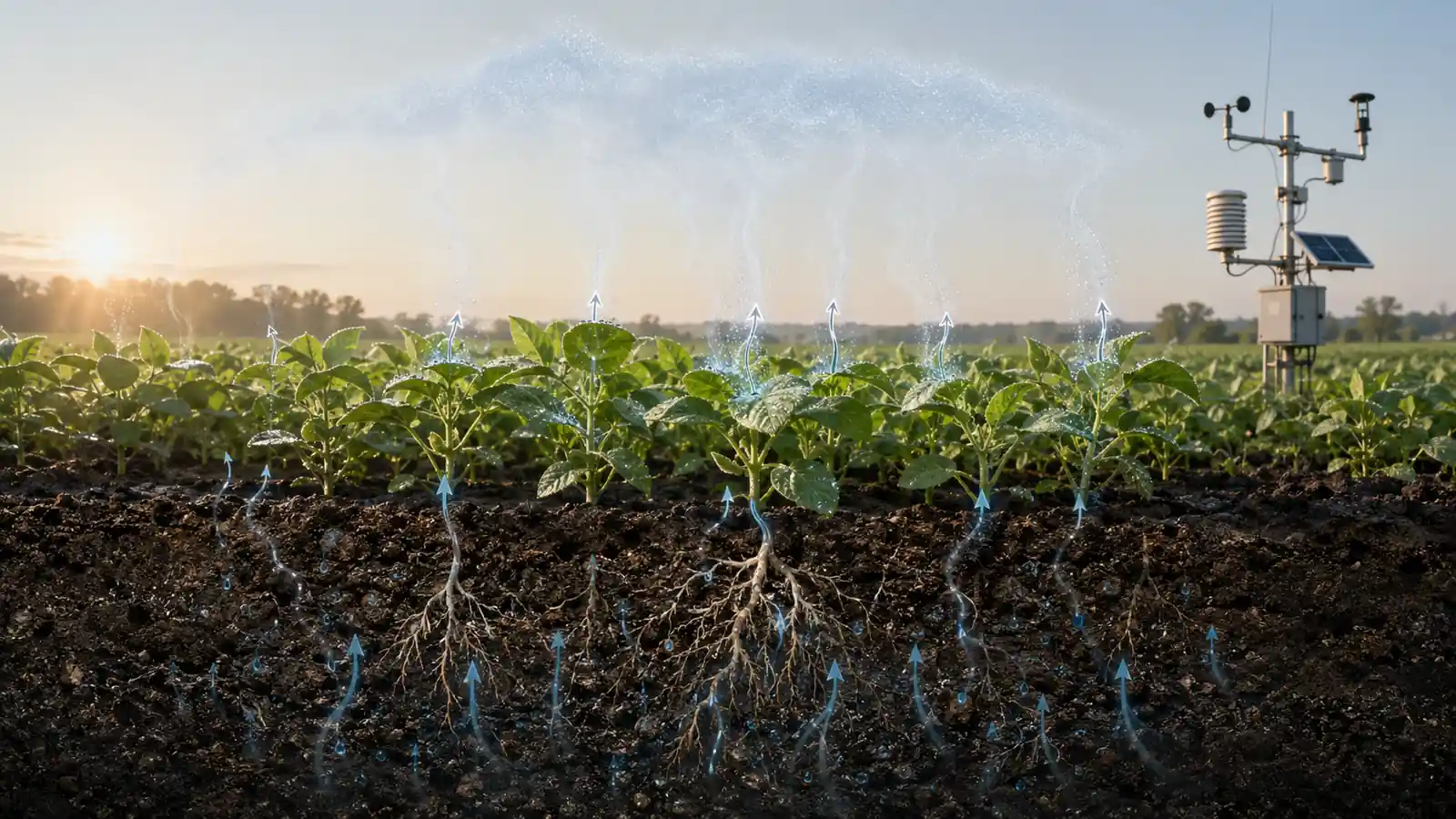
Evapotranspiration is the combined movement of water from land to air through evaporation from soil and surfaces plus transpiration from plants. It links the water cycle to plant physiology because roots draw water upward and leaves release vapor through stomata. A simple water-budget relation is ET = E + T, where E is evaporation and T is transpiration.
In real landscapes, evapotranspiration depends on sunlight, wind, humidity, temperature, soil moisture, crop type, and leaf area. It changes through the day and across the growing season as plants open or close stomata and as wet soil dries. It shapes agricultural water-balance modeling because vapor returned from fields can influence local humidity, cloud formation, and irrigation demand. Used in devices include lysimeters, eddy-covariance towers, sap-flow sensors, irrigation controllers, satellite radiometers, and field weather stations.
The concept matters because evapotranspiration is often the largest water loss from cropland, forests, and grasslands. Hydrologists use it to estimate drought stress, reservoir demand, watershed flow, and climate feedbacks. Agronomists use it to schedule irrigation and compare crop water-use efficiency.
Measurements may be direct, using mass or flux instruments, or estimated from weather data with reference-crop equations.
Example:
A wheat field can show high evapotranspiration on a hot windy day even when no liquid water is visibly leaving the soil.
Related Terms:
NoSuchDevice is a free archive of machines that do not exist yet but already have a shadow in physics. I research and write every entry alone, with no ads. Take a look around the archive, or help keep it free.