

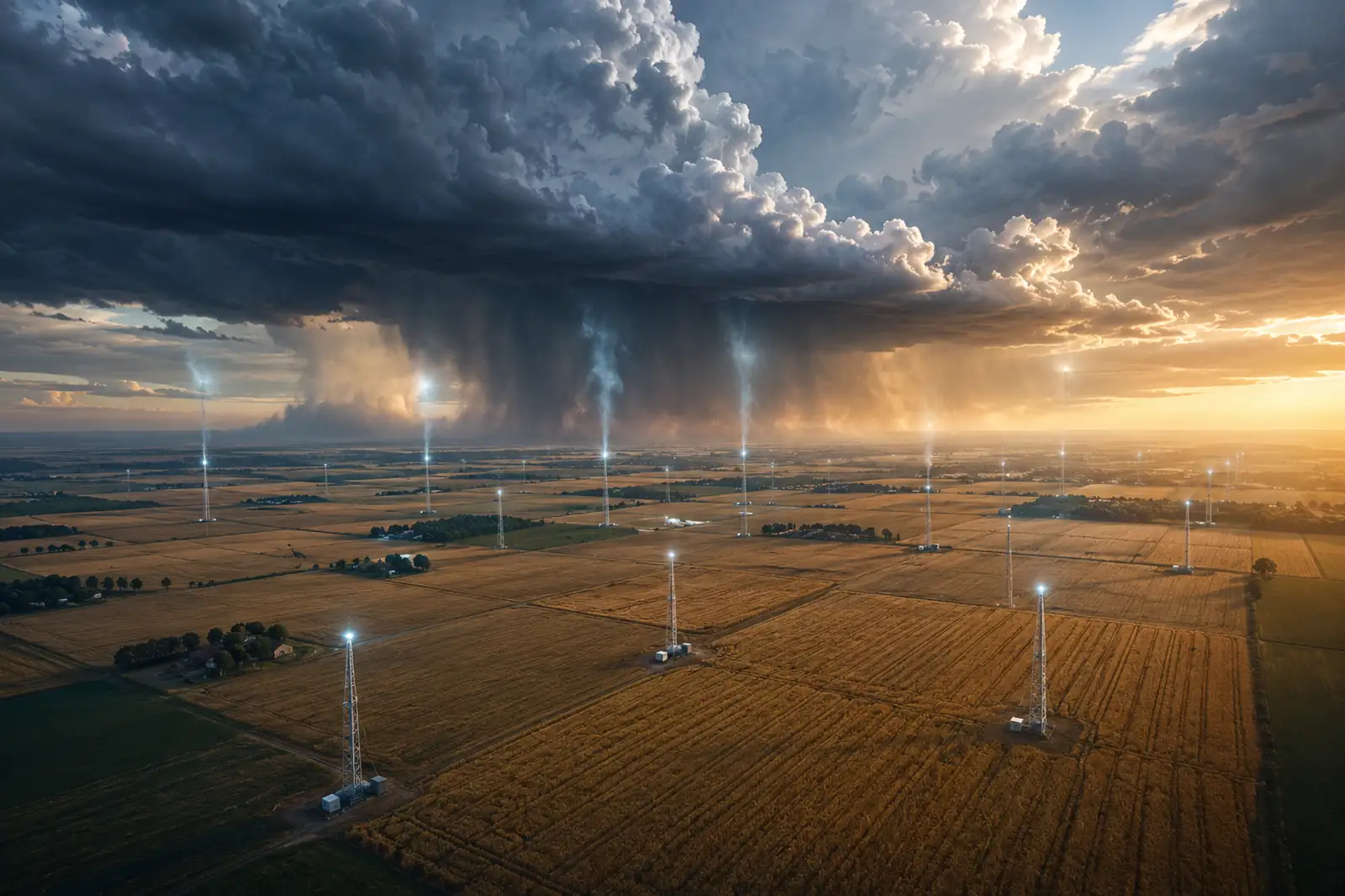
In South Australia’s Eyre Peninsula, wheat farmers track weekly rainfall totals with the attention most people reserve for financial statements. A season delivering 270 millimetres rather than 230 is not a better season or a worse season in any relative sense. It is the margin between a viable crop and a write-off. Modern precision agriculture has given these farmers extraordinary control over soil chemistry, fertiliser timing, and pest management. The one variable that determines everything still arrives on its own schedule and respects no optimization strategy.
A quantum weather modifier would change that. Not by generating water, but by doing what the atmosphere has almost always been ready to do: condense.
The short version: A quantum weather modifier is a ground-based device that uses directed electromagnetic fields tuned to the resonant frequency of water molecule hydrogen bonding to push atmospheric vapor past the nucleation threshold on demand. A single unit influences precipitation over roughly 5 to 15 hectares. A coordinated network of several hundred can reshape rainfall patterns across an agricultural region. The energy the device provides is a trigger, not a fuel source – atmospheric latent heat does the actual work, at leverage ratios that can exceed 25 million to one.
Key Takeaways
- The atmosphere above a typical wheat farm already holds enough water vapor for a meaningful rainfall event. What is missing is a trigger, not water.
- A 10-kilojoule trigger releasing 250 gigajoules of atmospheric energy is not a claim about efficiency. It is a claim about latent heat, and the arithmetic is straightforward.
- One device manages a field. Three hundred devices coordinated by AI reshape a regional climate – and the failure modes at that scale are categorically different from anything a single mast faces.
- Quantum weather modification does not escape the butterfly effect. It operates within the predictable window before atmospheric chaos takes over. That window is 20 to 60 minutes wide.
- The governance problem is at least as complex as the engineering problem. Redirecting atmospheric moisture from one farm to another is physically trivial and currently legally undefined.
Table of Contents
Cloud Nucleation Physics: What a Quantum Weather Modifier Actually Triggers
Water vapor above agricultural land is not a shortage problem. On a humid morning over a South Australian wheat field, a column of air one square metre wide and two kilometres tall holds several kilograms of water in vapor form. The reason it does not become rain is that water molecules need a surface to condense onto – a nucleation site – and over clean continental air with low aerosol concentrations, those sites are relatively rare.
Natural cloud formation relies on particles: dust, pollen, sea salt crystals, combustion products. Water vapor attaches to these aerosols and builds into droplets. In polluted urban air, nucleation happens readily. Over clean farmland, vapor stays suspended far past the humidity levels that would produce rain in a city. The atmosphere is supersaturated and stable until something tips it.
Conventional cloud seeding introduces artificial nucleation sites – silver iodide crystals dispersed by aircraft – and has demonstrated modest precipitation increases of 10 to 15 percent over treated areas. The limitation is delivery: aircraft, logistics, pre-existing cloud, and a statistical scattering process that puts most of the seeding material in the wrong place at the wrong time.
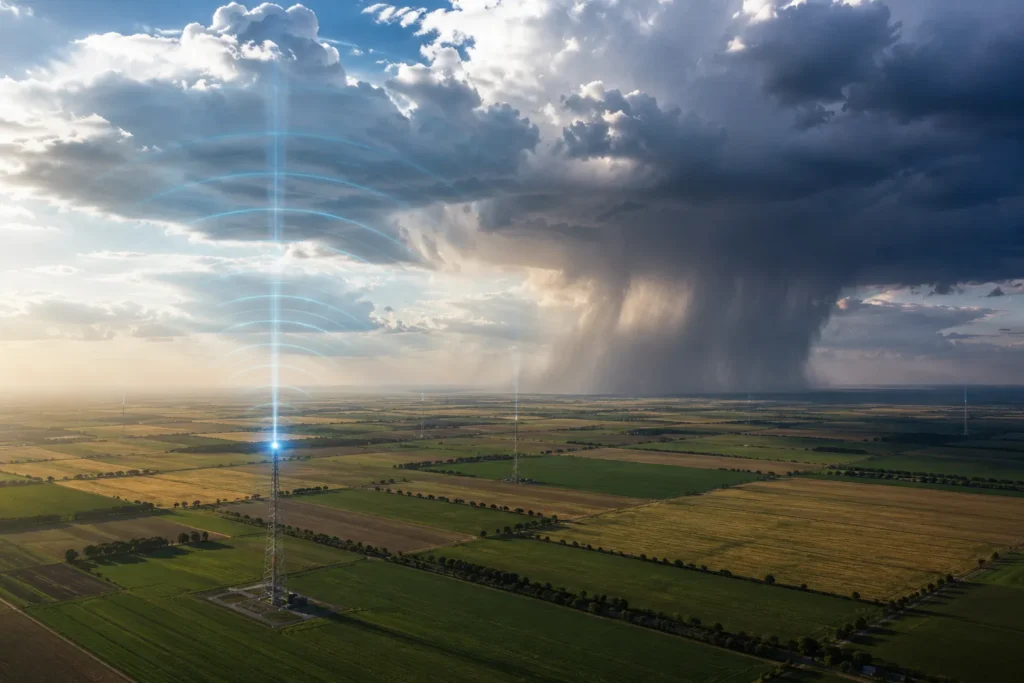
A device built on quantum principles would work differently. Rather than introducing physical particles, it would generate a directed electromagnetic field tuned to the vibrational frequency at which water molecules form hydrogen bonds preferentially. Aimed upward toward a cloud base, this field would raise the probability of spontaneous nucleation within a defined volume of air from background levels to near certainty. The droplets emerge from vapor already present. The device provides the quantum push. The atmosphere provides everything else.
What a Quantum Weather Modifier Would Actually Look Like
The device is not a weather station. In architecture it is closer to a phased-array radar antenna mounted on a steel mast, with a power plant and sensor package at the base.
The antenna array generates a sustained resonant electromagnetic field directed at a defined altitude zone – typically the base of convective cloud, between 600 and 2,000 metres above ground. Unlike radar, which sends and receives pulses, the modifier holds a continuous field whose frequency steps through a range derived from real-time atmospheric sensor readings. Humidity profiles, temperature gradients, and aerosol concentrations all shift the optimal nucleation frequency minute by minute. The device adapts.
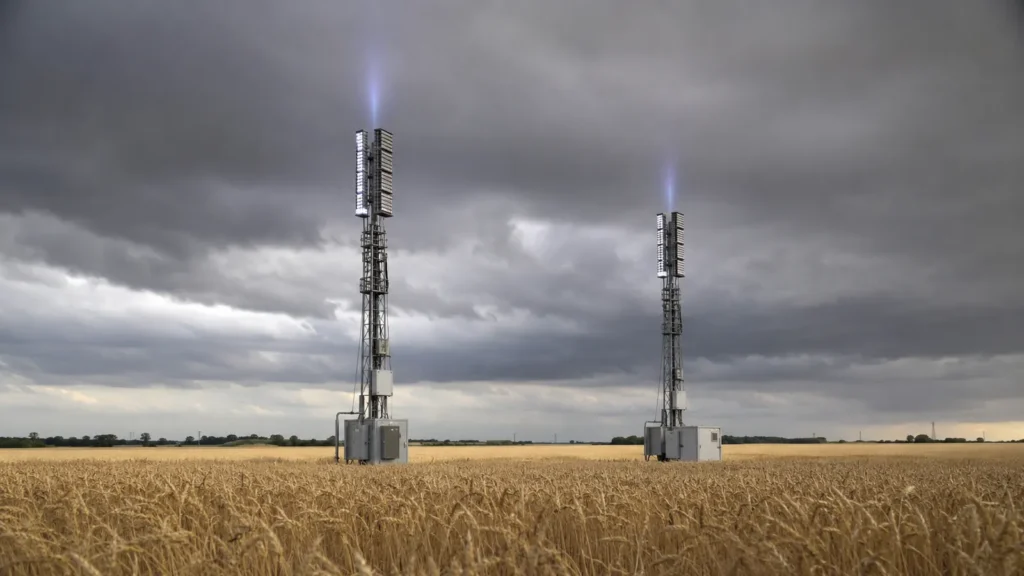
At small scale, a single installation covers 5 to 15 hectares of influence radius depending on cloud altitude and humidity. A 2,000-hectare wheat property would require between 130 and 400 units for full coverage – a distributed grid communicating through a central management system. The masts themselves would stand 8 to 25 metres tall, with a physical footprint modest enough to install between crop rows without meaningful yield disruption.
Remote sensing infrastructure provides the atmospheric information these devices need to operate. Humidity profiles at altitude, cloud base height, vapor density maps, wind shear data – without continuous feeds at this resolution, the device fires blind. The modifier and the monitoring layer are inseparable. One without the other is an expensive mast in a field.
Scale differentiation is real and matters for deployment planning. A small family operation might run a single unit primarily for frost prevention – triggering condensation heat release at crop height during critical spring nights rather than attempting to create rain. A large agro-industrial complex would run a coordinated grid to direct rainfall toward specific paddocks at specific points in the growing cycle.
The Leverage Ratio That Makes Quantum Weather Modification Thermodynamically Viable
Here is where the device stops sounding implausible.
The energy the modifier provides is a trigger. The energy that falls as rain comes from atmospheric latent heat – thermal energy stored in water vapor since it evaporated from ocean, river, or soil surface. When vapor condenses into liquid droplets, it releases that stored energy. The device does not supply it. The device chooses when and where the atmosphere releases it.
The formula for condensation energy is:
E = m x L
Where E is total energy released by condensation, m is the mass of condensed water in kilograms, and L is the latent heat of condensation for water: 2.5 x 10^6 joules per kilogram.
For a rain event delivering 10 millimetres across a single hectare: that is 0.01 metres of water depth over 10,000 square metres, giving a mass of 100,000 kilograms. Substituting:
E = 100,000 kg x 2,500,000 J/kg = 2.5 x 10^11 J = 250 gigajoules
That 250 gigajoules – roughly 70,000 kilowatt-hours – is what the atmosphere releases during a moderate rain event over one hectare. The quantum weather modifier did not produce that energy. It was already overhead, in supersaturated vapor waiting for a trigger.
The estimated trigger energy for a single firing event runs between 1 and 100 kilojoules depending on atmospheric conditions. At 10 kilojoules:
Leverage ratio = 250,000,000,000 / 10,000 = 25,000,000 to 1
| Parameter | Value | What It Represents |
|---|---|---|
| Rain event (10mm, 1 hectare) | 100,000 kg water | Mass of precipitation |
| Energy released by condensation | 250 GJ | Atmospheric energy, not device energy |
| Estimated trigger energy | 10 kJ | Device energy input |
| Leverage ratio | ~25,000,000:1 | Atmospheric energy vs trigger cost |
| Device power draw per event | ~3 kWh | Comparable to running a kettle for 90 minutes |
The sky above a wheat farm is a charged battery. The quantum weather modifier is the switch.
A 25-million-to-one leverage ratio is the kind of number this archive exists to chase down.
I make all of it alone, with no ads. If it is worth a coffee a month to you, that keeps the next one coming.
Keep it alive →How a Network of Quantum Weather Modifiers Would Coordinate a Region
A single device over a single field is useful in the way a thermostat is useful. A grid of several hundred devices coordinated across an agricultural region is a fundamentally different system, and the engineering problems it raises are categorically different from the ones a single mast faces.
Artificial intelligence operating in eco-tech is the layer that makes network-scale quantum weather modification coherent rather than chaotic. Individual devices do not decide when to fire. A regional AI working from numerical weather prediction outputs, satellite humidity maps, real-time sensor data from the mast arrays, and soil moisture readings across every field makes those decisions. Timing is everything: trigger device 12 before device 7 and the nucleation front moves northeast. Reverse the sequence and the rain falls two kilometres to the west.
The coordination envelope for effective network operation spans roughly 50 to 800 kilometres across, depending on atmospheric stability. Beyond that radius, chaotic divergence in the air mass prevents reliable prediction of where interventions travel. Network architecture would be layered: individual masts report to field-level controllers, which report to regional management nodes, which operate within an atmospheric model updated every 30 to 60 minutes.
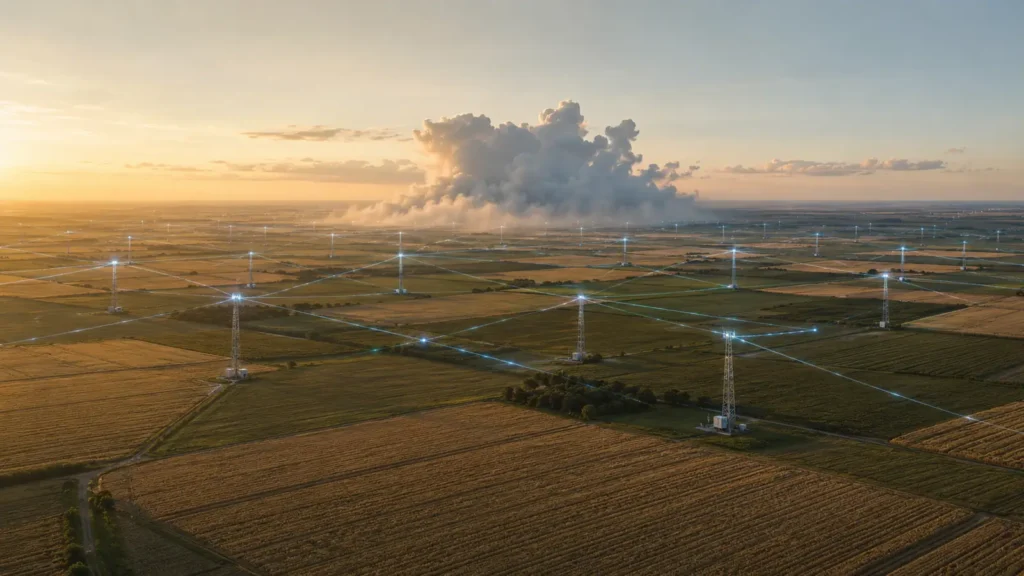
Local control and regional shaping are different problems. Local control means delivering 15 millimetres to a specific paddock on a specific day. Regional shaping means nudging a weather system so it deposits more precipitation over an agricultural zone and less over adjacent uninhabited land. Local control requires precise timing. Regional shaping requires sustained multi-day coordination and enough atmospheric modelling confidence to predict where a nudge goes several cycles forward.
Reading the Atmosphere in Real Time
Weather prediction and weather modification require the same foundational capability: a detailed, continuously updated model of the atmosphere above a specific region.
Numerical weather prediction models run by agencies such as the European Centre for Medium-Range Weather Forecasts operate at resolutions down to 3 kilometres and update on one-hour cycles. At that resolution, a quantum weather modifier network knows where water vapor is accumulating, where convective instability is building, and when conditions for nucleation triggering are optimal. The decision window for firing is narrow – atmospheric configurations that support effective triggering typically persist for 20 to 60 minutes before wind or temperature shift alters the parameters. A system that fires 45 minutes late has missed its opportunity entirely.
The butterfly effect is the hard constraint. A 10-kilojoule trigger nudges a cloud base by a kilometre or two. Over six hours, that deviation propagates across 80 kilometres of airspace through nonlinear atmospheric dynamics and the outcome is no longer predictable at the resolution available to the management AI. Quantum weather modification operates within a reliable window before chaos takes over. The technology does not master chaos. It acts quickly enough that the prediction horizon has not yet collapsed.
How does a farmer verify the device worked? When natural rain arrives 20 minutes after a triggering event, attribution is genuinely murky. Long-term statistical verification – comparing precipitation records over instrumented farms with matched control farms across multiple seasons – is the only reliable method, and it requires years of data to generate a clear signal. Individual events remain ambiguous. Seasonal averages are where the effect emerges.
Beyond Rain – Frost Prevention, Shade Control, and the Full Spectrum
Precipitation triggering is the headline application. It is also not where the technology would likely make its first commercially viable deployment.
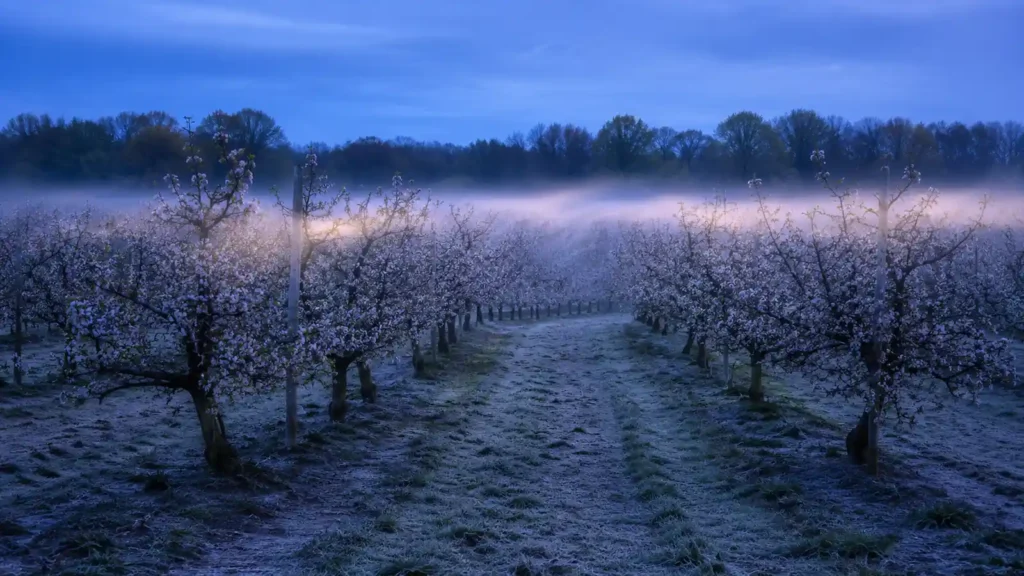
Frost prevention is the simpler problem, and it works on the same physics. When water vapor condenses at low altitude – fog formation close to ground level – it releases roughly 2,500 joules per gram. Over an orchard at 2 metres above the canopy, a controlled condensation event can raise air temperature by 1.5 to 3 degrees Celsius within minutes. A late spring frost arrives with a 6-hour forecast window and can destroy a full fruit crop with overnight temperatures below zero lasting as little as 2 hours. A quantum weather modifier running at 10 to 15 percent of its precipitation power, directed horizontally at canopy height, holds surface temperatures above the damage threshold for the duration of the frost event without the operational overhead of frost protection helicopters or overhead sprinkler systems.
Heat stress management is the third application mode. Triggering thin, high-coverage cloud at 1,500 to 2,000 metres altitude during peak summer afternoons reduces solar radiation reaching crop surfaces. Studies on maize and wheat show that canopy temperature reduction of 3 degrees Celsius during anthesis – the grain-filling stage that lasts roughly three weeks – can improve final yield by 8 to 14 percent. A device network capable of reliably delivering that shade window during the critical anthesis period is not atmospheric engineering at civilizational scale. It is a precision yield management tool with a measurable return, operating from the same antenna hardware used for rainfall events.
The Climate Theft Problem
There is a question that device specification documents reliably avoid: where does the condensed water come from?
The answer is atmospheric moisture in transit. A cloud system moves over a region and carries a water budget. A quantum weather modifier network capturing 100,000 kilograms of that water over an agricultural zone is pulling moisture that would otherwise continue downwind. For the farm operating the modifiers, that is a precipitation management success. For the farm 60 kilometres northeast that received less rain than atmospheric models predicted, it is an unexplained deficit.
Conventional cloud seeding already produces documented disputes between upwind operators and downwind landholders. At the scale quantum weather modification implies – hundreds of devices running continuously during growing season across a major agricultural region – the redistribution of atmospheric moisture would be substantial and directional.
Natural ecosystems face the same problem. A device network that consistently redirects precipitation from native forest to crops is not neutrally engineering the weather. Forests that depend on specific seasonal rainfall patterns for fire suppression and river recharge absorb changed precipitation without any compensation mechanism. Governance frameworks for atmospheric moisture do not exist at this scale. Conventional water law covers rivers and aquifers. Air is unlegislated. The technology would arrive before the legal structures needed to manage it – in precisely the same pattern as groundwater extraction industrialised decades before aquifer depletion became a recognised harm.
From One Field to a Planetary System: The Evolutionary Arc
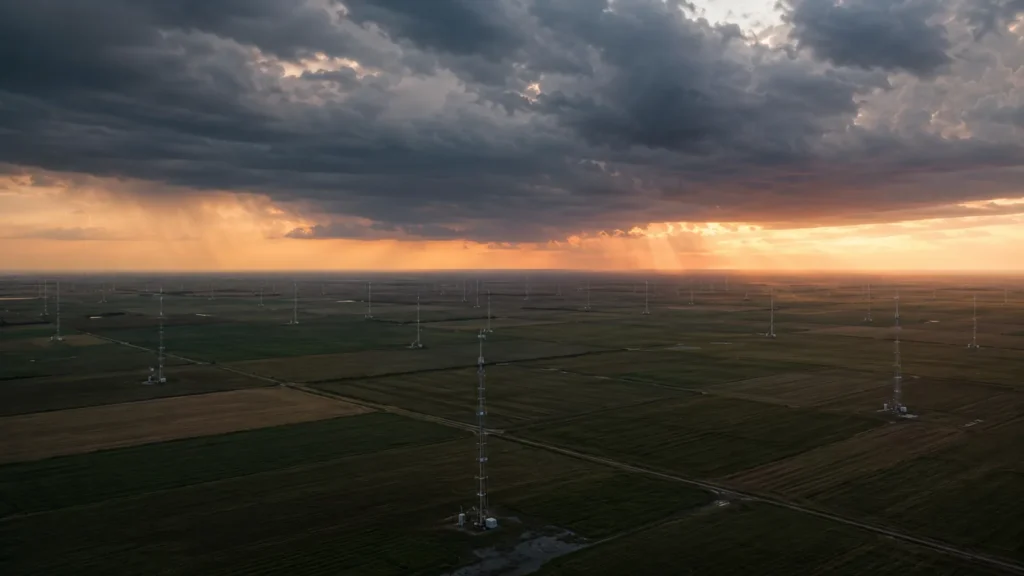
The mast-mounted first-generation device is proof-of-concept hardware at the scale where individual farms can test the principle.
First Generation: Farm-Scale Proof of Concept
Early devices would be standalone units with their own power, sensor package, and local controller. Deployment would begin with frost prevention on high-value crops where a single overnight freeze justifies the installation cost: orchards, vineyards, seed production farms. Data from these early deployments would calibrate the atmospheric models and establish the verification protocols that precipitation triggering would later require. The signal-to-noise problem of attribution gets solved here, at small scale, before grid-level deployment.
Mature Deployment: Grid Integration Across Agricultural Regions
At engineering maturity, the antenna arrays would integrate into existing agricultural infrastructure – irrigation support towers, electrical distribution poles, communication masts already present across large properties. Power would come from regional grids or co-located solar generation. The AI coordination layer would run as a shared regional utility service, the same way weather forecasting operates as a public good today. A farmer would subscribe to a precipitation management service rather than maintaining individual devices. The hardware disappears into the infrastructure. The rainfall management capability remains.
Civilizational Scale: Directed Continental Hydrology
At the largest scale – several engineering generations away – a continental network coordinated under shared governance could redirect atmospheric moisture from ocean evaporation toward interior regions experiencing progressive desertification. The Sahel, the Loess Plateau, the interior of Australia already show that large-scale reforestation locally increases rainfall through evapotranspiration feedback loops. A modifier network would be an accelerant: tilting atmospheric moisture pathways rather than waiting for vegetation cover to shift them over decades. That is not near-term engineering. The seed is a steel mast on a wheat farm. What it grows into depends on the governance frameworks built around it before the second generation arrives.
The View From NoSuchDevice
I want to be honest about what earns this device its place in this archive, and what about it genuinely concerns me.
The physics is not in dispute. Nucleation physics is real, latent heat leverage is arithmetic, and the 25-million-to-one ratio between trigger energy and atmospheric release is not optimism – it is the latent heat of condensation applied to a rain event over one hectare. A first-generation quantum weather modifier is physically coherent. The engineering path from a phased-array antenna to reliable nucleation triggering is difficult, not impossible. Proof-of-concept hardware for electromagnetic nucleation induction exists at laboratory scale. The device described in this article has a legitimate claim to Zone 2 speculative engineering: known physics, unbuilt hardware, plausible development path.
What I find harder to dismiss is the governance gap. Every powerful agricultural technology has arrived before the institutions capable of managing it. Synthetic nitrogen transformed food production and also created hypoxic dead zones in every major river delta on Earth. Groundwater pumping fed billions and drew down aquifers now measured in decades of remaining capacity. Quantum weather modification would be an order of magnitude more potent than either, and the commons being consumed – atmospheric moisture in transit – is currently owned by no one and regulated by nothing.
The technology class itself matters beyond farming. Devices that interact with planetary systems at leverage ratios this large are, in their mature form, tools for managed continental hydrology. That capability could address desertification at the scale the problem actually exists, not at the scale current irrigation infrastructure can reach. Whether that destination is worth the path through an unresolved governance problem, I honestly do not know. The physics earns the device its place here. The rest is a question about institutions, which are considerably harder to engineer than antennas.
You read the whole thing.
That is rarer than it should be. A device that turns a 10-kilojoule trigger into 250 gigajoules of rainfall is exactly the kind of machine this archive was built to take seriously. I make every piece alone, with no ads and no investor deciding what gets written. If you want the next machine taken apart like this one, you can help me make it.
A coffee a month is enough to keep it free for everyone.
Prefer crypto or a one time gift? Other ways to give →
Frequently Asked Questions
How is a quantum weather modifier different from conventional cloud seeding?
Cloud seeding disperses physical particles from aircraft and relies on statistical nucleation. A quantum weather modifier generates a directed electromagnetic field from the ground, tuned to water molecule hydrogen bonding frequency, triggering nucleation within a defined volume without introducing material into the atmosphere. Precision, ground-based operation, and repeatability are the principal differences.
Would this technology work over deserts or regions with very low atmospheric humidity?
Below roughly 40 percent relative humidity, the atmospheric water vapor budget is too thin for nucleation triggering to produce meaningful precipitation. The device accelerates condensation of vapor already present – it does not generate water. Regions with persistent humidity deficits remain outside the effective operating range without a separate atmospheric moisture transport system.
Can the same device be used to suppress rainfall rather than trigger it?
In principle, yes. A field configured to inhibit nucleation could delay or weaken precipitation over a target zone. Suppression works against thermodynamic tendency while triggering works with it, meaning suppression requires significantly more power and is considerably less reliable. Triggering is the primary application class.