





What Is Gibbs free energy?
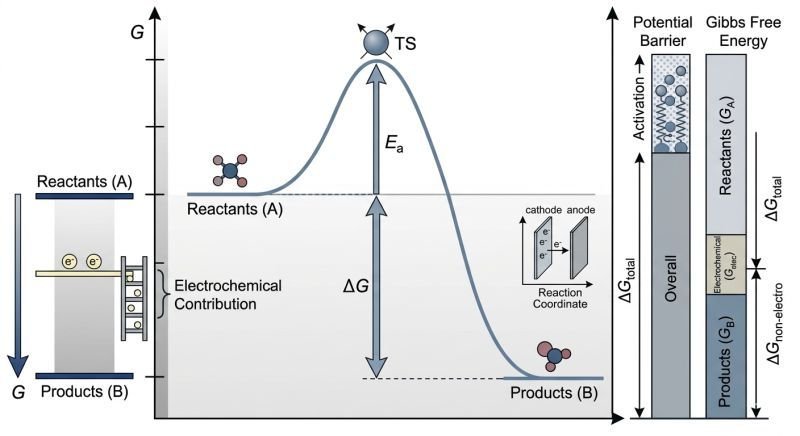
Gibbs free energy is a thermodynamic potential that represents the maximum non-expansion work obtainable from a process at constant temperature and pressure. It is defined by G = H – TS, where enthalpy and entropy contributions determine whether a reaction can proceed spontaneously under given conditions. A negative change in Gibbs free energy indicates that useful work can be extracted as the system moves toward equilibrium.
For electrochemical conversion, the Gibbs free energy change links chemistry to electrical output through cell potential and transferred charge. In hydrogen fuel cells, delta G for forming water sets the theoretical electrical work limit, while real operation falls below that limit because of activation, ohmic, and mass-transport losses. Using electrochemical energy conversion thermodynamics, engineers compare theoretical voltage with measured polarization behavior to quantify performance gaps.
The concept matters because it separates total released heat from usable electrical work, guiding realistic efficiency targets and system architecture decisions. It also supports operating-window analysis across temperature and pressure ranges, helping predict how reaction driving force and stack performance shift in practical deployment.
Example:
A fuel cell model uses delta G for hydrogen oxidation to estimate ideal voltage before subtracting irreversible losses observed in test data.
Related Concepts:
- Enthalpy Change
- Entropy Change
- Nernst Equation
NoSuchDevice is a free archive of machines that do not exist yet but already have a shadow in physics. I research and write every entry alone, with no ads. Take a look around the archive, or help keep it free.