





What Is Graphene?
Graphene is a single atomic layer of carbon atoms arranged in a two-dimensional hexagonal lattice. This structure gives it unusually high electrical conductivity, mechanical strength, thermal conductivity, and accessible surface area for its mass. In charge-storage contexts, the familiar capacitance relation C = epsilon A / d helps explain its appeal: large active area A and very small separation d can support high capacitance at an interface.
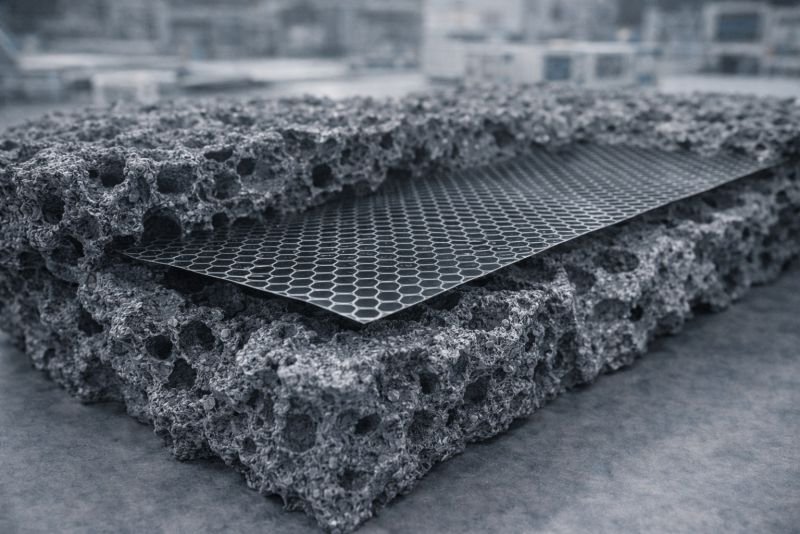
In real materials engineering, graphene is used as flakes, films, foams, inks, or composite additives rather than as a perfect isolated sheet. In high-rate electrostatic storage, preventing sheet restacking is critical because stacked layers lose accessible surface and slow ion access. Used in devices include supercapacitors, flexible sensors, conductive coatings, membranes, and structural composites.
The material matters because it combines electrical transport and surface-driven behavior in one platform. That makes it attractive for fast electronics, energy storage, and sensing, but real performance still depends on defect density, contamination, pore architecture, contact resistance, and manufacturing consistency. A laboratory-quality graphene sheet and a large-volume industrial graphene product can behave very differently.
Researchers characterize graphene with Raman spectroscopy, sheet resistance, electron microscopy, and surface-area measurements. These tests reveal whether the material is highly conductive, overly defective, badly restacked, or well suited for a specific engineering use.
Example:
A porous graphene electrode can store charge rapidly when electrolyte ions reach a large accessible surface without excessive layer stacking.
Related Terms:
- Ion Transport
- Energy Density (Wh/kg)
- Surface Area
NoSuchDevice is a free archive of machines that do not exist yet but already have a shadow in physics. I research and write every entry alone, with no ads. Take a look around the archive, or help keep it free.