






What Is Linear induction motor?
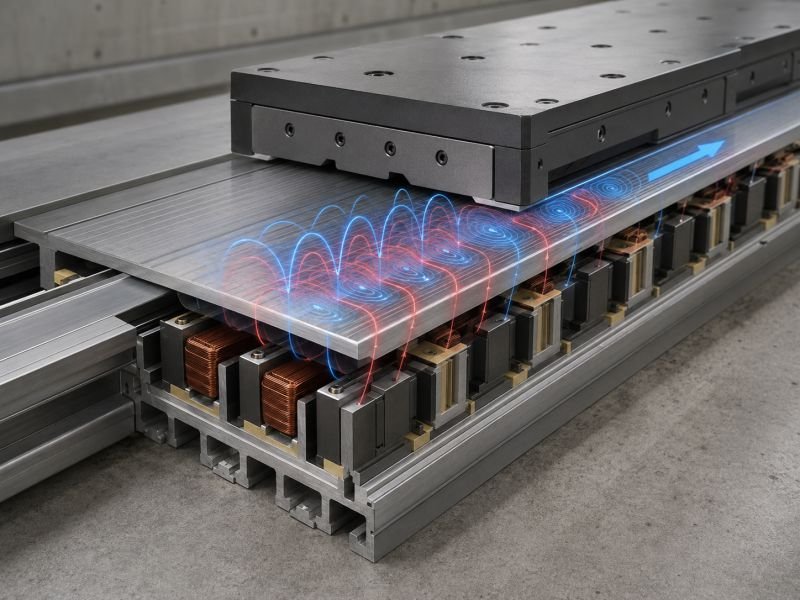
Linear induction motor is an induction motor unrolled into a straight line so that electromagnetic force produces linear motion instead of torque. An alternating current in the primary creates a traveling magnetic field whose synchronous speed is approximately vs = 2f tau, where f is supply frequency and tau is pole pitch. Currents induced in a nearby conductive secondary then generate thrust through electromagnetic interaction.
In real systems, the secondary may be an aluminum reaction plate, a conductive rail, or a moving vehicle-mounted surface, while the primary can be mounted on the vehicle or in the guideway. This arrangement is common in contactless ground propulsion where direct mechanical drivetrain parts are reduced. Used in devices include airport shuttles, automated people movers, launch tracks, conveyor systems, and experimental transport corridors.
The concept matters because it provides propulsion without gears, tires, or rotary transmission elements, which can simplify guidance and regenerative braking in controlled environments. Designers still need to manage slip, air gap, heat, and end effects, since those factors influence thrust density and efficiency. For transport engineering, the motor is important whenever motion must be distributed along a track or surface rather than produced only onboard.
Example:
A people mover can accelerate along a station guideway when coils in the track create a traveling field that pulls a conductive plate forward.
Related Terms:
- High-Temperature Superconductor
- Traveling Magnetic Field
- Eddy Current
NoSuchDevice is a free archive of machines that do not exist yet but already have a shadow in physics. I research and write every entry alone, with no ads. Take a look around the archive, or help keep it free.