

A fully loaded delivery truck rolling down a city boulevard at 60 km/h is doing something that barely registers as remarkable. But roughly 20% of the fuel energy that truck burns – the portion that nobody in the cargo chain is paying attention to – goes into deforming rubber and asphalt. The tyre compresses on contact and recovers on release. The road flexes by a fraction of a millimetre under each axle and rebounds. Both surfaces heat up slightly. The energy does not go to moving the load. It goes into warming the planet at ground level, one kilometre at a time. For 150 years of engineering optimisation, this number has barely moved, because the contact between wheel and road is not inefficiency in a system that could be designed differently. It has been treated as physics itself.
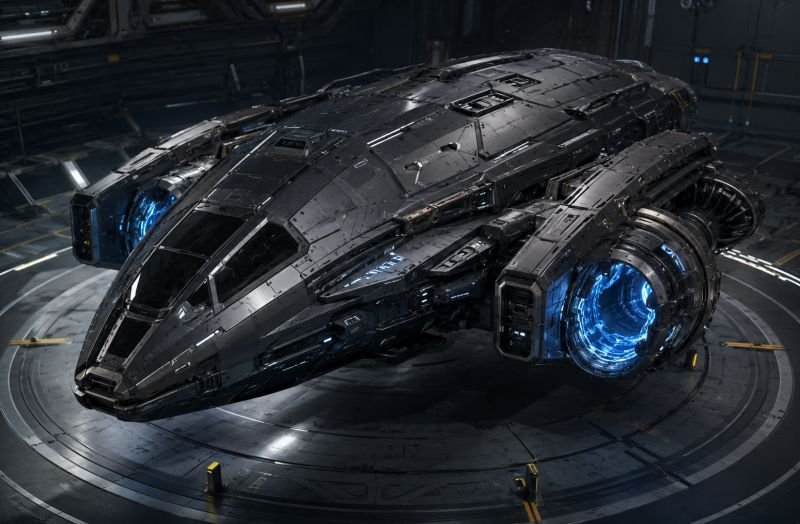
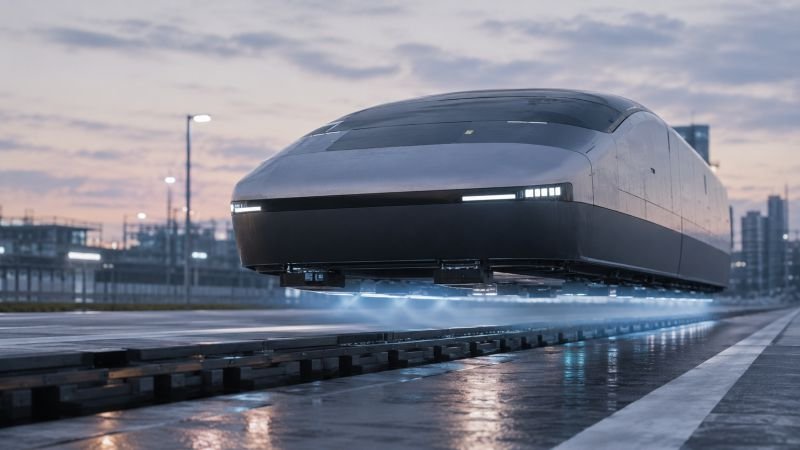
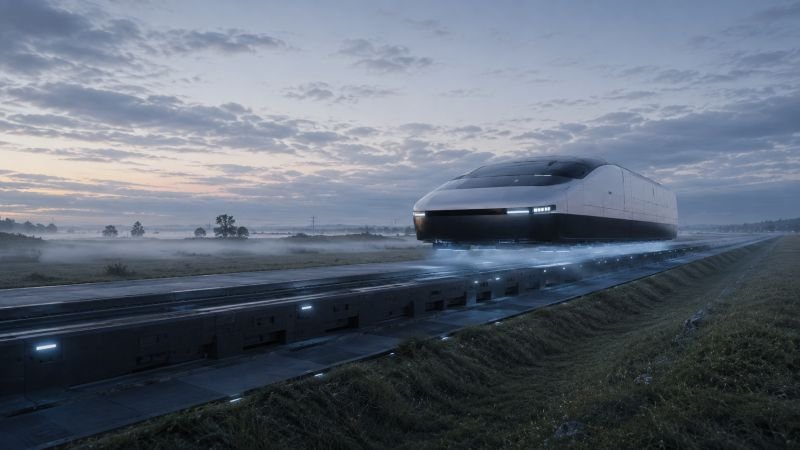
A quantum levitation vehicle disagrees with that framing. The device hovers above the road on a column of frozen field geometry, maintaining its position with no mechanical contact and no active correction. The wheel is not improved. It is absent.
The short version: A quantum levitation vehicle uses flux pinning – the quantum mechanical locking of magnetic field lines inside a cooled superconducting material – to hold a vehicle at a fixed height above a magnetised road surface. Rolling resistance drops to zero. Propulsion comes from a linear motor built into the road. The physics is established. The engineering challenge is the road: a continuous magnetised, cryogenically maintained surface that does not yet exist at city scale, but does not require any new science to build.
Key Takeaways
- Quantum flux pinning is positional rigidity, not magnetic repulsion – the vehicle cannot drift up, down, or sideways without an external force, which makes it stable in ways a conventional Maglev train is not
- Rolling resistance accounts for 15-25% of total energy consumption in road vehicles; eliminating it entirely changes the energy arithmetic of ground transport at scale
- The cryogenic penalty of maintaining superconductors at 77 K is real, but pre-cooling before departure shifts the energy balance firmly in the vehicle’s favour
- Airports, ports, and automated freight corridors are the first deployment environment – not public roads, and not by accident
- If this technology reaches city scale, the road ceases to be passive infrastructure and becomes an active propulsion and positioning system – a different category of engineering than anything built before
Table of Contents
The Energy Tax Built Into Every Road Vehicle
Rolling resistance is one of those numbers that appears in engineering textbooks and then quietly disappears from public conversation. It sits between 15% and 25% of total energy expenditure in a typical road vehicle. In a long-haul truck, the figure climbs higher. In stop-start urban conditions, it competes with braking loss for the title of largest single energy drain in the system.
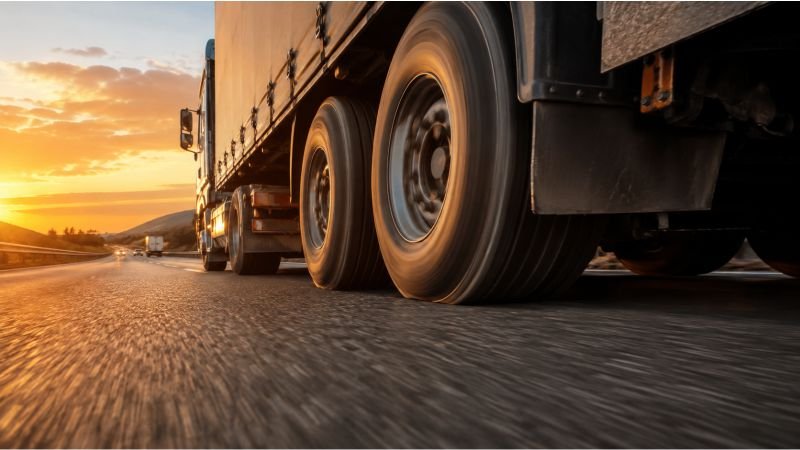
The reason it persists is structural. Reducing rolling resistance is possible – low-resistance tyre compounds, optimised inflation pressure, stiffer sidewalls. But none of these eliminations the contact. The wheel requires it. The road requires it. The entire mechanical logic of ground transport requires a surface to push against, and every surface that can be pushed against deforms. At the molecular level, energy moves from the vehicle into the road with every metre of travel, and there is no design solution within wheel-based transport that makes that transfer stop.
Quantum levitation removes the contact. Not through improved materials or better geometry, but by replacing the wheel-road interface with a field-geometry interface that carries no mechanical energy transfer at all. The energy tax does not get smaller. It goes to zero.
What replaces it – and whether that replacement is energetically cheaper – is the more interesting question.
Flux Pinning Is Not Magnetic Levitation
The phrase “magnetic levitation” triggers an immediate mental image: two magnets held with the same pole facing, repelling each other, one floating above the other. That image is accurate for a laboratory demonstration. It is not accurate for a quantum levitation vehicle, and the distinction matters because the simpler model does not work for free-moving road vehicles.
Magnetic repulsion is unstable. A vehicle floating above magnets by raw repulsion force would drift sideways at the slightest perturbation, requiring constant active correction to stay on course. This is workable for trains constrained to rails with precisely defined geometry. It is not workable for a vehicle that needs to navigate a roundabout.
How Quantum Locking Holds the Vehicle in Place
When a type-II superconductor cools below its critical temperature in the presence of a magnetic field, the field does not get expelled completely. It threads through the material in quantised channels called flux tubes. Once the material is fully superconducting, these flux tubes are locked in place. Moving the superconductor relative to the magnetic field requires displacing those tubes, which costs energy the system will not spend. The result is that the superconductor resists displacement in every direction simultaneously – up, down, sideways, tilt. It is not floating above the field source. It is locked to a specific position relative to it.
A superconductor cooled over a magnetic surface and then released holds exactly the height at which it was cooled. Push it sideways and it returns. Pull it upward and it pulls back down. The spatial relationship between the material and the field is, within the physical tolerances of the superconductor, geometrically rigid without any active control system. The quantum mechanical foundations of this behaviour are covered in detail in The Role of Quantum Mechanics in Future Technologies.
Why This Is a Different Machine From a Maglev Train

Maglev rail makes a useful reference point precisely because it exists. The Japanese SCMaglev, the German Transrapid, commercial lines in China – these demonstrate that magnetic levitation works at vehicle scale, at high speed, under real operating conditions. They are proof of principle for the levitation concept. They are not models for a quantum levitation road vehicle.
Maglev trains use rail geometry to constrain the vehicle in the lateral direction. The track does the work that flux pinning does in the concept here. Remove the rail and a conventional Maglev vehicle becomes an unstable hovering platform. A quantum levitation vehicle, because flux pinning provides inherent positional stability in all directions, does not need a physical rail. The road geometry constrains it through the field geometry, which can be shaped around curves, intersections, and junctions in ways that a fixed rail cannot.
How a Quantum Levitation Vehicle Could Operate
The Surface That Makes the Road Do New Work
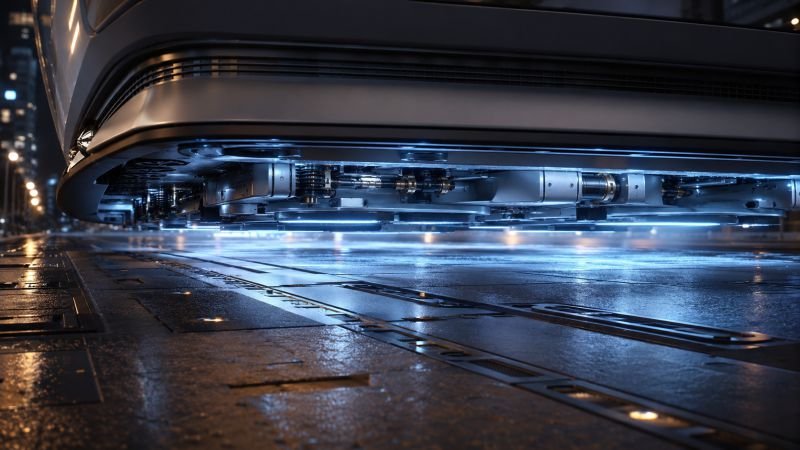
A quantum levitation vehicle does not hover above an ordinary road. The road must be engineered as a magnetic surface – a continuous arrangement of permanent magnets or programmable electromagnets embedded in a durable substrate, creating a controlled field at a defined height above the surface. The vehicle’s undercarriage carries the superconducting elements, cooled before departure and maintained at operating temperature throughout the journey.
The engineering demand on the road surface is not the magnetism itself, which is straightforward. It is the geometric precision and continuity of the field across kilometre-scale distances, including curves, intersections, and elevation changes. Flux pinning locks the vehicle to the field geometry. Any discontinuity in that geometry – a gap, a shift in field orientation, an uneven transition between road sections – creates a positional inconsistency that the vehicle must absorb. The road is not passive. It becomes active infrastructure, and it must be maintained to tolerances that current road engineering does not require.
Winter conditions introduce a specific complication. Ice accumulation on the magnetic surface raises the physical road level without moving the magnetic field. A vehicle pinned to a field centred 5 centimetres above the road surface finds that 3 centimetres of ice reduces its physical clearance to 2 centimetres. Heated road elements – already deployed in some cold-climate road infrastructure – address the problem directly, at the cost of additional energy demand from the road system.
Cornering, Braking, and the Question of Speed
Flux pinning provides positional stability. It provides no propulsion. A quantum levitation vehicle moves through a linear induction motor embedded in the road surface, which generates a travelling magnetic wave that the vehicle rides. This eliminates the drivetrain entirely – no gearbox, no axles, no differential, no wheel bearings. The vehicle is a platform with a superconducting underbody, its forward motion governed by the field frequency from below.
Cornering in this system works through field geometry. The magnetic surface through a curve is oriented to gradually rotate the pinned position laterally, guiding the vehicle through the turn without requiring mechanical steering in the conventional sense. The vehicle follows the road because the field geometry moves and the vehicle stays locked to it. Braking reverses the linear motor field, converting kinetic energy back to electricity. Acceleration responds to field frequency increase. The driver – if there is one – interacts with a propulsion and guidance system that lives in the road, not in the vehicle.
Regenerative Capture Without a Wheel to Spin
Conventional regenerative braking harvests kinetic energy by running the drive motor as a generator during deceleration. The linear motor achieves the same during braking, returning energy to the road system’s electrical grid. A secondary opportunity exists in the vehicle itself. Small positional oscillations relative to the magnetic field – from load shifts, minor surface variations, vibration from adjacent traffic – represent mechanical energy. A piezoelectric or electromagnetic harvesting layer built into the cryogenic housing converts these micro-displacements into electricity. The yield per event is small. Across a full operating day at logistics volumes, it contributes meaningfully to the vehicle’s energy budget. The efficiency principles governing these energy recovery systems are examined in The Science of Energy Conversion Efficiency.
Building a Quantum Levitation Vehicle: What the Engineering Actually Requires
Load Capacity and What Limits It
Flux pinning force depends on the density of flux tubes, which depends on the magnetic field strength and the properties of the superconductor. Current high-temperature superconductors – specifically REBCO coated conductors, rare earth barium copper oxide – demonstrate pinning forces in the range of 10 to 100 newtons per square centimetre under strong applied fields. A vehicle undercarriage covering 1.5 square metres of active superconducting surface in a strong field could generate a total upward force comfortably beyond 100,000 newtons – more than ten times the weight of a loaded passenger vehicle.
Load capacity, in other words, is not the limiting factor. The limiting factor is maintaining field uniformity and thermal stability across that surface area in a vehicle moving through varying environmental conditions. A laboratory superconductor the size of a book is easy to cool evenly and maintain at temperature. A 1.5-square-metre undercarriage at 100 km/h, in a range of ambient temperatures and humidity levels, is a different thermal engineering problem. The physics permits it. The cooling architecture that does it reliably and compactly does not yet exist in road-vehicle form.
Redesigning From the Chassis Up
A quantum levitation vehicle is not a conventional car with the wheels removed. The structural logic of the vehicle changes entirely. Conventional vehicle design transmits forces through suspension geometry to wheels. Remove the wheels and that entire load path disappears. The cryogenic undercarriage becomes the structural base. Body, passenger space, and cargo volume mount above a sealed, thermally insulated platform. The vehicle is closer in structural concept to a ship hull – a form designed to maintain integrity above a supporting medium – than to any road vehicle that currently exists.
Manufacturing follows from this. Conventional automotive supply chains – tyres, brake pads, suspension components, exhaust systems – are irrelevant. The relevant suppliers are cryogenic system engineers, superconducting material manufacturers, and linear motor specialists. These industries exist and produce at industrial scale. They do not yet produce at automotive volumes or automotive cost targets.
The Superconductor Decision
The choice of superconducting material defines operating temperature and therefore the entire character of the cryogenic system. The comparison between the two main options carries real consequence:
| Property | Low-Temperature Superconductors (LTS) | High-Temperature Superconductors (HTS) |
|---|---|---|
| Critical temperature | 4-30 K | 77-130 K |
| Coolant required | Liquid helium (~4 K) | Liquid nitrogen (~77 K) |
| Coolant cost | High, constrained supply | Low, widely available |
| Flux pinning force | Very strong | Strong and improving (REBCO) |
| Mechanical handling | Brittle, difficult to shape | Improving with coated conductor format |
| Road vehicle viability | Low | Medium-high |
HTS materials, specifically REBCO coated conductors, define the viable path. Liquid nitrogen is inexpensive, globally abundant, and manageable in a vehicle context. Liquid helium requires a supply chain with structural limitations and per-litre costs that make road vehicle application commercially indefensible at present. The vehicle described here assumes HTS operation at 77 K.
Everything here is free. Readers are the reason it stays that way.
I make all of it alone, with no ads. If it is worth a coffee a month to you, that keeps the next one coming.
Keep it alive →The Energy Arithmetic of Zero Rolling Resistance
A vehicle consuming 20 kWh per 100 km under typical urban conditions loses roughly 4-5 kWh of that total to rolling resistance. Eliminate rolling resistance and the vehicle is, in principle, 20-25% more energy-efficient. That is the opening claim. The cryogenic system is the response.
Maintaining the superconducting undercarriage at 77 K requires continuous refrigeration. The coefficient of performance of a cryogenic system – the ratio of cooling power delivered to electrical energy consumed – follows from thermodynamics:
COP = T_cold / (T_hot – T_cold)
Where T_cold is the operating temperature and T_hot is the ambient environment. For an HTS vehicle at 77 K in an ambient temperature of 300 K (approximately 27 degrees Celsius):
COP = 77 / (300 – 77) = 77 / 223 = 0.35
This is the theoretical maximum. Real cryogenic systems achieve 30-50% of the Carnot limit, placing practical COP between 0.10 and 0.17. To deliver 1 kW of cooling at 77 K, the system draws 6 to 10 kW of electrical input. If the vehicle undercarriage requires 500 watts of cooling during operation, the cryogenic system consumes 3 to 5 kW continuously – comparable to running a full climate control system in an electric vehicle.
The arithmetic lands like this: rolling resistance saving of 4-5 kWh per 100 km, against a cryogenic penalty of 3-5 kWh per 100 km at highway speeds. The margins are close enough to make on-road active cooling a borderline proposition. Pre-cooling the undercarriage overnight using grid electricity – before the vehicle moves at all – changes the calculation significantly. A vehicle that departs at 77 K and relies on passive thermal insulation to maintain that temperature through a working shift, recharging the cryogenic system at the depot during off-hours, uses grid electricity at off-peak rates for the cooling energy and on-board electrical systems for propulsion only. Under that model, the energy balance favours the quantum levitation vehicle clearly. The framework for evaluating system-level efficiency trade-offs across transport modes is examined in The Principles of Sustainable Transportation.
The Noise That Stops Existing

Tyre noise on urban roads above 50 km/h is the dominant acoustic output of road traffic – louder than engine or drivetrain noise in modern electric vehicles at any speed above a walking pace. Remove the tyres and that noise source disappears. The linear motor produces electromagnetic hum at frequencies that can be managed through shielding geometry in the road surface. A street carrying 200 quantum levitation vehicles per hour would produce the approximate acoustic environment of a street carrying 20 well-maintained electric vehicles. That is not an incremental improvement in urban noise. It is a change of category.
Where Quantum Levitation Vehicles Make Sense First
Public roads are not the starting point. The infrastructure requirement – magnetised surface, embedded linear motor grid, cryogenic maintenance stations at intervals – makes open public deployment a distant horizon. The question is not whether this technology eventually reaches city streets. The question is where it builds its economic and engineering case first.
Closed Environments: The Logical Entry Point
Airport logistics corridors already operate autonomous ground vehicles on defined routes. Container handling zones in major ports manage vehicle fleets on fixed paths. Automated warehouse facilities run guided vehicles through precisely mapped environments. These settings share three properties that make quantum levitation viable before public roads do: defined routes where magnetised surface only needs to cover known paths, controlled environments that reduce thermal load on the cryogenic system, and high-volume repetitive operation that amortises infrastructure cost over millions of vehicle-kilometres. A port that handles 10,000 container movements per day has both the operational density and the centralised maintenance infrastructure to make a quantum levitation fleet work.

Urban Freight: The Entry Point Nobody Is Discussing
Last-mile logistics vehicles in dense urban areas travel at low speeds, follow predictable routes, return to depots at the end of each shift, and are already transitioning to electric power under regulatory pressure. A fleet of quantum levitation delivery vehicles operating on dedicated freight lanes requires magnetised surface installation only in those specific lanes – not city-wide road replacement. Several cities are already designating or planning logistics lanes for emissions management. Installing magnetic surface in those lanes during planned road maintenance cycles reduces the incremental infrastructure cost substantially. The economic case closes faster than any full-network deployment scenario.
From a Single Test Lane to a City Network
The arc looks like this: a magnetised lane in a logistics facility proves the vehicle platform and the road surface under controlled conditions. A freight corridor of a few kilometres between two distribution centres proves the infrastructure at meaningful scale. A dedicated freight lane through a high-density urban district proves the economic model in a real city with real traffic management constraints. A shared corridor carrying both passenger and freight vehicles on the same magnetic surface proves multi-vehicle operation and opens the investment case for broader deployment. Each stage justifies itself commercially before the next stage requires funding. The city-scale network is the destination. It is not the business plan.
Two Problems the Device Has Not Solved Yet
The vehicle concept holds physically. The infrastructure challenges are real but tractable across most scenarios. Two problems sit at a harder boundary.

The first is cold weather at the road surface. Ice and compacted snow do not disrupt the magnetic field, but they change the geometry of the gap between vehicle and road. Flux pinning locks the vehicle to the field, not to the physical surface. Ice accumulation effectively raises the physical surface without moving the field origin. A vehicle operating with a nominal 5-centimetre gap finds that 3 centimetres of ice reduces its physical clearance to 2 centimetres. Below a threshold clearance, the geometry of the linear motor coupling degrades and the vehicle cannot be propelled at normal efficiency. Heated road elements solve the problem directly. They add electrical demand to the road infrastructure that must be accounted for in the energy arithmetic, and they require a maintenance regime for embedded heating elements that conventional roads do not.
The second is the failure mode. Flux pinning is passive – the superconductor holds its position without active input as long as it remains cold. If the cryogenic system fails and the superconductor warms above its critical temperature, flux pinning collapses and the vehicle descends. For any deployment involving passengers or autonomous freight in occupied areas, this descent must be controlled, predictable, and slow. One credible approach is a secondary mechanical suspension system in the vehicle chassis that monitors cryogenic system temperature and deploys automatically if the operating temperature rises above a defined threshold. A set of passive mechanical legs extends and takes the vehicle’s weight before levitation collapses fully, lowering the vehicle to the surface at a controlled rate. The vehicle becomes immobile – a recoverable situation rather than a hazard. The mechanism adds mass and complexity, but it makes the failure mode deterministic. That distinction matters for regulatory approval in any public deployment scenario.
The View From NoSuchDevice
I have spent longer than I expected on the energy arithmetic in this article, because the numbers are genuinely interesting and not in the direction most people assume. The rolling resistance saving and the cryogenic penalty nearly cancel each other out if the cooling system runs continuously on-board. Pre-cooling before departure changes that picture substantially – and the pre-cooling model is not a cheat or a workaround. It is the natural operating pattern for a fleet vehicle that returns to a depot at the end of a shift. Most of the vehicles this technology will encounter first are exactly that kind of vehicle.
What I find most honest to say is that this is not a personal vehicle technology in any near-term frame. A quantum levitation family car requires a magnetised driveway, a magnetised road network extending to every destination, cryogenic maintenance at every stop of meaningful duration, and a regulatory framework that does not exist. None of that arrives quickly. I would not bet on it arriving in my lifetime for general consumer use. That is not a dismissal of the technology. It is a statement about which problems are hard.
The freight and logistics case is different. Closed routes, defined infrastructure, professional operators, high vehicle utilisation, centralised maintenance – these conditions already describe the operating environment that makes the physics viable. I think the first magnetised logistics corridor will be built not as a moonshot but as a mundane infrastructure upgrade by an operator who has calculated that the energy saving justifies the surface cost. That is a less exciting story than the one about frictionless urban mobility. It is probably the real one.
What this technology seeds, if it reaches scale, is a reconceptualisation of what a road is. A road that propels vehicles, positions them geometrically, and recovers energy from their deceleration is not road infrastructure anymore. It is something closer to a distributed machine. The quantum levitation vehicle is not the interesting end state. The active road is.
You read the whole thing.
That is rarer than it should be, and it is the exact kind of attention I built this archive for. I make every piece alone, with no ads and no investor deciding what gets written. If you want the next machine taken apart like this one, you can help me make it.
A coffee a month is enough to keep it free for everyone.
Prefer crypto or a one time gift? Other ways to give →