




What Is Nafion?
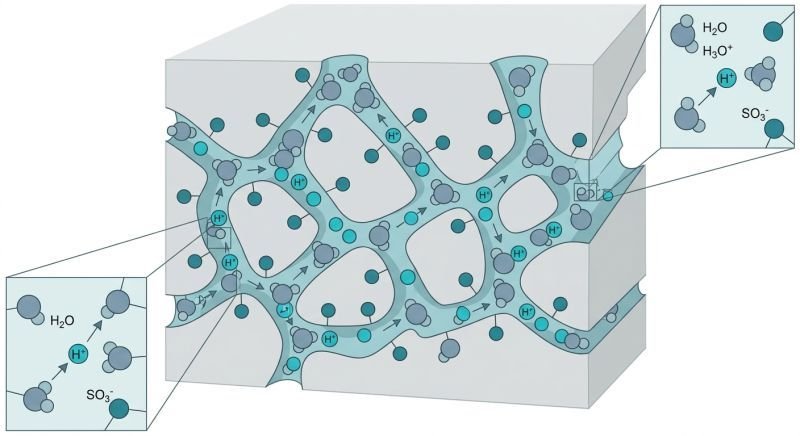
Nafion is a perfluorosulfonic acid polymer widely used as a proton-conducting membrane material in low-temperature fuel cells and related electrochemical devices. Its fluorinated backbone provides chemical and mechanical stability, while sulfonic acid side groups attract water and create ionic domains for proton transport. This microphase-separated structure enables high proton conductivity when hydrated and strong electronic insulation, which is required for efficient charge separation across a membrane-electrode assembly.
In operating stacks, Nafion performance depends on water content, temperature, and compression conditions. If hydration declines, ionic pathways contract and membrane resistance rises; if liquid water accumulates excessively, gas transport near electrodes can degrade. Engineers tune thickness, reinforcement, and humidification control to balance conductivity, durability, and crossover resistance. Within polymer electrolyte fuel cell materials science, Nafion remains a benchmark for comparing newer ionomer chemistries and composite membranes.
The concept matters because membrane material limits often govern stack lifetime, cold-start behavior, and system-level efficiency. Understanding Nafion transport and degradation behavior supports better thermal-water management strategies and more reliable long-duration operation in transport and stationary applications.
Example:
When inlet gases are humidified correctly, a Nafion-based membrane maintains lower ohmic losses and higher voltage during continuous load cycling.
Related Concepts:
- Proton Conductivity
- Ionomer Morphology
- Membrane Hydration
NoSuchDevice is a free archive of machines that do not exist yet but already have a shadow in physics. I research and write every entry alone, with no ads. Take a look around the archive, or help keep it free.