


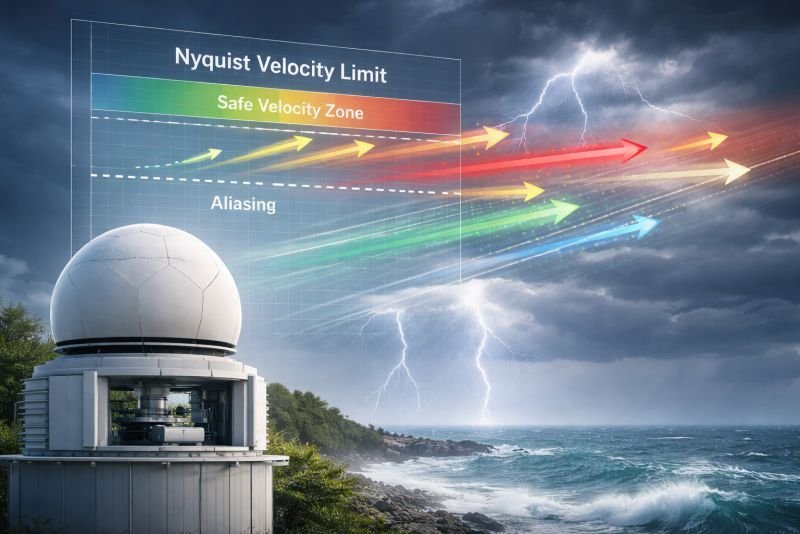
What Is Nyquist Velocity Limit?
Nyquist velocity limit is the highest speed a pulsed Doppler measurement system can detect without confusing the signal with a slower motion in the opposite direction. It appears because the instrument samples returning wave information at discrete time intervals rather than continuously. If the motion is too fast between samples, the measured phase shift wraps around and the recorded velocity becomes ambiguous.
In radar and lidar systems, the Nyquist velocity limit depends on wavelength and pulse repetition frequency. A higher pulse rate raises the unambiguous velocity range, while a longer wavelength also increases the measurable limit. In pulsed Doppler wind profiling systems, this limit matters because strong winds can exceed the instrument’s clean measurement range and produce aliasing.
The term matters in engineering because it defines a hard sampling boundary. Once that boundary is crossed, the instrument still returns a number, but the number may represent the wrong physical velocity unless correction methods such as dual-PRF sampling are used.
Example:
A pulsed lidar measuring storm winds can misread a fast inbound flow as a weaker outbound flow when the Nyquist velocity limit is exceeded.
Related Concepts:
- Doppler Shift
- Pulse Repetition Frequency
- Velocity Aliasing
NoSuchDevice is a free archive of machines that do not exist yet but already have a shadow in physics. I research and write every entry alone, with no ads. Take a look around the archive, or help keep it free.