





What Is oxygen reduction reaction?
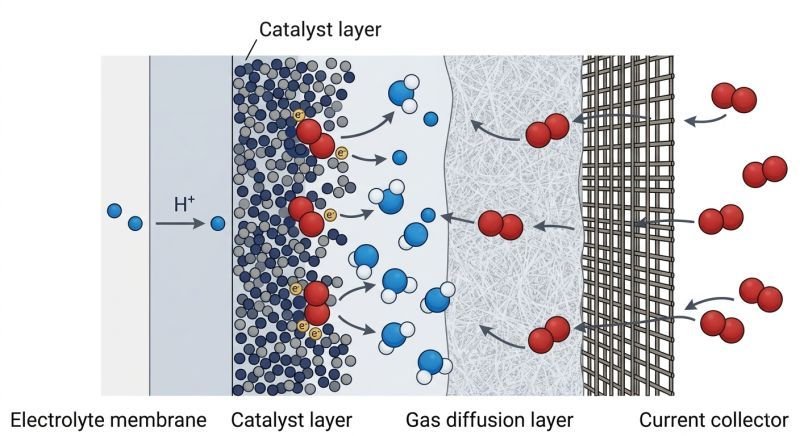
The oxygen reduction reaction is the cathodic electrochemical process where oxygen accepts electrons and combines with ions to form reaction products, typically water in acidic fuel cells. This multi-step reaction involves adsorption, bond breaking, and proton-coupled electron transfer on catalyst surfaces. Because these steps are kinetically slow, the reaction often requires significant overpotential, making it one of the dominant loss mechanisms in low-temperature fuel cell systems.
In proton-exchange devices, oxygen reduction occurs at the cathode where oxygen from air meets incoming protons and circuit electrons. Catalyst composition, particle size, and support structure strongly affect active-site availability and transport pathways through catalyst layers. Water production must be balanced with gas access to avoid flooding and diffusion limits. In cathode reaction engineering, controlling local oxygen concentration and liquid-water distribution is central to voltage retention at higher current density.
The concept matters because cathode losses from oxygen reduction largely set system efficiency, stack size, and material cost. Better ORR catalysts and electrode architectures can reduce platinum demand, raise power density, and improve durability across automotive and stationary operating cycles.
Example:
At high load, restricted oxygen transport in a wet cathode raises ORR overpotential and causes a visible drop in cell voltage.
Related Concepts:
- Cathodic Overpotential
- Platinum Catalyst
- Mass Transport Limitation
NoSuchDevice is a free archive of machines that do not exist yet but already have a shadow in physics. I research and write every entry alone, with no ads. Take a look around the archive, or help keep it free.