





What Is Peltier effect?
Peltier effect is heat absorption or heat release at an electrical junction when direct current passes through dissimilar conductive materials. Depending on current direction, one side of the junction cools while the other side warms. The heat flow is commonly modeled as Qdot = Pi * I, where Pi is the Peltier coefficient and I is current, linking thermal transfer directly to electrical drive conditions.
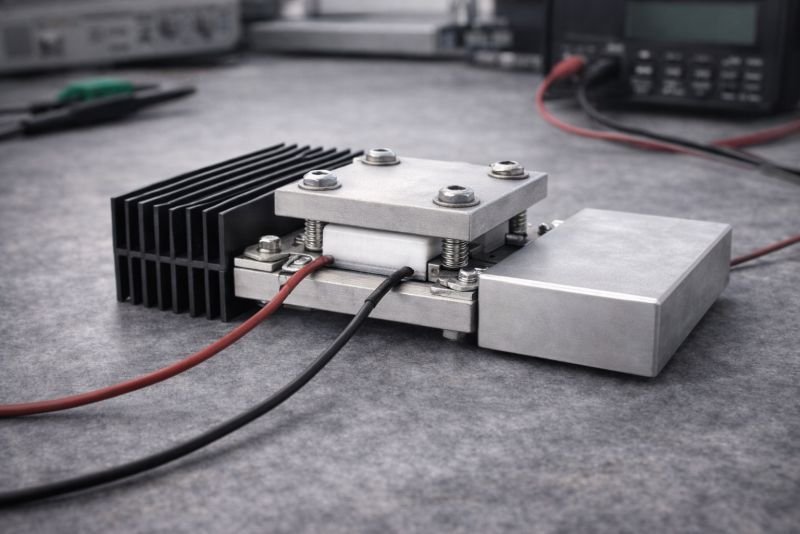
In practical thermoelectric assemblies, many p-type and n-type legs are connected electrically in series and thermally in parallel to increase total heat pumping. Real behavior includes Joule heating and thermal backflow, so performance depends on current setpoint, contact resistance, and heat sink design. These coupled effects are central in active thermoelectric temperature control technology across variable load conditions.
The concept matters because it enables compact cooling or heating without compressors, refrigerants, or moving parts in the module itself. Used in devices such as laser diode temperature stabilizers, portable vaccine carriers, and electronics spot coolers, Peltier effect supports reliable thermal management where precise control and small form factor are critical. Engineers evaluate coefficient of performance and durability tradeoffs before selecting this approach over vapor-compression systems.
Example:
A diode package in an optical instrument is held at a fixed operating temperature by reversing module current when ambient conditions change.
Related Concepts:
- Seebeck Effect
- Joule Heating
- Thermal Resistance
NoSuchDevice is a free archive of machines that do not exist yet but already have a shadow in physics. I research and write every entry alone, with no ads. Take a look around the archive, or help keep it free.