







In 2013, engineers working on the Voyager 1 power system ran calculations they already knew the answer to. The probe was 19 billion kilometers from the Sun. Solar panels were useless that far out. The only reason Voyager was still transmitting was a small device bolted to its chassis that had been converting heat into electricity continuously since 1977. No fuel was burned. No turbine spun. A temperature difference, maintained across a block of semiconductor material, had been generating current for 36 years.
That device was a thermoelectric generator. It worked in deep space because the principle behind it requires nothing except a temperature difference and the right material.
The short version: When two different electrical conductors are joined and their junctions held at different temperatures, a voltage appears across the circuit. This is the Seebeck effect, and it is the basis of thermoelectric generation. The voltage is proportional to the temperature difference and to a material property called the Seebeck coefficient, which in the best modern thermoelectric materials reaches roughly 200 to 300 microvolts per degree Celsius. That may sound small, but across a large temperature gradient and a well-designed stack of junctions, thermoelectric generators have powered spacecraft, waste heat recovery systems, and remote scientific stations with no moving parts and no maintenance.
Table of Contents
How Charge Carriers Respond to a Temperature Gradient
The thermoelectric effect is not a chemical reaction. No fuel is consumed. The mechanism is purely physical, rooted in the behavior of electrons inside a conducting material when one end of that material is hotter than the other.
In any conductor or semiconductor, electrons are in constant thermal motion. Their average kinetic energy is proportional to temperature. Heat one end of a copper rod and the electrons at the hot end move faster than those at the cold end. Faster electrons diffuse toward the cold end, carrying their charge with them. As the cold end accumulates excess electrons, an electric field builds up opposing further diffusion. The material reaches an equilibrium where the electric force pushing electrons back toward the hot end balances the thermal pressure driving them toward the cold end. That equilibrium state contains a voltage difference between the two ends.
This is the Seebeck effect. It was first observed in 1821 by Thomas Johann Seebeck, who noticed that a compass needle deflected when two dissimilar metals were joined at two junctions held at different temperatures. He interpreted it as a magnetic effect. Later analysis established that what he had observed was a voltage driving a current, which in turn generated the magnetic field.
The critical insight is that a single material cannot produce useful work from this voltage. The electrons that diffuse to the cold end cannot go anywhere without a circuit. Connect the two ends of the rod through an external load and current flows, but only if the circuit is closed through a different material. The voltage in the two materials in series either adds or subtracts depending on the sign and magnitude of their respective Seebeck coefficients.
This is why thermoelectric devices are always built from pairs of materials: one where electrons are the dominant charge carrier (n-type semiconductor) and one where positive “holes” carry charge in the opposite direction (p-type semiconductor). Connect them in series electrically and in parallel thermally, and their voltages add.
The Seebeck Coefficient and What It Measures in a Real Material
Every material has a Seebeck coefficient, usually written as S and measured in microvolts per kelvin (uV/K). It describes how much voltage appears per degree of temperature difference across the material.
Copper, one of the best electrical conductors, has a Seebeck coefficient of roughly 1.8 uV/K. That is nearly useless for power generation. The best thermoelectric semiconductors in practical use today, materials like bismuth telluride (Bi2Te3), reach Seebeck coefficients of 200 to 300 uV/K. The difference matters enormously once you work through the numbers.
The voltage generated by a thermoelectric couple is described by:
V = S x delta T
Where V is the output voltage in volts, S is the Seebeck coefficient of the material pair in volts per kelvin, and delta T is the temperature difference between the hot and cold junctions in kelvin.
Take a bismuth telluride module with an effective Seebeck coefficient of 200 uV/K (0.0002 V/K) across a temperature difference of 200 degrees Celsius (200 K):
V = 0.0002 V/K x 200 K = 0.04 V
That is 40 millivolts from a single junction pair. A commercial thermoelectric module stacks 127 junction pairs in electrical series. The total voltage becomes:
V = 0.04 V x 127 = 5.08 V
At a typical internal resistance of around 2 ohms and with a matched external load, this module can deliver roughly 6 to 8 watts of electrical power from a 200-degree temperature difference. For a device with no moving parts and zero maintenance requirements, that figure changes character depending entirely on the application.
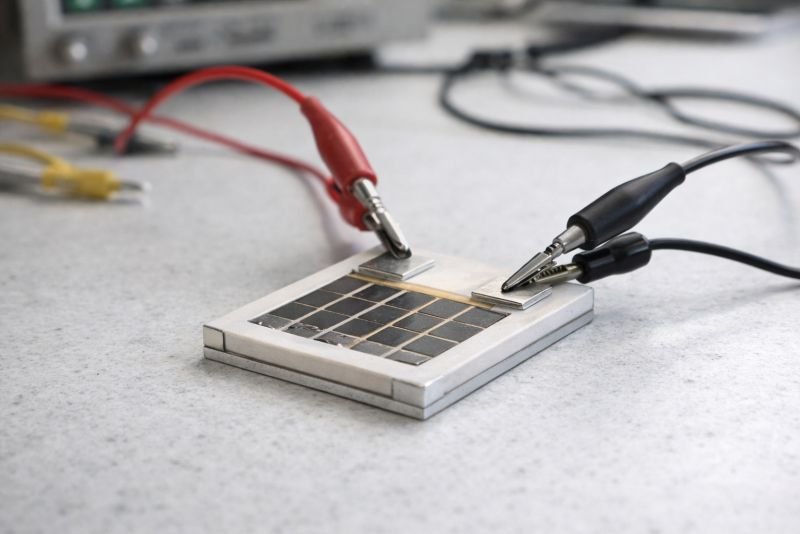
What determines whether a material is a good thermoelectric is not the Seebeck coefficient alone. A material that produces a high voltage but also conducts heat efficiently is self-defeating: heat flows rapidly from hot to cold through the material itself, collapsing the temperature difference the device depends on. A material that produces high voltage but has very high electrical resistance wastes the generated current as heat. The engineering target is a material that combines a high Seebeck coefficient, low thermal conductivity, and low electrical resistivity simultaneously. These three properties together define the figure of merit.
The Figure of Merit and Why It Is So Difficult to Maximize
The three material properties that govern thermoelectric performance combine into a single dimensionless quantity called ZT, the thermoelectric figure of merit. A higher ZT means more efficient conversion of heat into electricity.
ZT = (S^2 x sigma) / kappa x T
Where S is the Seebeck coefficient in volts per kelvin, sigma is the electrical conductivity in siemens per meter, kappa is the thermal conductivity in watts per meter-kelvin, and T is the absolute temperature in kelvin.
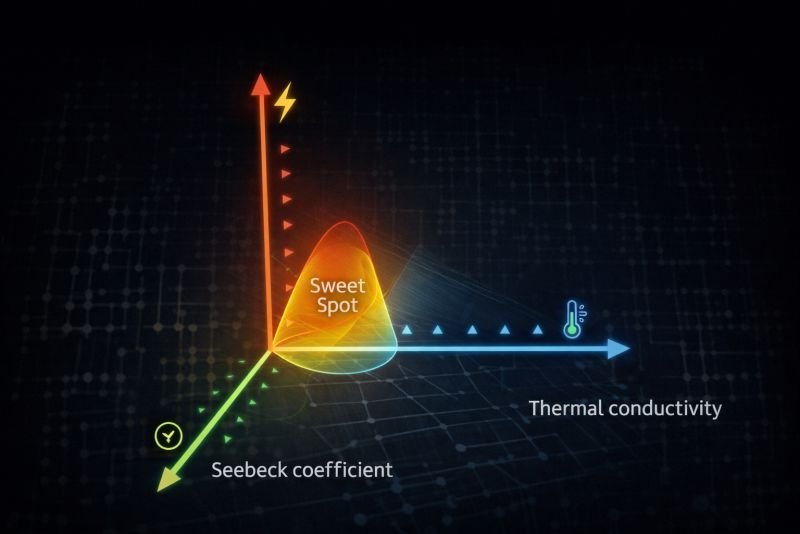
The numerator, S^2 x sigma, is called the power factor. It measures how much electrical power the material can produce per unit temperature gradient. The denominator, kappa x T, represents the thermal energy flowing through the material. The ratio captures the central engineering challenge: the same atomic-scale interactions that make a material electrically conductive tend to also make it thermally conductive. In metals, free electrons carry both charge and heat. Increasing electrical conductivity tends to increase thermal conductivity proportionally, keeping ZT low.
Semiconductors offer a partial escape from this coupling. In a carefully doped semiconductor, electrical conductivity can be tuned through carrier concentration while thermal conductivity is partly decoupled because heat is also carried by lattice vibrations (phonons) rather than electrons alone. Scattering phonons without scattering electrons is the target of most thermoelectric materials research.
| Material | ZT at Peak Temperature | Peak Temperature (C) | Primary Use |
|---|---|---|---|
| Bismuth Telluride | ~1.0 | 25 to 150 | Cooling modules, low-grade heat recovery |
| Lead Telluride | ~1.5 to 2.0 | 500 to 600 | Mid-temperature waste heat |
| Silicon-Germanium | ~0.6 to 1.0 | 900 to 1000 | Radioisotope generators (spacecraft) |
| Half-Heusler Alloys | ~1.0 to 1.5 | 400 to 700 | Industrial waste heat |
For context, a ZT of 1 corresponds to roughly 10 to 15% of the theoretical maximum efficiency (Carnot efficiency) at typical operating temperatures. A ZT of 3, which has been demonstrated in laboratory nanostructures but not in bulk practical materials, would push conversion efficiency above 20% at useful temperature differences. Commercial thermoelectric generators currently operate at 5 to 8% efficiency under real conditions.
Everything here is free. Readers are the reason it stays that way.
I make all of it alone, with no ads. If it is worth a coffee a month to you, that keeps the next one coming.
Keep it alive →Where the Carnot Limit Constrains Thermoelectric Generation
Every heat engine, whether it burns fuel, uses steam, or operates by the Seebeck effect, is bounded by the Carnot efficiency limit. This is not a limitation of engineering. It is a consequence of thermodynamics.
The maximum possible efficiency of any heat engine operating between a hot reservoir at temperature T_hot and a cold reservoir at T_cold is:
Carnot efficiency = 1 – (T_cold / T_hot)
Both temperatures must be expressed in kelvin. For a thermoelectric generator with a hot-side temperature of 500 degrees Celsius (773 K) and a cold-side temperature of 50 degrees Celsius (323 K):
Carnot efficiency = 1 – (323 / 773) = 1 – 0.418 = 0.582, or 58.2%
The Carnot limit is not what a thermoelectric generator actually achieves. It is the theoretical ceiling. A real bismuth telluride module operating across only a 150-degree difference has a Carnot limit of roughly 33%, and its actual efficiency with ZT of 1 lands around 5%. The gap between the limit and the reality is what materials research is trying to close.

The Carnot formula also explains why thermoelectric generators improve dramatically when the temperature difference is large. Spacecraft radioisotope generators use plutonium-238 as a heat source, which produces a surface temperature around 1000 degrees Celsius. Against the 4-kelvin temperature of deep space, the Carnot limit approaches 100%. The silicon-germanium materials used in those generators achieve only a fraction of that limit, but the absolute temperature difference is large enough to generate hundreds of watts continuously.
For industrial waste heat recovery, the temperature differences available are much smaller. Exhaust gases from cement kilns run at 300 to 400 degrees Celsius. Automotive exhaust pipes reach 600 to 700 degrees Celsius at load. These are real temperature differences, but they sit in a range where current thermoelectric materials recover only a few percent of the available thermal energy. That is why thermoelectric waste heat recovery in industrial settings is deployed selectively, where the cost of the module is offset by the continuous availability of heat that would otherwise be discarded.
How Engineers Design Thermoelectric Systems Around These Limits
Knowing the physics of the Seebeck effect tells a materials scientist what properties to optimize. Engineering a working thermoelectric system requires a separate set of decisions about how to manage heat flow at the system level.
The fundamental problem is thermal management. A thermoelectric module generates power in proportion to the temperature difference maintained across it. If heat flows too slowly to the hot side, the temperature drops. If heat is not removed fast enough from the cold side, the temperature rises. Either failure collapses delta T and drops power output. The module itself is not the only component that matters.
Thermal interface materials between the heat source and the hot side of the module determine how efficiently heat transfers into the ceramics. Contact resistance adds series resistance to the electrical circuit. Heat sinks on the cold side must be sized correctly for the operating environment.

In automotive thermoelectric generators, engineers wrap modules around sections of the exhaust pipe, then bond finned aluminum heat exchangers to the cold side. The modules must also survive repeated thermal cycling from cold startup to full operating temperature without fracturing. Bismuth telluride is brittle. Long-term reliability requires both mechanical design and careful thermal management.
For industrial waste heat recovery systems operating at higher temperatures, lead telluride modules can be cascaded: a high-temperature stage converts heat from 600 down to 300 degrees, and a low-temperature bismuth telluride stage converts the remaining gradient from 300 down to ambient. Each stage operates in the temperature range where its materials perform best.
What engineers cannot change is the underlying trade-off between efficiency and output power. A module with a large thermal resistance will maintain a large delta T but will not extract much heat per second, limiting absolute power output. A module with low thermal resistance extracts more heat but risks closing the temperature gap. The optimal design balances these, tuned to the specific application and the available heat source.
Peltier Cooling: The Seebeck Effect in Reverse
The Seebeck effect has a direct inverse. Drive current through a thermoelectric material pair and heat moves from one junction to the other. This is the Peltier effect, named after Jean Charles Athanase Peltier, who observed it in 1834, and it is the physical basis of thermoelectric coolers.
What causes heat to pump? When current drives electrons from the p-type to the n-type material at one junction, the electrons move to a higher energy state. They absorb heat from the junction to do so, cooling it. At the other junction, electrons return to a lower energy state and release that heat. The direction of pumping reverses with the direction of current.
Thermoelectric coolers based on this effect are found in portable refrigerators, CPU cooling systems, laboratory instruments that need precise temperature control, and medical devices. They have no moving parts, produce no vibration, and can achieve temperature differences of up to 70 degrees Celsius in single-stage configurations. Multi-stage devices reach lower temperatures but at sharply reduced efficiency.
The same figure of merit, ZT, governs cooling efficiency as governs power generation efficiency. The same materials that make good generators make good coolers. The engineering challenge for cooling applications is somewhat different: the goal is to move as much heat as possible with as little electrical input as possible, rather than to extract as much electricity as possible from a given heat flow.
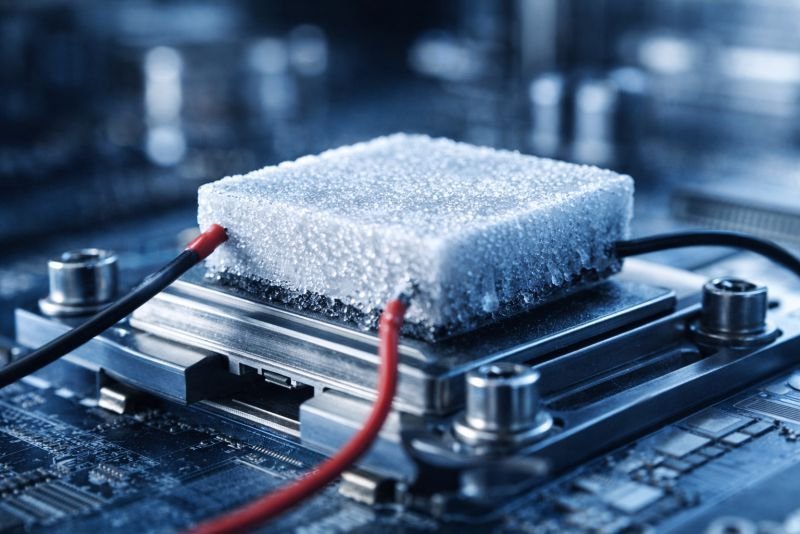
This reversibility is one of the most useful properties of thermoelectric devices. The same module can generate power when a temperature difference is imposed from the outside, or create a temperature difference when power is fed into it. Which role it plays depends only on whether thermal or electrical boundary conditions are applied.
Technologies the Thermoelectric Effect Could Enable
The thermoelectric effect is already used, but its current deployment represents a small fraction of what the physics permits. Most waste heat generated by industrial processes is discarded. Most temperature differences that exist in the built environment, in oceans, in geothermal gradients, and in biological systems remain untapped.

The constraint is always materials: existing thermoelectric materials are either too expensive, too fragile, too toxic (lead, tellurium), or too inefficient at the temperature ranges where the most abundant waste heat exists. If materials with ZT above 3 become manufacturable at scale, the economics of thermoelectric generation change substantially. A single steel plant discards enough heat to power thousands of homes. Automotive exhaust alone in the United States represents tens of gigawatts of thermal energy cycling through pipes and into the air.
Body heat thermoelectric wearables, harvesting the 50 to 100 milliwatts of power available from the temperature difference between skin and air, could power low-energy sensors and medical monitoring devices indefinitely. Satellite and spacecraft design would shift if lighter, higher-efficiency thermoelectric generators became available. Deep-sea thermoelectric generators exploiting the temperature gradient between warm surface water and cold deep water could power autonomous ocean monitoring networks.
The thermoelectric effect does not require combustion, does not require sunlight, and does not require wind. It requires only that two sides of a material be at different temperatures. That condition is met continuously in almost every industrial, biological, and geophysical system on Earth. The question is whether the materials to exploit it efficiently will be engineered in time to matter.
You read the whole thing.
That is rarer than it should be, and it is the exact kind of attention I built this archive for. I make every piece alone, with no ads and no investor deciding what gets written. If you want the next machine taken apart like this one, you can help me make it.
A coffee a month is enough to keep it free for everyone.
Prefer crypto or a one time gift? Other ways to give →
Technologies Related to This Concept
| Technology | Concept |
|---|---|
| Motion-Powered Earbuds | Concept: Earbuds that harvest energy from head movements to stay charged. |
| Piezoelectric and Thermoelectric Hybrid Footpaths | Concept: Combining piezoelectric and thermoelectric technologies in footpaths to maximize energy harvesting. |
| Thermoelectric Building Materials | Concept: Materials that convert temperature differences in buildings into electricity. |
| Thermoelectric Roads Utilizing Temperature Differences | Concept: Roads that generate power from the temperature difference between surface and subsoil. |
| Bio-Reactors Employing Thermoelectric Generators | Concept: Using temperature differences in reactors to generate additional electricity. |