



What Is Phased-array Antenna?
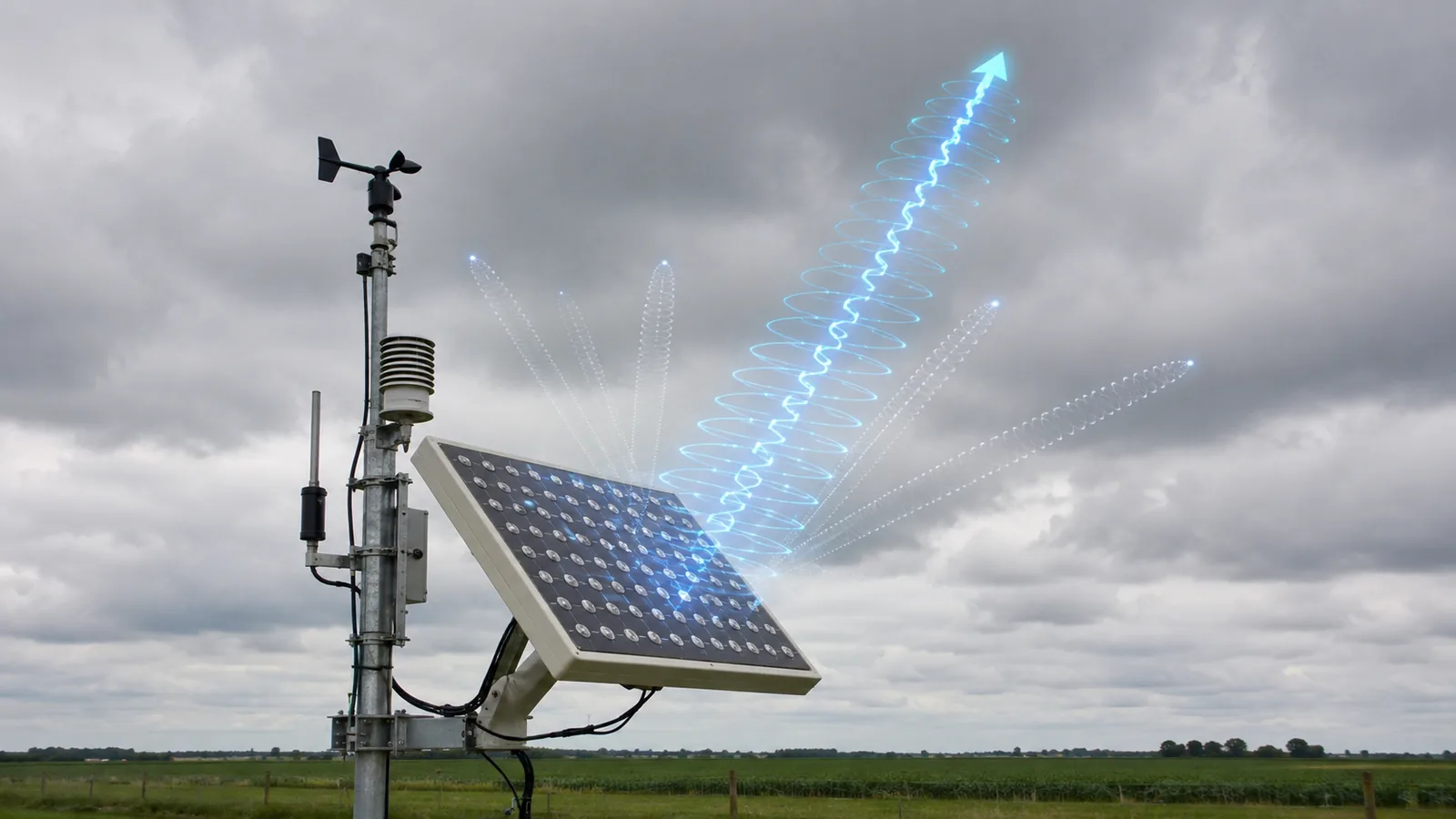
Phased-array antenna is an antenna system made from many radiating elements whose signals are timed with controlled phase shifts. Instead of mechanically turning a dish, the array steers its beam by changing how waves from different elements add or cancel. A simple steering relation is Delta phi = 2 pi d sin(theta) / lambda, where d is element spacing and lambda is wavelength.
In real systems, phase control shapes beam direction, width, side lobes, and power distribution. Arrays can scan rapidly, track multiple targets, or hold energy on a selected volume while adapting to interference and changing geometry. They support atmospheric electromagnetic systems when directed fields or radar measurements must be aimed without moving large hardware. Used in devices include radar panels, satellite terminals, 5G base stations, radio telescopes, aircraft sensors, and electronic warfare receivers.
The concept matters because it turns wave interference into a control mechanism. Engineers use phased arrays wherever speed, precision, compactness, or multi-beam operation matters more than simple fixed radiation. Their performance depends on calibration, element spacing, amplifier linearity, thermal drift, and signal-processing algorithms.
Designers also manage grating lobes by keeping spacing small enough relative to wavelength for the required scan angle.
Example:
A weather radar can electronically sweep a phased-array antenna beam across a storm cell faster than a rotating dish can scan the same volume.
Related Terms:
- Beamforming
- Radar
- Electromagnetic Field
NoSuchDevice is a free archive of machines that do not exist yet but already have a shadow in physics. I research and write every entry alone, with no ads. Take a look around the archive, or help keep it free.