



What Is Radial Velocity?
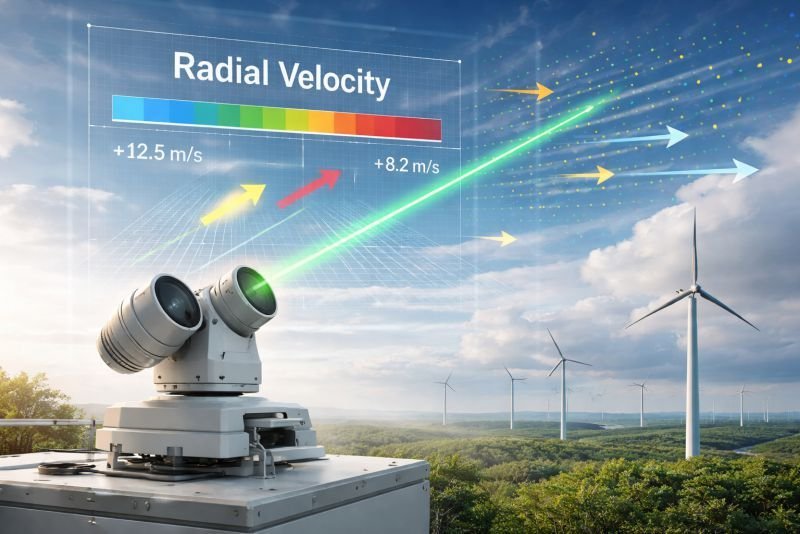
Radial velocity is the component of an object’s motion measured directly along the line between the observer and the object. In atmospheric sensing systems, it describes how fast airborne particles are moving either toward or away from a sensor along the direction of an emitted measurement beam. This directional velocity is extracted from the frequency shift of reflected electromagnetic waves.
Because radial velocity captures motion only along the beam axis, it represents just one part of the full wind vector. Instruments such as Doppler lidar reconstruct the complete horizontal wind speed by measuring radial velocity from multiple beam directions within Doppler lidar wind profiling systems.
Radial velocity plays a central role in remote sensing, astronomy, radar meteorology, and atmospheric wind measurement because it allows scientists to determine motion without physically contacting the moving medium.
Example:
A scanning lidar determines the horizontal wind vector by combining radial velocity measurements taken from several beam angles.
Related Concepts:
- Doppler Shift
- Wind Vector
- Velocity Azimuth Display
NoSuchDevice is a free archive of machines that do not exist yet but already have a shadow in physics. I research and write every entry alone, with no ads. Take a look around the archive, or help keep it free.