






What Is Resonance Frequency?
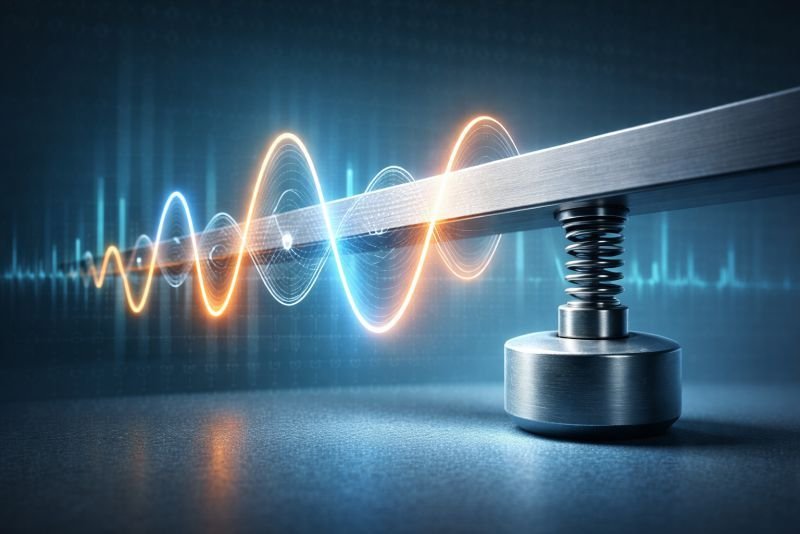
Resonance frequency is the natural frequency at which a physical structure vibrates with the greatest amplitude when subjected to a periodic force. Every mechanical system – from a bridge cable to a microscopic beam – has one or more frequencies where energy input is transferred into motion with unusually high efficiency. At this point, even a small driving force can produce large oscillations because the timing of the force matches the system’s internal dynamics.
The value of the resonance frequency depends on factors such as mass distribution, stiffness, geometry, and damping. Engineers often design systems either to exploit resonance for energy transfer or to avoid it when large oscillations could cause mechanical damage.
In domains such as vibration-based piezoelectric energy harvesting systems, devices are deliberately tuned so that their resonance frequency matches common environmental vibrations, allowing small mechanical motions to produce measurable electrical output.
Example:
A cantilever beam mounted on a vibrating machine produces its strongest oscillations when the machine’s vibration matches the beam’s resonance frequency.
Related Concepts:
- Harmonic Oscillation
- Mechanical Damping
- Natural Frequency
NoSuchDevice is a free archive of machines that do not exist yet but already have a shadow in physics. I research and write every entry alone, with no ads. Take a look around the archive, or help keep it free.