




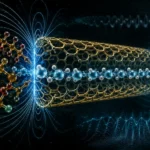


Imagine a floor tile that generates electricity with every footstep. Not through solar panels. Not through heat. Just through the simple, ordinary pressure of a shoe sole hitting the ground. The tile contains no moving parts, no fuel, no wires running to a power station. It contains a crystal. And that crystal, when squeezed, does something strange: it pushes electrons.
This is not science fiction. It is already happening in Tokyo train stations, in Tel Aviv sidewalks, in sports stadiums across Europe. The underlying principle is called the piezoelectric effect, and it was first documented in 1880 by brothers Pierre and Jacques Curie. Pierre Curie would go on to share the Nobel Prize in physics, and later lend his name to one of the most important temperature limits in materials science. But in 1880, what the brothers had discovered was something almost magical: press on a quartz crystal, and it produces a measurable voltage. Apply a voltage to that same crystal, and it bends.
For most of the 20th century, this effect powered precision clocks, sonar systems, and ultrasound machines. Now engineers are asking a bigger question. What if you could harvest all the mechanical energy the world throws away every single second – vibrating bridges, rattling engines, rhythmic footsteps – and turn it directly into electricity? No combustion. No turbines. No carbon.
Table of Contents
Understanding the Piezoelectric Effect
To understand why this works, you have to go very small. Not just small like a grain of sand. Small like a single atom and its neighbours.
Every solid material is built from atoms arranged in a repeating pattern called a crystal lattice. In most materials, the positive charges (atomic nuclei) and negative charges (surrounding electrons) are distributed so symmetrically that they cancel each other out perfectly. The material sits there, electrically neutral, completely indifferent to being squeezed.
But certain materials have a lattice with no centre of symmetry. The arrangement of atoms is slightly lopsided. In quartz – silicon dioxide, the same material in beach sand and glass – the silicon and oxygen atoms sit in a helical arrangement that has no mirror-equivalent centre. In lead zirconate titanate, a synthetic ceramic known everywhere as PZT, a lead atom sits at the corner of a cube while a titanium or zirconium atom sits slightly off-centre inside it.
When you press on these materials, the lattice deforms. The atoms shift position. And because the arrangement was already asymmetric, that shift moves the positive ions slightly away from the negative ions. Suddenly, within each tiny unit cell of the crystal, there is a separation of charge: a positive end and a negative end. Physicists call this an electric dipole.
Now multiply that by approximately 10 to the power of 22 – the number of unit cells in a cube of PZT roughly the size of a sugar cube. Every one of those microscopic dipoles is pointing in the same direction. Their electric fields add together. At the surface of the material, electrons pile up on one face and are depleted on the other. Connect two electrodes to those surfaces, and current flows.
The maths behind the moment
The relationship between stress and electrical output is captured in a beautifully simple equation:
P = d x T
P is the polarisation that develops at the surface (measured in coulombs per square metre). T is the mechanical stress applied to the material (measured in pascals, or newtons per square metre). And d is the piezoelectric coefficient – the number that tells you how good a particular material is at this conversion, measured in coulombs per newton (C/N).
For quartz, d is about 2.3 picocoulombs per newton. A picocoulomb is 0.000000000001 coulombs. Quartz is precise and extremely stable, which is why it runs your wristwatch to an accuracy of a few seconds per month. But it is not a power generator.
For PZT, d climbs to between 400 and 600 picocoulombs per newton. That is roughly 200 times more charge per unit of force. Squeeze a piece of PZT and you get a real, usable pulse of electricity. This is why PZT shows up in everything from hospital ultrasound probes to the igniter in your gas cooker.
Why Some Crystals Are Better Than Others
Not every material that lacks a centre of symmetry becomes a practical energy source. The difference between a laboratory curiosity and a useful device comes down to a handful of measurable properties, and understanding them reveals why researchers have spent decades searching for the perfect piezoelectric material.
The coupling factor: how much energy actually crosses over
Imagine pressing a spring attached to a generator. Some of the energy you put into compressing the spring comes back out as electricity. The rest stays in the spring as mechanical deformation or leaks away as heat. The electromechanical coupling factor, written as k, measures exactly this ratio.
k squared = electrical energy converted / total mechanical energy input
For PZT, k ranges from about 0.65 to 0.75. That means up to 75% of the mechanical energy stored in the material under stress can cross over into electrical energy. The other 25% stays mechanical. For comparison, a typical electromagnetic generator in a power station converts mechanical rotation to electricity at efficiencies above 95%. Piezoelectric materials are less efficient at peak conversion, but they win in different ways: no moving parts, no bearings, no lubrication, no maintenance, and they work at scales where spinning a turbine is simply impossible.
Resonance: the sweet spot where output spikes
Every physical object has a natural frequency at which it prefers to vibrate. Push a swing at exactly the right rhythm and it swings higher with each cycle. The same principle applies to a piezoelectric beam clamped at one end – a configuration called a cantilever harvester.
At resonance, the beam’s vibration amplitude is maximised for a given driving force, and the electrical output rises dramatically. For a beam a few centimetres long, resonance typically falls between 30 and 300 Hz – which is excellent news, because vibrations from machinery, traffic, and human movement cluster in exactly this range. The challenge engineers face is that resonance is a narrow peak. A harvester tuned to 100 Hz produces very little power when the dominant vibration in its environment shifts to 80 Hz. This is one of the field’s central unsolved problems.

The Curie temperature: the one limit you cannot ignore
Here is the catch with piezoelectric ceramics. Heat them past a certain critical temperature and the asymmetric crystal structure that makes them piezoelectric collapses. The atoms rearrange into a more symmetric configuration, the dipoles disappear, and the material becomes electrically inert. This critical point is called the Curie temperature, named – again – after Pierre Curie, who discovered it.
For PZT, the Curie temperature sits between 150 and 350 degrees Celsius depending on the exact composition. That sounds high until you consider applications near jet engines, industrial furnaces, or even the exhaust systems of cars. At those temperatures, PZT simply stops working. Engineers working in high-heat environments turn to other materials: aluminium nitride (AlN) thin films maintain their piezoelectric properties past 1000 degrees Celsius, making them candidates for sensors embedded directly in turbine blades.
Five Materials, Five Different Worlds
The table below captures the tradeoffs that make material choice in piezoelectric engineering so consequential. No single material wins across every dimension, which is why researchers keep hunting for something better.
| Material | Charge Output (d, pC/N) | Max Temperature (°C) | What It Is Good For |
| Quartz | ~2.3 | > 550 | Ultra-stable frequency references, precision sensors. Your watch runs on this. |
| PZT ceramic | 400 – 600 | 150 – 350 | The workhorse. Ultrasound, igniters, harvesters, actuators. Highest output, but contains lead. |
| PVDF polymer | ~30 – 35 | ~80 | Flexible film you can sew into clothing or wrap around curved surfaces. Low output but huge versatility. |
| BaTiO3 | ~100 – 190 | ~120 | Lead-free alternative for moderate applications. A strong candidate for future medical devices. |
| AlN thin film | ~3 – 5 | > 1000 | Works in extreme heat. Used in MEMS sensors and research into turbine blade monitoring. |
From Crystal to Circuit: What a Real Harvester Looks Like
A piezoelectric energy harvester is not glamorous to look at. The most common design is a thin strip of PZT or PVDF, roughly the size and shape of a tongue depressor, clamped firmly at one end and free to wobble at the other. A small weight is glued to the free end to bring the resonance frequency down into the range of ambient vibrations. Two thin metal electrodes sandwich the piezoelectric layer. Wires connect those electrodes to a circuit.
When the whole assembly sits on a vibrating surface – the casing of an industrial pump, the floor of a train carriage, the chassis of a car – the beam bends back and forth at the vibration frequency. Each bend stretches one surface of the piezoelectric layer and compresses the other. Charge separates. Current flows through the circuit. A small capacitor stores the accumulated charge until there is enough to power a sensor, transmit a data packet, or charge a battery.
How much power can you actually get?
This is the question every engineer asks before committing to a design. The answer depends on the size of the harvester, the strength of the vibration source, and how well the resonance frequency is matched. A rough estimate for a cantilever harvester operating at resonance is:
P = (1/2) x k^2 x m x (excitation amplitude x frequency)^2 / (4 x damping ratio x natural frequency)
In practice, what this means: a MEMS-scale harvester with a proof mass of half a gram, operating at 100 Hz with a vibration amplitude of 25 micrometres, generates roughly 10 to 100 microwatts. That sounds tiny – and for lighting a room, it is. But a modern ultra-low-power temperature sensor, combined with a wireless transmitter, needs only about 10 microwatts to measure, process, and broadcast data every few seconds. The numbers match.
Scale up to a harvester the size of your palm embedded in a road surface, and every passing car produces a pulse of several milliwatts. A busy urban intersection with 1,000 vehicles per hour, each triggering a 5-milliwatt pulse for half a second, delivers roughly 700 watt-hours per day – enough to run the traffic signal system through the night without touching the grid.

The impedance problem nobody tells you about
There is a subtler engineering challenge hiding inside every piezoelectric circuit. A PZT element behaves electrically like a small capacitor – it stores charge rather than delivering a steady current. To extract maximum power, the load connected to the harvester must have an electrical resistance that matches the internal impedance of the source. At 100 Hz with a typical PZT capacitance of 10 nanofarads, that optimal resistance is:
R_opt = 1 / (2 x pi x 100 Hz x 10 nF) = approximately 160 kilohms
Standard electronic circuits do not naturally present 160 kilohms as a load. Bridging that gap requires specialised power electronics – synchronised switch harvesting circuits, for example, that briefly short the piezoelectric element at precisely the right moment in each vibration cycle to maximise charge extraction. This is an active research area, and improvements here could double the effective output of existing harvesters without changing the piezoelectric material at all.
Everything here is free. Readers are the reason it stays that way.
I make all of it alone, with no ads. If it is worth a coffee a month to you, that keeps the next one coming.
Keep it alive →Engineering Limits of Piezoelectric Energy Harvesting
Piezoelectric technology is not finished. Three challenges in particular separate where the science is today from where engineers want it to be.
Getting rid of the lead
PZT contains lead – a toxic heavy metal that accumulates in soil and groundwater, damages the nervous systems of children, and is banned from most consumer electronics in Europe and increasingly elsewhere in the world. The European Union’s RoHS directive has granted piezoelectric ceramics a temporary exemption specifically because no adequate replacement exists. But that exemption will not last forever.
Researchers have been working on lead-free alternatives for twenty years. Barium titanate (BaTiO3) and potassium sodium niobate (KNN) both show genuine promise, but neither matches PZT on all performance dimensions at once. Understanding exactly why lead is so effective – why the specific size and electronic character of the lead ion sitting at the corner of the PZT unit cell produces such exceptional piezoelectric behaviour – remains one of the deeper open questions in solid-state chemistry.
Harvesting across a wide frequency range
The vibration frequency of the world is not constant. The engine in a car revs up and down. Footfall patterns change. Wind gusts at irregular intervals. A harvester tuned to a single resonance frequency behaves like a radio antenna tuned to exactly one station: it captures its target brilliantly and misses everything else.
Several approaches are being explored: arrays of cantilevers each tuned to a different frequency, nonlinear mechanical designs that produce a broader response peak, and active systems that mechanically adjust their own stiffness to chase the dominant frequency in the environment. None has yet achieved the combination of broad bandwidth and high peak efficiency that a practical mass-market harvester would need.
How long do they last?

Bend a piezoelectric beam a million times and it is probably fine. Bend it a billion times and you start to see fatigue. The crystal domains – regions of aligned dipoles inside the material – gradually drift under cyclic mechanical and electrical stress, softening the piezoelectric response over years. For a sensor embedded in a concrete pillar that is expected to monitor structural health for decades without replacement, this is a serious concern. Quantifying the long-term degradation rate under real-world conditions, and developing material treatments that slow it, is ongoing work in laboratories from Zurich to Tokyo.
Future Applications of the Piezoelectric Effect
The piezoelectric effect is 144 years old. For most of that time, it lived inside specialist devices: sonar arrays, precision oscillators, medical imaging equipment. What has changed is the world around it.
The Internet of Things is creating demand for billions of sensors deployed in locations where replacing batteries is completely impractical – buried in concrete, mounted on rotating machinery, injected into the human body. At the same time, the power consumption of microelectronics has collapsed. A sensor node that needed a watt in 2005 now needs a microwatt. The gap between what a piezoelectric harvester can produce and what a useful device needs to run has quietly closed.
Heartbeats as a power source

Cardiac pacemakers keep roughly 1.5 million people alive every year. Each one contains a battery that lasts 7 to 12 years. When the battery dies, the patient undergoes surgery to replace the device. It is a procedure with real risks, especially for elderly patients. Piezoelectric films bonded to the surface of the heart muscle can harvest energy directly from the rhythmic contraction of the myocardium – the same motion the pacemaker is regulating. Early animal studies have demonstrated that this approach can generate enough power to run the electronics of a modern pacemaker indefinitely. If it translates to humans, it eliminates the battery replacement surgery entirely.
Shoes that charge your phone
Human walking generates roughly 1 to 5 watts of recoverable mechanical energy at the knee and heel with every step. Thin flexible PVDF films laminated inside a shoe sole can capture a fraction of that energy with each footfall. Current prototypes produce around 1 to 4 milliwatts of average power during walking – not enough to charge a smartphone quickly, but more than enough to power a continuous health monitor tracking heart rate, blood oxygen, and location. The shoe becomes the battery. The motion is the fuel.
Bridges that monitor themselves
Every major bridge in the world undergoes periodic inspection by engineers who tap, probe, and scan its structure looking for cracks and fatigue. It is slow, expensive, and imperfect. Embedding piezoelectric sensor nodes throughout a bridge’s concrete and steel creates a nervous system for the structure itself. Each node harvests energy from the vibrations caused by traffic, wind, and thermal expansion. Each node continuously monitors the acoustic signature of the material around it, transmitting alerts if the vibration pattern changes in ways that suggest developing damage. The bridge stops being a passive object and starts being an active participant in its own safety.
You read the whole thing.
That is rarer than it should be, and it is the exact kind of attention I built this archive for. I make every piece alone, with no ads and no investor deciding what gets written. If you want the next machine taken apart like this one, you can help me make it.
A coffee a month is enough to keep it free for everyone.
Prefer crypto or a one time gift? Other ways to give →
Technologies Related to This Concept
| Technology | Concept |
| Motion-Powered Earbuds | Concept: Earbuds that harvest energy from head movements to stay charged. |
| Energy-Generating Staircases: What Happens When a Building Starts Paying for Its Own Lights | Concept: Staircases in homes or offices that capture energy from footfalls. |
| Energy-Generating Noise Barriers with Piezoelectric Materials | Barriers that produce electricity from sound vibrations. |
| Bio-Reactors with Integrated Piezoelectric Sensors | Sensors that harvest energy from vibrations for reactor monitoring. |
| Energy-Generating Car Parks with Piezoelectric Flooring | Parking lots that generate power from vehicle movement. |