






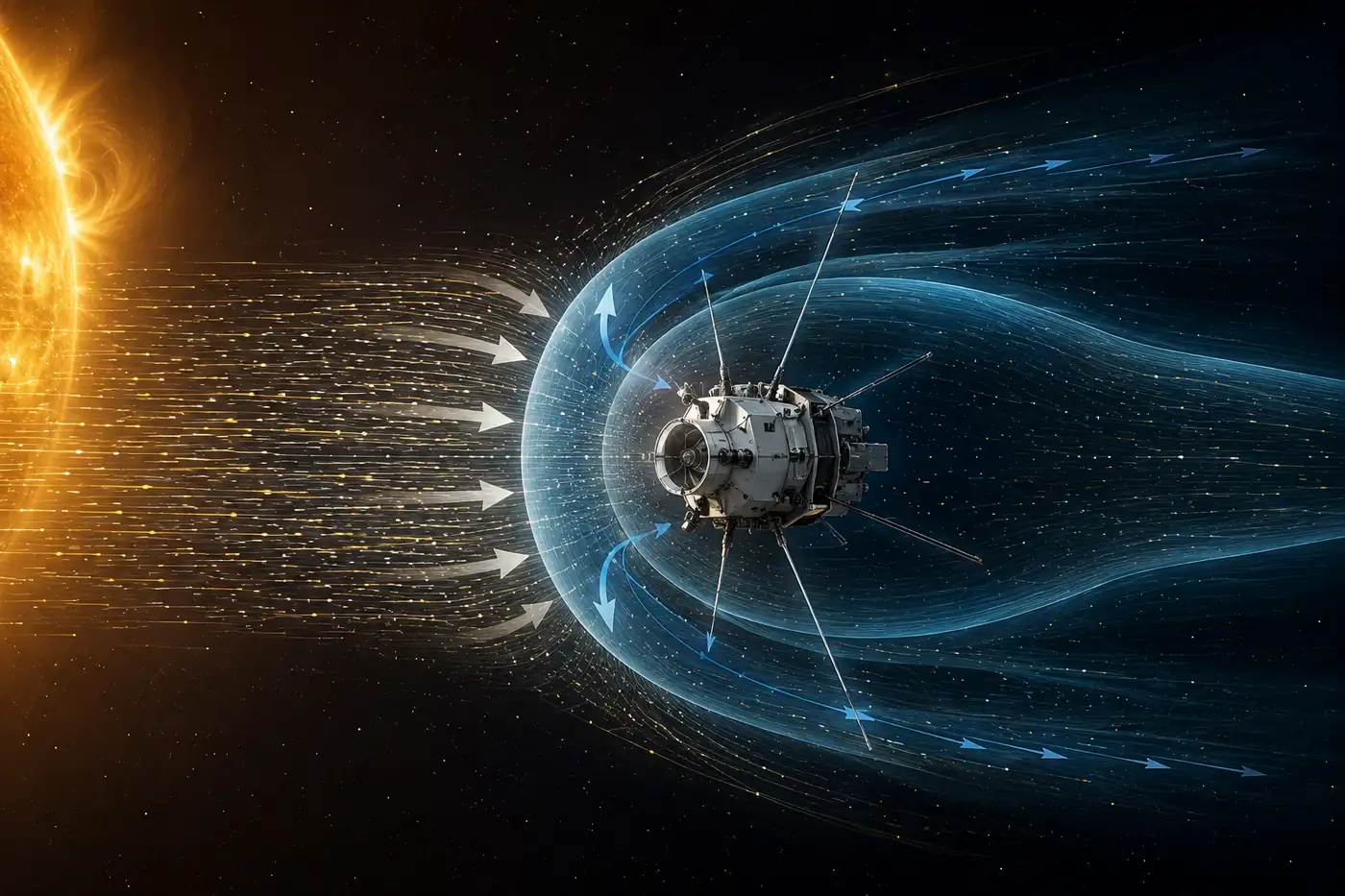
What Is Solar wind ram pressure?
Solar wind ram pressure is the dynamic pressure exerted by the solar wind as its moving plasma transfers momentum to magnetic fields, atmospheres, or obstacles. It depends on particle mass density and speed, so a common form is P_ram = rho v^2. Faster or denser plasma produces a larger mechanical effect.
In real space environments, ram pressure changes with solar activity, coronal mass ejections, stream interactions, and distance from the Sun. It can compress magnetospheres, move boundary layers, and increase particle flux at spacecraft. Used in devices include plasma monitors, space-weather instruments, magnetic sails, and magnetohydrodynamic energy converters.
The concept matters because it connects a thin plasma stream to measurable forces and boundary motion. In solar wind energy capture, ram pressure sets the momentum available to a magnetic collector and the load that station-keeping must resist. It also helps forecast geomagnetic activity and spacecraft charging risk.
Measurements combine particle density, ion composition, and bulk velocity from solar wind monitors. Engineers use those values to estimate pressure loads, field standoff distance, and event-driven changes in plasma power flux.
Example:
During a coronal mass ejection, increased solar wind ram pressure can push Earth’s magnetopause closer to the planet.
Related Terms:
- Power Density
- Energy Density
- Bow Shock
NoSuchDevice is a free archive of machines that do not exist yet but already have a shadow in physics. I research and write every entry alone, with no ads. Take a look around the archive, or help keep it free.