



What Is Superconducting loop?
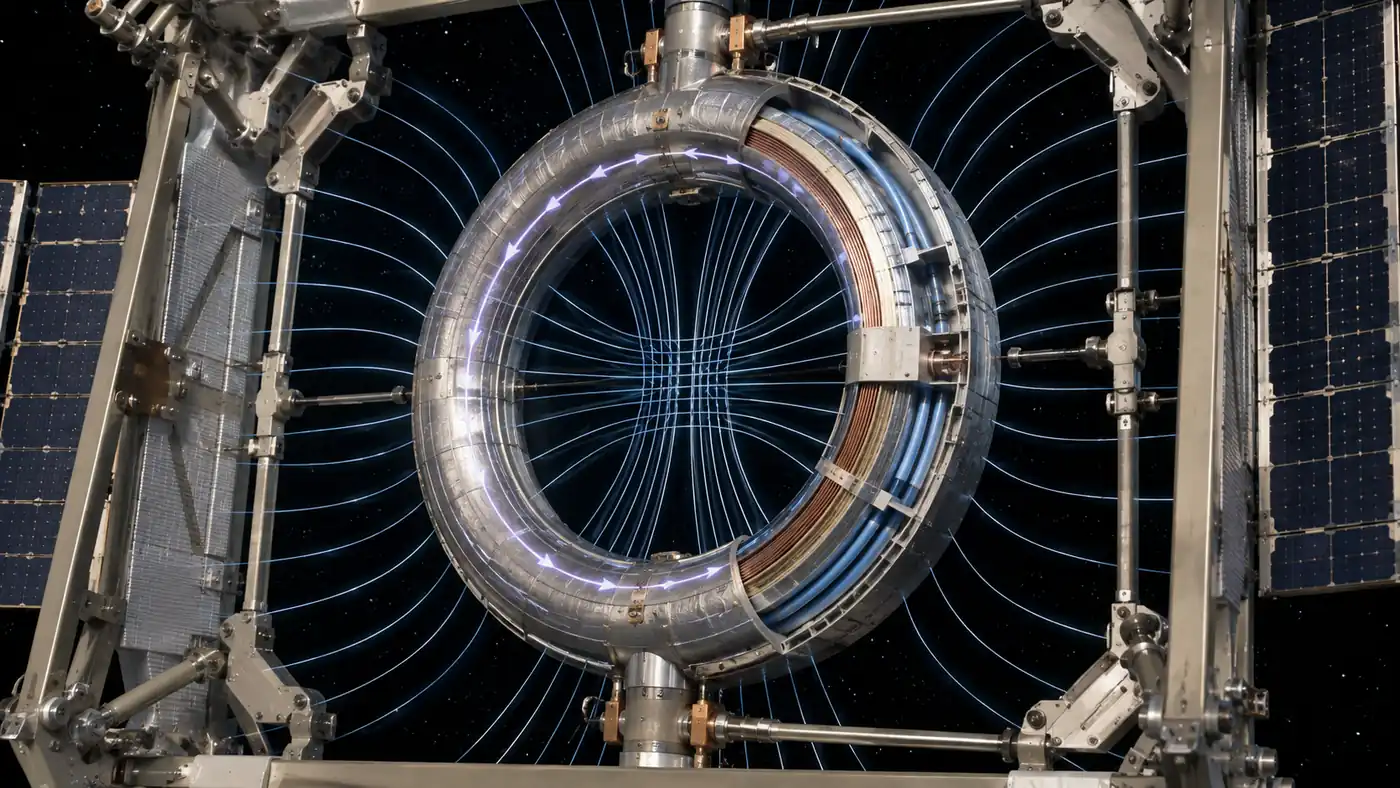
Superconducting loop is a closed circuit made from material that can carry electrical current with zero DC resistance below its critical conditions. Once current is established, it can persist with very low loss and create a stable magnetic field. The stored magnetic energy is often written as U = 1/2 L I^2.
In real systems, the loop must remain below its critical temperature, critical current, and critical magnetic field. If any limit is exceeded, a quench can convert part of the conductor back to a resistive state. Used in devices include MRI magnets, particle accelerators, superconducting magnetic energy storage, and large magnetic-field spacecraft concepts.
The concept matters because it allows strong magnetic fields without continuous resistive heating. In space electromagnetic systems, a superconducting loop can maintain a large interaction field while consuming little operating power. Similar loops support precision sensors, fusion magnets, and field-generating structures where ordinary conductors would overheat.
Engineers characterize superconducting loops by inductance, persistent current, cryogenic margin, quench protection, and magnetic-field geometry. Mechanical stress is also important because large currents create strong forces inside the coil.
Example:
A superconducting loop in a cryogenic magnet can maintain high current while producing a strong field for particle guidance.
Related Terms:
NoSuchDevice is a free archive of machines that do not exist yet but already have a shadow in physics. I research and write every entry alone, with no ads. Take a look around the archive, or help keep it free.