



What Is Tidal current?
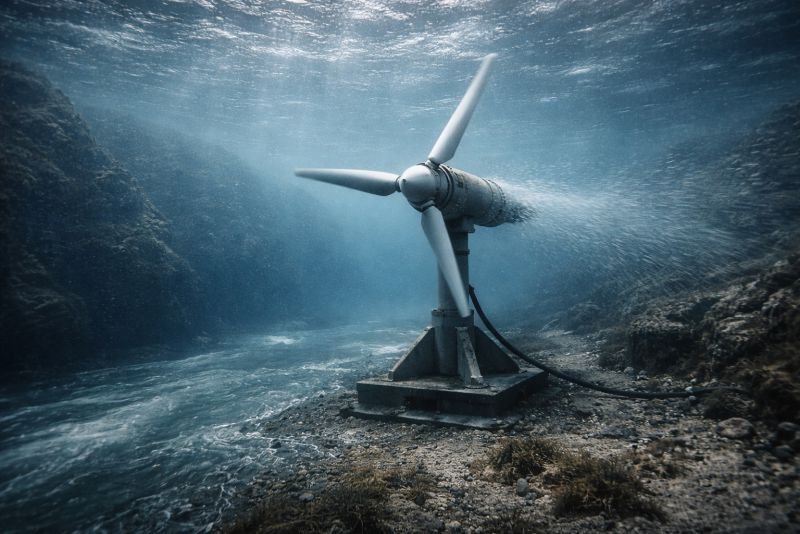
Tidal current is the horizontal movement of seawater driven by changing tide levels and phase differences across coasts, channels, and estuaries. Instead of storing energy in height difference, a stream site offers kinetic energy in moving water. Turbine power is commonly estimated with P = 0.5 rho A v^3 Cp, so a modest increase in current speed produces a much larger increase in extractable power.
In practice, the fastest tidal currents occur where large water volumes are squeezed through narrow passages or around headlands. The flow reverses with ebb and flood, but well-designed rotors can generate in both directions. Local seabed shape, friction, and upstream forcing from Tidal Force determine whether a site delivers weak drift or machine-scale velocities for turbines. Sites above about 2 to 3 metres per second attract the most engineering attention.
The concept matters because current speed is the main economic filter for tidal stream projects. In marine current energy engineering, developers use velocity distributions, turbulence levels, and depth profiles to size rotors, predict fatigue loading, and estimate how much extraction can occur before the flow slows enough to reduce returns.
Example:
An underwater turbine in a narrow strait can produce several times more power after peak acceleration than the same rotor would in a broad sheltered bay.
Related Concepts:
- Power Coefficient
- Flood Tide
- Ebb Tide
NoSuchDevice is a free archive of machines that do not exist yet but already have a shadow in physics. I research and write every entry alone, with no ads. Take a look around the archive, or help keep it free.