



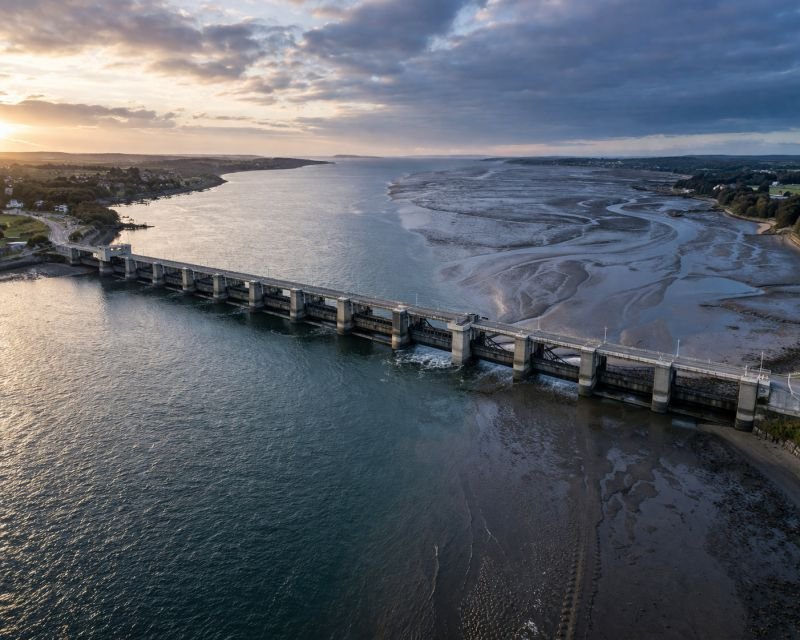
Off the coast of Brittany, at the mouth of the Rance river estuary, a 750-metre concrete dam has been generating electricity since 1966. Twice a day, without fail, the Atlantic tide rises against its face. Twice a day it falls. For nearly six decades the structure has harvested that movement, producing around 540 gigawatt-hours of electricity annually. No fuel arrives by tanker. No grid operator worries about cloud cover or wind forecasts. The power simply comes, pulled out of the water by the same force that has governed ocean tides since long before humans existed.
The short version: Tidal energy works because the Moon’s gravity stretches Earth’s oceans into a bulge that follows the lunar orbit, creating two high tides and two low tides roughly every 24 hours. The difference in water height between high and low tide creates a pressure head that can drive turbines, while tidal currents can spin underwater rotors directly. A 10-metre tidal range across a 1 square kilometre basin holds enough potential energy to generate around 139,000 kilowatt-hours per tidal cycle. Because tidal patterns are governed by orbital mechanics, tidal energy output can be predicted years in advance, making it unlike any other renewable source.
Table of Contents
How Lunar Gravity Pulls the Oceans Out of Shape
Gravity does not pull uniformly. The Moon exerts a stronger gravitational pull on the side of Earth facing it than on the side facing away. That difference, tiny compared to Earth’s own surface gravity but applied across an entire ocean, is enough to deform the water surface.
The result is a pair of oceanic bulges. One forms on the side of Earth directly facing the Moon, where lunar gravity is strongest. A second forms on the opposite side, where the centrifugal effect of Earth-Moon orbital rotation slightly outweighs the weaker lunar pull. As Earth rotates beneath these two bulges over roughly 24 hours, any given point on the coastline passes through two high tides and two low tides. The Sun adds its own smaller tidal force, roughly 46% as powerful as the Moon’s, which either amplifies or partially cancels the lunar tide depending on alignment.
Spring and Neap Tides
When the Sun, Earth, and Moon align along a straight line, which happens at new moon and full moon, the solar and lunar tidal forces work in the same direction. The combined effect produces spring tides, where the tidal range reaches its maximum. During a spring tide at the Bay of Fundy in Nova Scotia, the water surface rises and falls by up to 16 metres across a tidal cycle.
When the Sun and Moon sit at right angles relative to Earth, their tidal forces partially cancel. These neap tides produce the smallest tidal ranges of the lunar cycle. The ratio between spring and neap ranges is typically around two to one. For a tidal energy plant, that ratio matters enormously: the potential energy stored in a tidal range scales with the square of the height difference, so a site producing twice the tidal height during spring tides generates roughly four times the energy per cycle.
The Potential Energy Stored in Tidal Height Difference
Every tidal barrage site holds energy in the height difference between high water and low water. That difference is called the tidal range. The potential energy available depends on three things: the tidal range, the surface area of the tidal basin being filled, and the density of seawater.
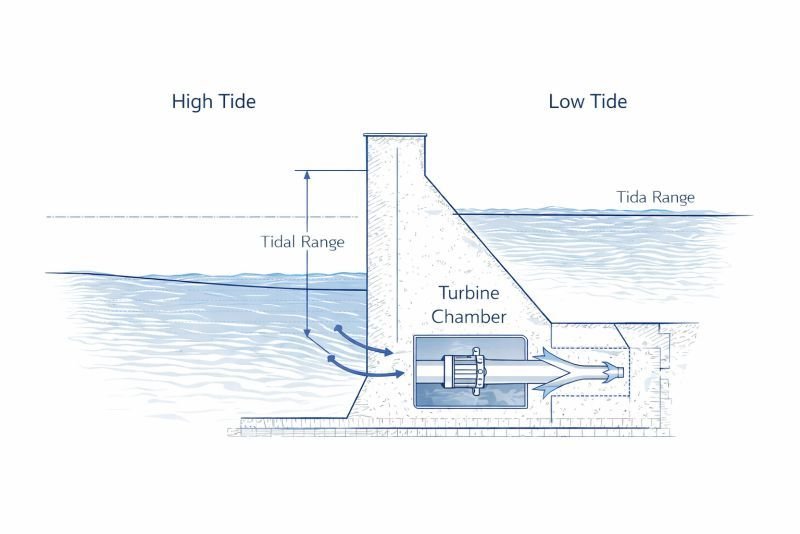
The formula that captures this is straightforward:
E = 0.5 x rho x g x A x h²
Here, E is the potential energy in joules. Rho is the density of seawater, approximately 1025 kilograms per cubic metre. G is the acceleration due to gravity, 9.81 metres per second squared. A is the surface area of the enclosed basin in square metres. H is the tidal range in metres.
The factor of 0.5 appears because the water does not all sit at the maximum height. As a basin fills, the water level rises continuously, so the average height of the water above the low-tide baseline is half the total range.
Apply those numbers to a realistic site. Take a tidal basin with a surface area of one square kilometre (1,000,000 square metres) and a tidal range of 10 metres. Substituting:
E = 0.5 x 1025 x 9.81 x 1,000,000 x 100
E = approximately 502 billion joules, or 502 gigajoules
Converting to kilowatt-hours (divide by 3.6 million): around 139,000 kilowatt-hours per tidal cycle from that single square kilometre. With four tidal cycles per day, the theoretical daily energy available approaches 556,000 kilowatt-hours per square kilometre before accounting for turbine efficiency. Real systems recover around 25 to 30% of the theoretical maximum, but the arithmetic still produces commercially significant numbers for sites with large basins and strong tidal ranges.
Where Tidal Energy Concentrates: the Coastal Funnel Effect
Tidal range in the open ocean averages less than a metre. At a coastline, that range can multiply dramatically. The Bay of Fundy’s 16-metre spring tides are not a geological accident. They are a resonance effect.
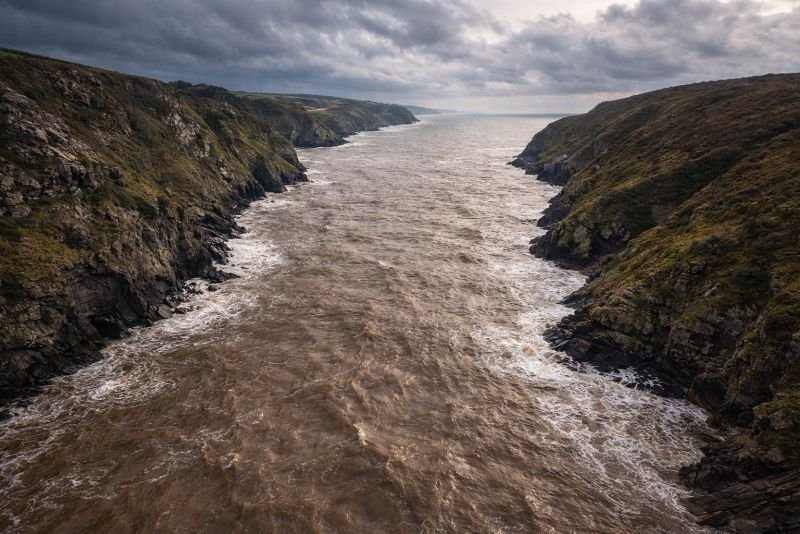
Water has mass. When a tidal wave enters a narrowing bay or estuary, the water has nowhere to go but up. The shape of the channel concentrates the flow. More critically, the Bay of Fundy has a natural resonance period of roughly 13 hours, close enough to the 12.4-hour tidal cycle that the incoming tide amplifies its own reflection. Water piling in from the last tidal cycle meets the next tidal pulse still sloshing back, and the two reinforce each other.
This same funnel geometry amplifies tidal ranges in the Bristol Channel between England and Wales (up to 14 metres at Avonmouth), in the Severn Estuary, and along stretches of the Patagonian coast in Argentina. These locations represent the richest tidal energy resources on Earth, precisely because local geometry multiplies what orbital mechanics starts.
| Location | Maximum Tidal Range | Notable Feature |
|---|---|---|
| Bay of Fundy, Canada | 16.3 metres | Resonance period close to tidal cycle |
| Ungava Bay, Canada | ~15 metres | Sub-Arctic, limited development to date |
| Bristol Channel, UK | ~14 metres | Severn barrage proposals active since 1970s |
| Rance Estuary, France | ~13.5 metres | World’s first tidal barrage, operational 1966 |
| Gazhskaya Bay, Russia | ~10 metres | Small demonstration plant has operated |
Tidal Currents: Harvesting Flow Without a Dam
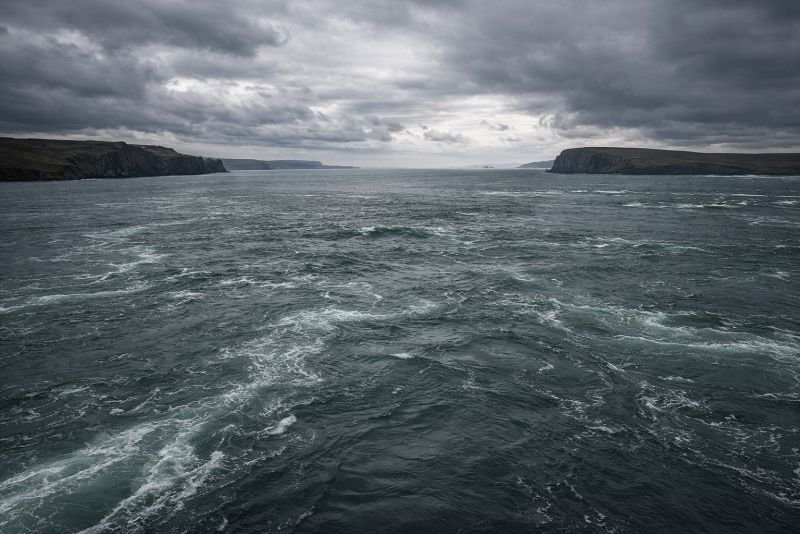
Not all tidal energy arrives in the form of vertical rise and fall. In channels, straits, and around headlands, the horizontal movement of tidal water produces powerful currents, sometimes exceeding 3 to 4 metres per second in confined passages. Those currents carry kinetic energy that turbines can extract directly, without any dam or barrage.
The physics mirrors wind energy closely. A turbine immersed in moving water extracts power from the kinetic energy of the flow, which scales with the cube of current velocity. The relevant formula is:
P = 0.5 x rho x A x v³ x Cp
P is power in watts. Rho remains the fluid density (1025 kg/m³ for seawater, roughly 830 times the density of air). A is the rotor swept area in square metres. V is the current velocity in metres per second. Cp is the power coefficient, representing what fraction of the available kinetic energy the turbine can extract. The theoretical maximum for any turbine, known as the Betz limit, is about 59.3%. Real tidal turbines achieve around 35 to 45%.
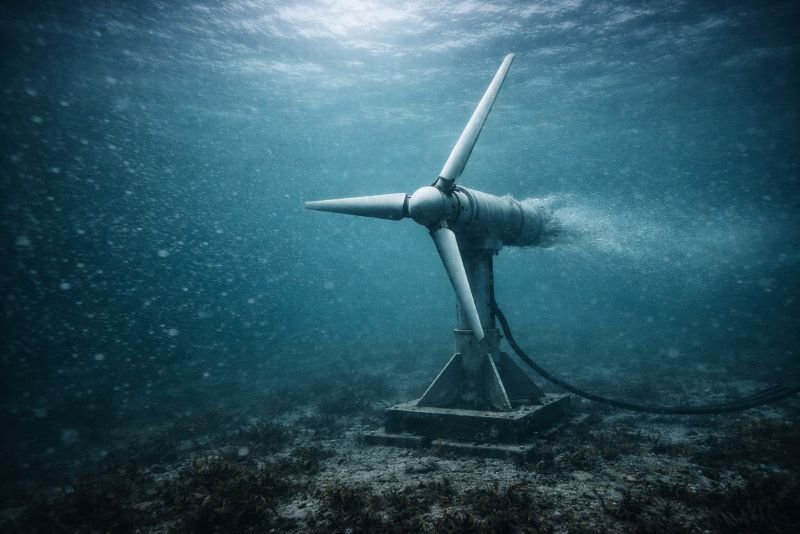
Consider a tidal turbine with a rotor 20 metres in diameter, giving a swept area of approximately 314 square metres, placed in a current running at 2.5 metres per second with a power coefficient of 0.40:
P = 0.5 x 1025 x 314 x (2.5)³ x 0.40
P = 0.5 x 1025 x 314 x 15.625 x 0.40
P = approximately 1,007,000 watts, or 1 megawatt
That single turbine, the size of a small building, produces a megawatt continuously while the tide runs. Velocity matters enormously: double the current speed to 5 metres per second and the same turbine produces 8 megawatts. Finding sites with high sustained tidal velocities is the central engineering challenge for tidal stream developers.
The density advantage of seawater over air is critical here. A tidal turbine rotor can be physically much smaller than a wind turbine rotor and still intercept the same power, because water carries so much more energy per cubic metre of flow.
Everything here is free. Readers are the reason it stays that way.
I make all of it alone, with no ads. If it is worth a coffee a month to you, that keeps the next one coming.
Keep it alive →The Limits Physics Places on Tidal Extraction
Tidal energy carries the imprint of the Moon’s orbital energy. Every joule extracted from a tidal flow is, in an infinitesimally small way, slowing the Moon’s orbit and lengthening Earth’s day. Tidal friction has been doing this naturally for billions of years. The rate at which natural tides slow Earth’s rotation is currently about 2.3 milliseconds per century per century. Human tidal extraction is negligible against that background process, but the physical linkage is real.
More practically, tidal extraction at large scale modifies the local hydrodynamics of the system being exploited. A barrage does not merely capture energy; it changes the tidal range on both sides of the structure, alters sediment transport, and modifies circulation patterns in the estuary. The Rance barrage reduced the tidal range inside the estuary from its natural maximum and altered mud flat ecology significantly in its first decade of operation. Marine ecosystems adapted over time, but the intervention was substantial.
What percentage of available tidal energy can a site realistically deliver? The hydrodynamics of each location impose a ceiling. Extracting too much energy from a tidal system reduces the currents that carry the energy in the first place. Studies of the Pentland Firth between mainland Scotland and Orkney, one of Europe’s most energetic tidal sites with peak currents exceeding 5 metres per second, suggest that extracting more than around 20 to 30% of the gross theoretical energy flux would measurably reduce current speeds, diminishing returns for any further installation. That constraint is not a fault of the technology. It is how fluid systems respond when energy is removed from them.
How Engineers Read a Tidal Site
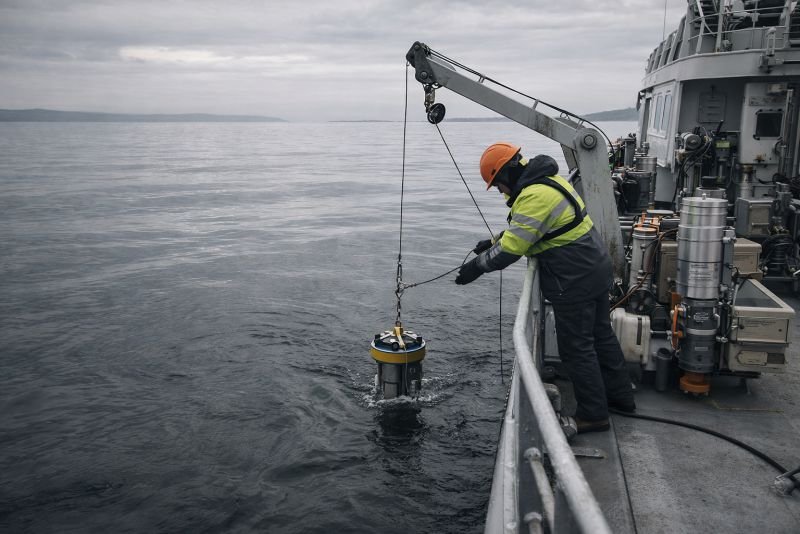
Before a turbine turns or a concrete pour begins, engineers characterise a tidal site through months of measurement. The variables that matter most are the tidal range, current velocity distribution across the water column, bathymetry, seasonal variation, and the local interaction between tidal flow and residual ocean currents.
What makes tidal energy unusual in the renewable sector is the precision with which all of these can be predicted. Tidal patterns are governed by gravitational mechanics. The positions of the Moon, Sun, and Earth are calculable centuries forward with precision sufficient to produce tidal predictions accurate to within minutes and centimetres. A solar farm operator cannot tell you how much power will be generated on a specific afternoon three years from now. A tidal plant operator can specify almost exactly when the tide will peak on that day, and calculate the expected energy yield accordingly.
That predictability translates directly into grid value. An energy source whose output can be scheduled precisely has lower integration costs than one requiring storage or backup to smooth its variability. Tidal installations on opposite coasts of a country can be deliberately offset to fill each other’s low-tide gaps. Two tidal sites separated by a few hundred kilometres typically have different tidal phase relationships, meaning their output peaks at different times. Coordinating them produces something approaching a baseload profile from a resource that is, at any single site, intermittent.
The limitation that tidal predictability cannot address is seasonal. Most tidal sites produce their largest outputs during spring tides and their smallest during neap tides, cycling over a 29.5-day lunar month. Annual variation exists too, because the Moon’s elliptical orbit brings it periodically closer to Earth at perigee, amplifying tidal forces by about 18% above the annual average. Engineers building revenue models for tidal projects must account for this multi-cycle structure carefully.
Tidal Energy in the Emerging Technology Landscape
The global technically accessible tidal resource is large enough to matter. Estimates of the global marine current energy resource range from 800 terawatt-hours to over 3,000 terawatt-hours per year, depending on methodology. World electricity consumption in 2023 was approximately 29,000 terawatt-hours. Tidal energy cannot power the world, but it can meaningfully contribute to grids in the right geographies, particularly the UK, Canada, France, South Korea, and Norway, where concentrated resources coincide with existing electricity demand.
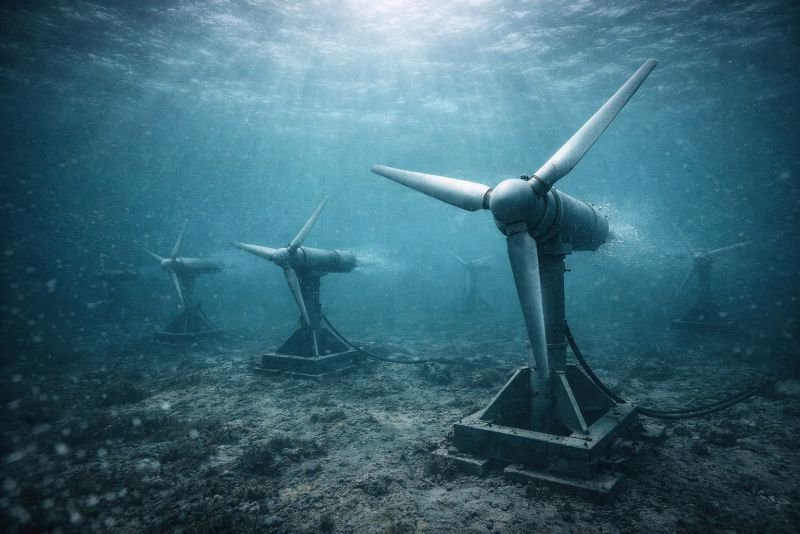
Tidal energy science is informing several emerging technology directions beyond conventional turbines and barrages. Flexible and compliant turbine blades, borrowed from aerospace research, are being tested to handle the biologically fouled, sediment-laden, occasionally debris-carrying environment of real tidal channels without the failure modes of rigid rotor designs. Gravity-base foundation systems, which sit on the seabed without piling, allow installation and removal without heavy drilling vessels.
The pairing of tidal prediction with battery storage is already being explored at small scale. Because tidal output at a single site follows a known pattern, the storage system does not need to handle surprises. It buffers the regular ebb and flow between tidal peaks, producing a smooth output profile using far less storage than would be needed to smooth an equivalent solar or wind installation of the same rated capacity.
Tidal energy’s deeper relevance to speculative technology is this: it represents a power source whose physics is entirely understood, whose resource is measurable with high confidence, and whose constraints are set by orbital mechanics rather than by weather or human behaviour. Any future energy system built around predictable, schedulable, geography-specific renewable sources will have to account for what the Moon has been offering, reliably, since the oceans formed.
You read the whole thing.
That is rarer than it should be, and it is the exact kind of attention I built this archive for. I make every piece alone, with no ads and no investor deciding what gets written. If you want the next machine taken apart like this one, you can help me make it.
A coffee a month is enough to keep it free for everyone.
Prefer crypto or a one time gift? Other ways to give →
Technologies Related to This Concept
| Technology | Concept |
|---|---|
| Tidal Energy in Coastal Cities: Powering Urban Areas with Ocean Tides | Concept: Utilizing tidal movements to generate electricity for coastal cities. |
| Tidal Energy Bridges | Concept: Bridges equipped with turbines to capture tidal energy beneath them. |
| Tidal Energy Barrages in Coastal Cities | Concept: Structures that harness tidal movements for electricity. |
| Underwater Turbines – The Future of Urban Renewable Energy | Concept: Implementing underwater turbines in city rivers and canals. |
| Energy Storage Solutions for Hydrokinetic Systems | Concept: Pairing hydrokinetic power with battery storage in cities. |