






What Is Tip speed ratio?
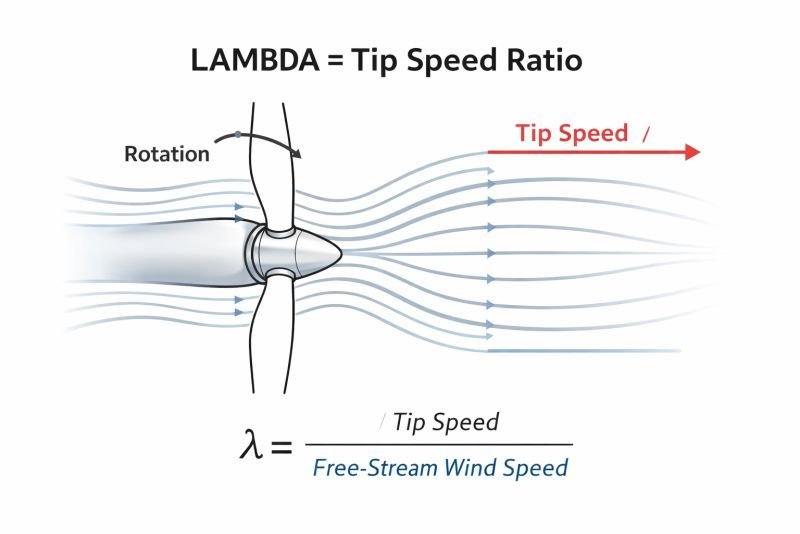
Tip speed ratio is the ratio of blade tip linear speed to free-stream wind speed, usually written as lambda. It is a key nondimensional parameter for rotating aerodynamic systems because it captures how fast a rotor sweeps through the flow relative to incoming air. For a given blade geometry, there is an operating range where lift generation and induced flow combine to maximize power coefficient.
If the ratio is too low, the rotor turns slowly and does not process enough airflow per unit time, reducing extractable power. If it is too high, profile drag and wake interaction increase, and aerodynamic efficiency falls. Control systems vary generator torque and blade pitch so operating points remain near the design optimum over changing wind conditions.
This metric matters because it directly connects rotor kinematics to wind farm energy conversion performance. It is also tied to local Angle Of Attack and loading behavior, so poor ratio control can increase fatigue while lowering annual energy production even when wind resources are strong. Acoustic emission and mechanical stress trends are also sensitive to persistent operation away from the intended ratio band.
Example:
A three-blade utility turbine may target a tip speed ratio near 7 in moderate wind to stay close to peak aerodynamic efficiency.
Related Concepts:
- Power Coefficient
- Angle Of Attack
- Rotor Torque Control
NoSuchDevice is a free archive of machines that do not exist yet but already have a shadow in physics. I research and write every entry alone, with no ads. Take a look around the archive, or help keep it free.