






What Is Weber bar?
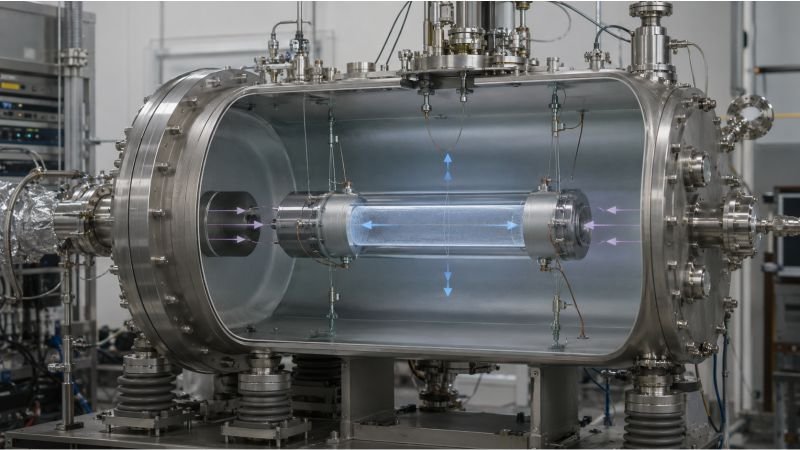
A Weber bar is a resonant mass detector designed to sense gravitational waves through tiny vibrations in a large solid cylinder. The concept relies on the idea that a passing gravitational wave slightly stretches and compresses space, causing a properly tuned mass to oscillate at one of its natural modes. The signal is extremely small, so the detector uses a massive bar, high mechanical quality factor, and sensitive transducers to distinguish true motion from environmental vibration.
For a simple bar mode, the resonant frequency can be approximated as f = v / 2L, where v is the sound speed in the material and L is the bar length. In real systems, aluminum alloys, cryogenic cooling, vacuum isolation, and vibration suspension improve sensitivity by reducing thermal and seismic noise. The bar responds most strongly when incoming wave frequencies overlap its mechanical resonance band.
The device matters because it was one of the first practical attempts to convert spacetime strain into a measurable laboratory signal. In resonant gravitational wave instrumentation, Weber bars show how weak coupling between matter and gravitational radiation defines detector scale. Used in devices include resonant mass antennas, cryogenic vibration sensors, precision transducer assemblies, and experimental platforms for testing weak mechanical signals.
Example:
A suspended aluminum cylinder can be monitored for minute resonant vibrations after a gravitational wave passes through the detector.
Related Terms:
- Gravitational Wave
- Resonant Mass Detector
- Quality Factor
NoSuchDevice is a free archive of machines that do not exist yet but already have a shadow in physics. I research and write every entry alone, with no ads. Take a look around the archive, or help keep it free.