

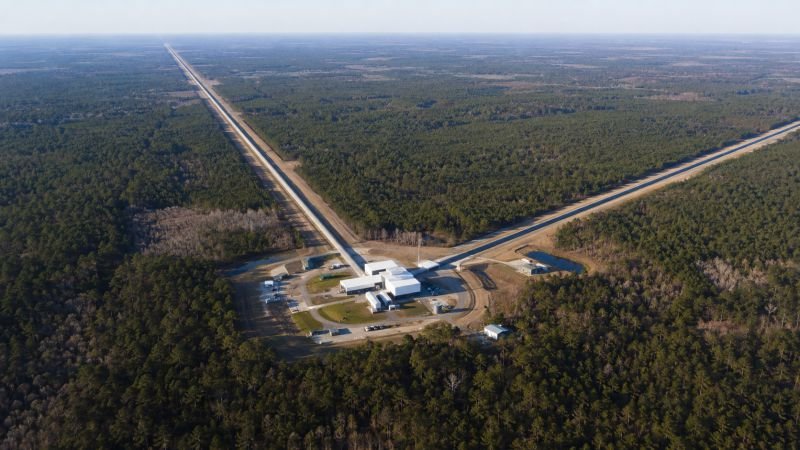
On September 14, 2015, two mirrors at LIGO – each suspended on glass fibers inside a four-kilometer evacuated tube – moved relative to each other by approximately one-thousandth the diameter of a proton. The displacement lasted under a second. It was caused by two black holes that merged 1.3 billion light-years away, releasing in that fraction of a second roughly fifty times the combined energy output of every visible star in the observable universe.
That energy traveled through intergalactic space, crossed our galaxy, passed through the solar system, and moved through Earth in less time than it takes to blink. It shifted mirrors by a distance that makes an atom look enormous. Then it kept going, carrying every joule into deep space, and the planet returned to its previous shape as if nothing had happened.
Nobody captured any of it. Nobody had a machine for that.
The short version: Gravitational waves are confirmed, physical, and energetic. They pass through Earth continuously – as brief intense pulses from cosmic collisions and as a faint stochastic background hum from billions of sources across cosmic time. A gravitational wave energy converter is a concept device that couples to spacetime curvature fluctuations and extracts that energy as electrical power. The coupling between conventional matter and gravitational radiation is so extraordinarily weak that a million-kilogram conventional resonator extracts roughly 10^-36 watts from the background. The device acquires engineering logic only if two conditions are met: a class of materials with fundamentally enhanced gravitational coupling, and a redefinition of what useful output means for a machine harvesting a source available everywhere in the universe.
Key Takeaways
- Gravitational waves carry measurable energy and arrive continuously – LIGO proved detection is possible, but detection and energy extraction are entirely different engineering problems
- The coupling between ordinary matter and spacetime curvature is so weak that even a city-sized conventional resonator would harvest less power than a bacterium produces metabolically
- A gravitational metamaterial with enhanced spacetime coupling is the theoretical key that changes the calculation from physically absurd to physically difficult
- The stochastic gravitational wave background – confirmed in 2023 by pulsar timing arrays – is continuous and permanent, unlike discrete merger events, making it the real target for a concept harvester
- The civilizational-scale version of this device does not power a city – it powers machines that can operate autonomously in deep space, drawing from the only energy source available everywhere in the universe
Table of Contents
The Signal That Has Been Moving Through Earth Since Before Earth Existed
Something crosses through every building, every ocean, every mountain range continuously. It has been doing this since the universe was young. The energy it carries was released by the most violent collisions in existence – merging black holes, colliding neutron stars, the final screams of dying massive stars. It passes through planets the way light passes through glass, except that glass at least absorbs a little.
Gravitational waves are distortions in spacetime itself – compressions and stretches of the geometry that space and time share, propagating outward from any massive object undergoing asymmetric acceleration. Unlike electromagnetic radiation, they do not interact with matter through electric charge or atomic resonance. They interact through mass and through the curvature of space. Everything has mass. Everything couples to gravity. The coupling, however, is so extraordinarily weak that a gravitational wave crossing the entire Earth deposits less energy than a single photon of visible light hitting a wall.
Why the Physics Confirms the Energy Is Real
The 2015 detection by LIGO – and the 2017 Nobel Prize it earned – confirmed that gravitational waves are not a mathematical artifact of general relativity but physical phenomena carrying real, measurable energy. The merger event GW150914 released approximately three solar masses of energy as gravitational radiation in under a second. The wave arrived at Earth with a strain of h ~ 10^-21: the entire planet compressed and stretched along the wave axis by less than the diameter of a single atomic nucleus.
That deformation required real energy. The question a gravitational wave energy converter asks is straightforward: if the energy is real, and it passes through everything, what would it take to catch some of it?
From Detector to Extractor: What LIGO Does Not Do
LIGO is the most sensitive measurement instrument ever built. Detecting a displacement of 10^-18 meters required suspending mirrors on glass fibers, operating at temperatures near absolute zero, filtering out ocean wave vibrations from thousands of kilometers away, and canceling quantum noise with squeezed light. The result is a machine that detects gravitational waves at extraordinary fidelity.
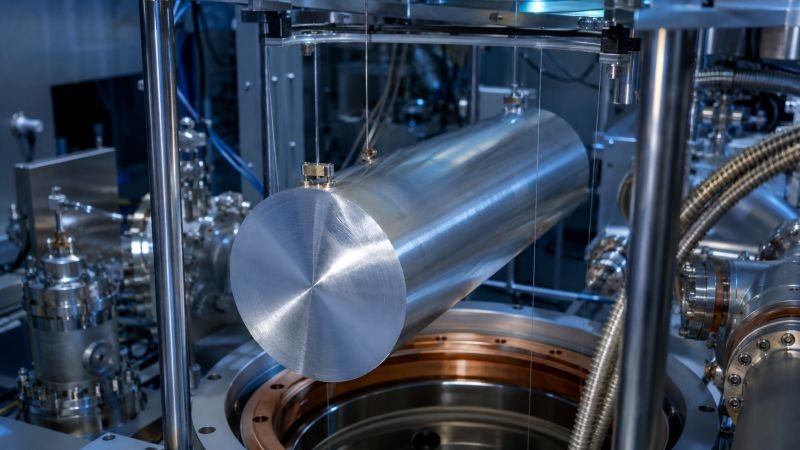
It harvests approximately zero useful energy from them.
Detection and extraction are different problems at a fundamental level. A thermometer detects thermal energy without absorbing it usefully. A gravitational wave detector measures spacetime displacement without converting it to power. The coupling between LIGO’s mirrors and the passing wave is in fact intentionally minimized – any absorption would disturb the measurement. A gravitational wave energy converter requires the exact opposite: maximum energy transfer into the material.
The Cross-Section That Sets the Scale
Every form of radiation has an absorption cross-section – the effective area representing how likely a given wave is to deposit energy into a given target. For visible light hitting a silicon atom, this is roughly 10^-19 m². For a 1,000-kilogram resonant aluminum cylinder – a Weber bar, the classic resonant mass detector developed in the 1960s – the effective cross-section for gravitational wave absorption is approximately 10^-30 m². That gap of eleven orders of magnitude is not a manufacturing problem. It is a consequence of how weakly gravity couples to matter at the fundamental level.
Making the resonator larger improves the cross-section, but only linearly with mass. A million-kilogram resonator reaches a cross-section of roughly 10^-27 m². The gap between detection and useful extraction cannot be closed with more conventional matter. It requires different matter.
How a Gravitational Wave Energy Converter Could Operate
A gravitational wave passing through a massive resonant structure causes that structure to oscillate. The oscillations are mechanical – compressions and extensions along the wave’s polarization axis, at the wave’s frequency. Those mechanical deformations can in principle be converted to electrical energy through piezoelectric transducers embedded in the resonant mass, through electromagnetic induction from moving conductive elements, or through quantum-mechanical transduction at engineered material interfaces. The conversion chain from mechanical oscillation to electrical current is well understood. The problem is always upstream of it.
The absorbed power P from a gravitational wave is:
P = σ_eff × F_gw
where σ_eff is the effective absorption cross-section of the device (m²) and F_gw is the incident gravitational wave energy flux (W/m²). For a conventional resonant mass of 10^6 kg tuned to the stochastic background:
- σ_eff (conventional matter) ~ 10^-27 m²
- F_gw (stochastic background) ~ 10^-9 W/m²
- P ~ 10^-36 W
One million kilograms of precision-engineered resonant mass, running continuously, producing 10^-36 watts. To put that number physically: the chemical energy in a single glucose molecule – the thing a bacterium eats once – is approximately 10^-18 joules. At 10^-36 watts, the converter would need roughly a billion years to accumulate that much energy. The number does not improve meaningfully by scaling up with conventional materials. The cross-section is the constraint.
Gravitational Metamaterials: The Required Material Hypothesis
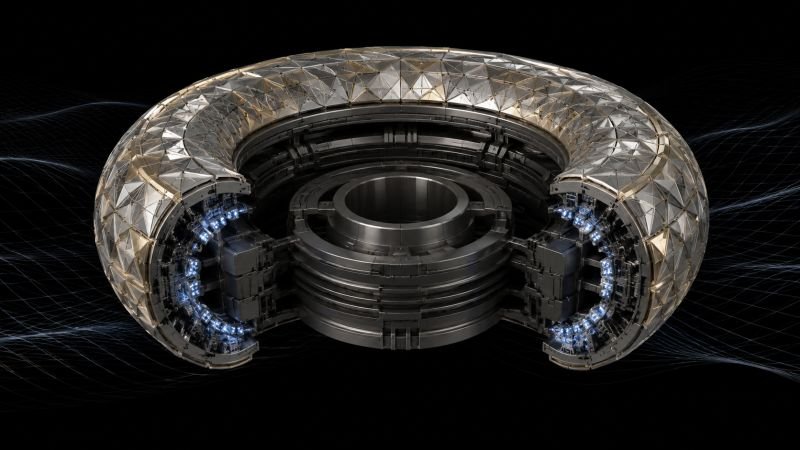
The path that changes this calculation runs through a class of materials that does not yet exist. A gravitational metamaterial is an engineered quantum structure whose coupling to gravitational radiation significantly exceeds that of ordinary matter. The quantum mechanical principles underlying enhanced coupling in electromagnetic metamaterials – engineered band structures, resonant quantum states, tailored permittivity – are not straightforwardly extended to gravitational coupling, which operates at a fundamentally different energy scale. But “not straightforwardly” is not the same as “physically forbidden.”
Quantum gravity effects at accessible energy scales remain one of the active frontiers in theoretical physics. The device hypothesis is that a sufficiently engineered quantum material could achieve cross-sections several orders of magnitude above conventional matter. At 10^12 enhancement – an extraordinary and undemonstrated figure – the absorbed power from the stochastic background for a million-kilogram resonator reaches approximately 10^-24 watts. That number is still not useful for a power grid. But it is a different class of answer, and it points toward a device that makes a different kind of engineering sense.
The Resonant Core and the Quality Factor
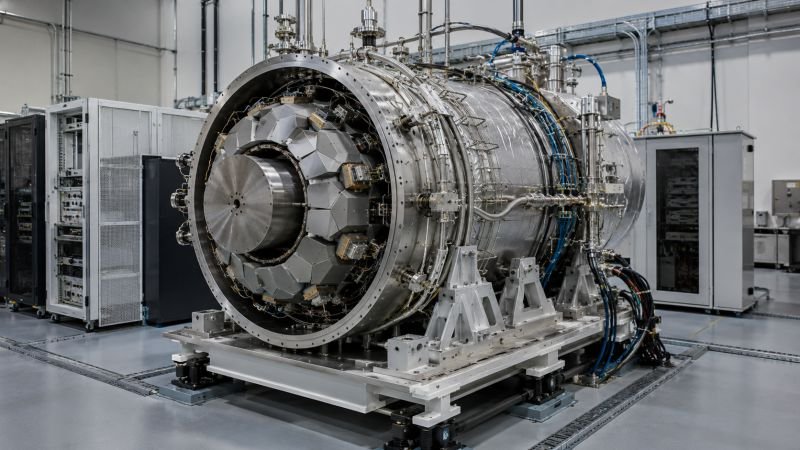
The mechanical backbone of the converter is a high-Q resonant mass – a large structure (torus, nested cylinder array, or space lattice) tuned to the frequency band where gravitational wave background flux is highest: roughly 10 to 300 Hz for stellar-mass binary sources. The quality factor Q determines how much energy accumulates across many wave cycles before conversion occurs. Cryogenic resonators in fused silica or sapphire reach Q values above 10^8, allowing energy from many thousands of wave cycles to build up. The gravitational metamaterial forms the outer coupling shell. The transduction elements – converting accumulated mechanical oscillation to electrical current – are the most conventional component in the design. Conversion efficiency at this stage is not what limits the device. It has never been what limits the device.
Everything here is free. Readers are the reason it stays that way.
I make all of it alone, with no ads. If it is worth a coffee a month to you, that keeps the next one coming.
Keep it alive →The Numbers That Set an Honest Scale
The stochastic gravitational wave background carries a continuous energy flux of approximately 10^-9 W/m² at Earth – one nanowatt per square meter. Solar irradiance at Earth’s surface averages 1,360 W/m². The gravitational wave background sits twelve orders of magnitude below sunlight.
| Source | Flux at Earth | Duration | Character |
|---|---|---|---|
| GW150914 (black hole merger) | ~3 × 10^-4 W/m² | ~0.2 seconds | Intense, single pulse, unpredictable |
| GW170817 (neutron star merger) | ~1 × 10^-3 W/m² | ~100 seconds | Highest detected, still brief |
| Stochastic background | ~10^-9 W/m² | Continuous | Permanent, all-sky, always present |
| Solar irradiance (comparison) | ~1,360 W/m² | Continuous | 12 orders of magnitude above background |
The stochastic background column is the one that matters for a concept device targeting continuous output. Individual merger events are brief and arrive at unpredictable intervals. The background is permanent – it will outlast Earth by billions of years and arrives equally from every direction. For a device designed to harvest continuously, a permanent source at lower flux is more useful than rare intense pulses.
For the converter to produce 1 microwatt continuously from the background requires an effective cross-section of 10^3 m² – one square kilometer of effective absorption area. With a gravitational metamaterial at 10^12 enhancement over conventional matter, a million-kilogram resonator reaches σ_eff ~ 10^-15 m², producing around 10^-24 watts. The gap between that and one microwatt is still nine orders of magnitude. The honest reading: a grid-scale power plant drawing on gravitational waves is not a 200-year device. A self-powered autonomous sensor is a different and more defensible question.
The Stochastic Background and the Seed Technology Path
Before 2023, gravitational wave astronomy was event-driven: something massive collided somewhere, LIGO or Virgo recorded the pulse, and the rest of the time the sky was quiet. In 2023, pulsar timing array networks across multiple continents found evidence of the stochastic gravitational wave background – the accumulated signal of supermassive black hole binary mergers across cosmic time, superimposed into a continuous low-frequency hum that permeates the universe. The background is not clean and monochromatic. It is a spectrum, spread from nanohertz to kilohertz frequencies depending on source populations.
For the concept device, this changes the target entirely. The converter does not wait for a black hole merger. It draws from a reservoir that has existed since before the first stars formed.
The Passive Cosmic Antenna as First Generation
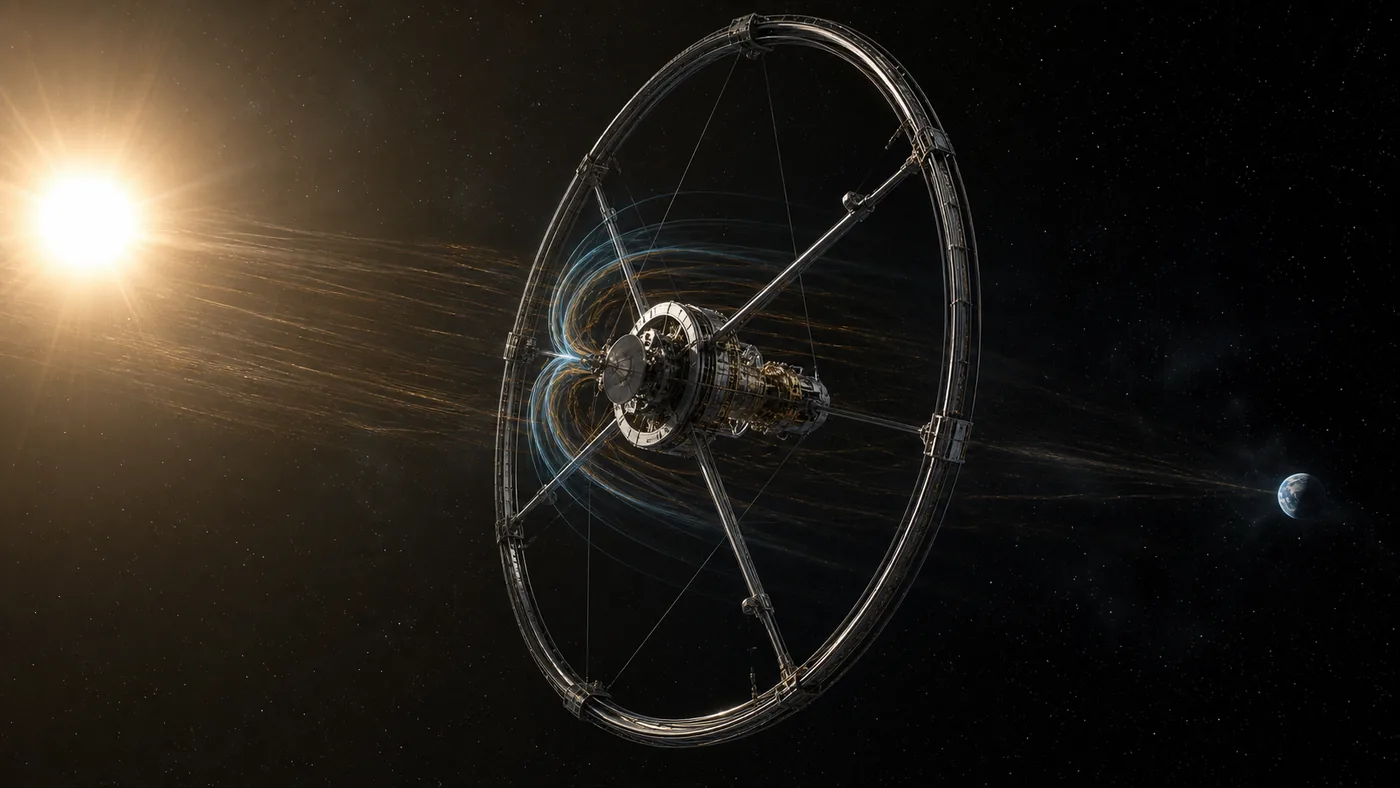
The seed form of this device is a passive cosmic antenna: a gravitational wave resonator that extracts enough energy to power only its own sensing and signal transmission systems. No grid output. No useful work for external loads. A machine that runs on spacetime itself.
This matters because of what it proves. A self-powering gravitational wave sensor would demonstrate, for the first time, that a coupling pathway exists between gravitational radiation and usable electrical current via material interaction. The first silicon photovoltaic cell of 1883 powered nothing useful and converted light at under 1% efficiency. It proved the pathway. Every solar panel installed since then descends from that proof. A working passive cosmic antenna is the equivalent for this device class.
The comparison with neutrino detection is instructive, briefly. The IceCube observatory at the South Pole – a cubic kilometer of instrumented Antarctic ice – detects roughly a dozen astrophysical neutrinos per year from a flux of approximately 10^10 particles per square centimeter per second. Neutrino-matter coupling is extraordinarily weak. Gravitational wave-matter coupling is weaker still. The architecture principle – very massive, very cold, very patient – points toward the first generation of the converter.
From Sensor to System: The Evolutionary Arc
The trajectory from passive cosmic antenna to mature gravitational wave energy converter follows the same pattern as every weak-coupling technology that eventually crossed into engineering viability.
The first generation device is a cryogenic high-Q resonant mass of roughly 10^3 to 10^5 kg, surrounded by an early gravitational metamaterial shell demonstrating measurable enhanced coupling, with quantum transduction elements at the material interface. It produces nanowatts. It proves the principle. It operates in deep space, powering its own instruments in an environment where no other energy source exists.
The mature generation incorporates gravitational metamaterial compositions with cross-section enhancements above 10^15, resonant lattice architectures at orbital scale, and multi-stage transduction chains with conversion efficiencies above 60%. At this stage the device produces microwatts to milliwatts continuously – sufficient to power long-duration autonomous probes, navigation beacons, and deep space sensors indefinitely, drawing from a source that is available equally at every point in the universe regardless of distance from any star.
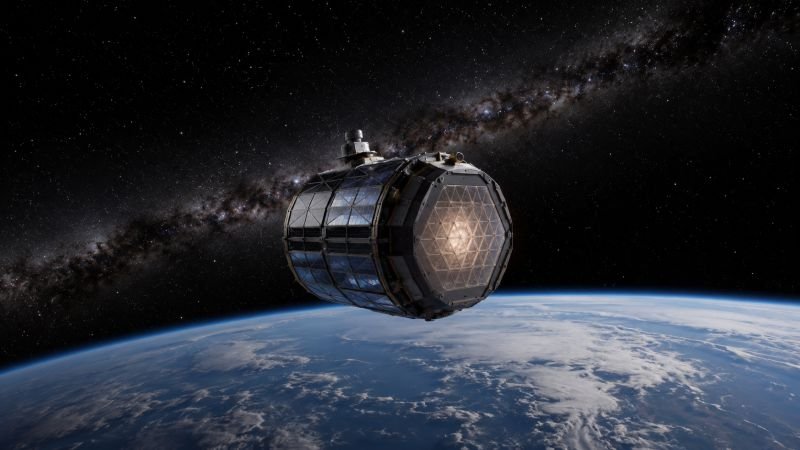
The civilizational-scale form is not a power plant in the familiar sense. It is planetary-scale resonant infrastructure – orbital arrays tuned to the peak gravitational wave background frequencies, harvesting the cumulative output of cosmic history as base-load power for a civilization that has moved beyond stellar proximity as a constraint. At this scale, the stochastic background is not a curiosity. It is infrastructure.
The View From NoSuchDevice
I want to be precise about where this device sits in the catalog, because it sits somewhere different from most things here.
The typical NoSuchDevice article describes a device in Zone 2 – the physics is settled, the engineering is difficult, and someone will build it when materials and economics align. A gravitational wave energy converter is unusual because it asks the reader to accept a material class – gravitational metamaterials – that has no current demonstration, no confirmed theoretical roadmap, and no laboratory precursor. That is closer to Zone 3 than anything else on the site. I am placing it here anyway, and I want to say why.
The history of materials physics is littered with coupling constants that seemed permanent and then were not. Electromagnetic metamaterials with negative refractive index existed as a mathematical curiosity for decades before they were fabricated. Topological insulators were a theoretical surprise that turned out to be realizable in dozens of material systems. The coupling between matter and gravitational radiation is described by general relativity to extraordinary precision. Nothing in general relativity says it cannot be modified by an engineered quantum system – it says only that nothing we have ever built has managed it.
The 200-year horizon for this device is honest in the sense that I think it might be achievable for the seed form – the passive cosmic antenna – within that window if materials science produces the right breakthrough. I do not think a grid-scale power source from gravitational waves is a 200-year device. I do not think it is a 500-year device. But I also do not know what gravitational metamaterials would look like once someone actually builds one, and I am aware that is exactly the kind of sentence that has preceded most of the interesting physics of the last century.
The device I find genuinely interesting is not the planetary-scale array. It is the probe in deep space, small and cold and patient, running indefinitely on the faint hum of black holes colliding a billion light-years away. That is a new relationship between engineering and the universe, and it seems worth thinking about carefully – even if the materials needed to build it do not exist yet.
You read the whole thing.
That is rarer than it should be, and it is the exact kind of attention I built this archive for. I make every piece alone, with no ads and no investor deciding what gets written. If you want the next machine taken apart like this one, you can help me make it.
A coffee a month is enough to keep it free for everyone.
Prefer crypto or a one time gift? Other ways to give →