






What Is yttria-stabilized zirconia?
Yttria-stabilized zirconia is a ceramic oxide material where yttrium oxide is added to zirconia to stabilize high-temperature crystal phases and create oxygen-ion conductivity. Doping introduces oxygen vacancies in the lattice, and those vacancies enable ion migration under a potential gradient. This combination of ionic transport, thermal robustness, and chemical stability makes the material a core electrolyte in solid oxide electrochemical systems.
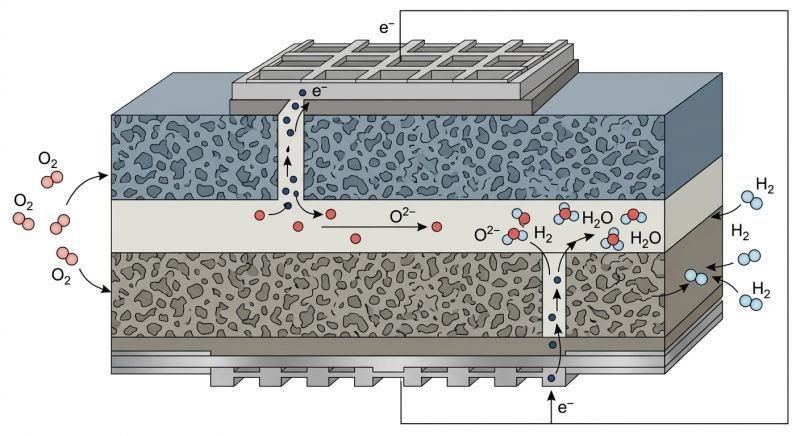
In solid oxide fuel cells, yttria-stabilized zirconia separates fuel and oxidant while conducting oxide ions from cathode to anode at elevated temperature. Conductivity increases strongly with temperature, so cells typically operate in ranges where ionic resistance is low enough for practical current density. Microstructure, grain boundaries, and electrode-electrolyte interfaces influence total polarization and durability under thermal cycling. In high-temperature ceramic fuel cell engineering, this electrolyte enables non-platinum electrodes and supports internal reforming pathways.
The concept matters because electrolyte selection defines operating window, efficiency, startup constraints, and long-term reliability in solid oxide stacks. Mastering YSZ behavior is central to scaling durable systems for distributed power, industrial heat integration, and grid-support applications.
Example:
A stationary SOFC stack uses YSZ electrolyte plates to conduct oxide ions efficiently once operating temperature reaches the designed ceramic regime.
Related Concepts:
- Oxygen Ion Conductivity
- Solid Oxide Fuel Cell
- Ceramic Electrolyte
NoSuchDevice is a free archive of machines that do not exist yet but already have a shadow in physics. I research and write every entry alone, with no ads. Take a look around the archive, or help keep it free.