





What Is aquifer permeability?
Aquifer permeability is the ability of subsurface rock or sediment to transmit water through connected pores, fractures, or grain boundaries. It is controlled by the size, shape, and connectivity of those openings rather than by porosity alone. A permeable formation allows groundwater to move with less resistance, while a tight clay or cemented layer restricts flow even if some void space is present.
In hydrogeology and engineering, permeability sets the scale for pumping performance, contaminant migration, and the radius reached by injected fluids. It is commonly interpreted through Darcy’s law, Q = k A Delta h / L, where flow rate depends on material conductivity, area, and hydraulic gradient across a distance. Grain sorting, fracture networks, clogging, and compaction can all change how easily water and suspended particles travel underground.
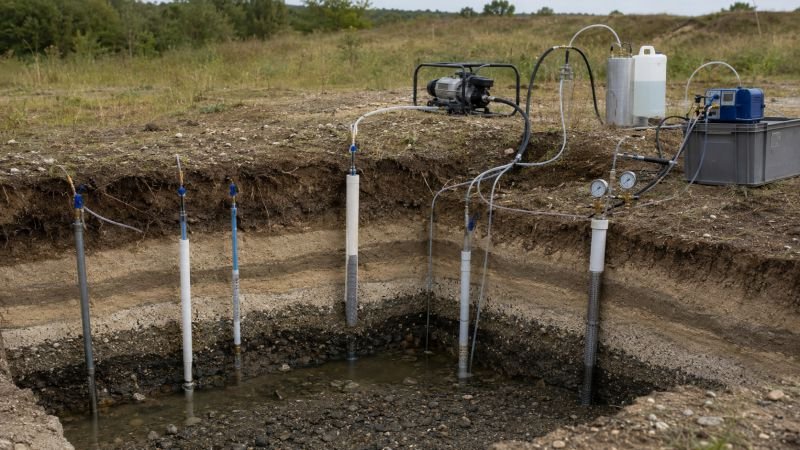
The concept matters because any subsurface treatment strategy must match the geometry of real flow paths rather than an idealized uniform layer. In subsurface flow engineering, aquifer permeability determines whether reactive materials can actually spread through a contaminant plume. Used in devices include pumping tests, injection manifolds, well screens, and tracer monitoring systems that characterize or exploit groundwater movement.
Example:
A sandy aquifer may accept an injected treatment slurry over several meters, while an adjacent clay lens can block lateral movement almost completely.
Related Terms:
- Nanoscale Zero-Valent Iron
- Porosity
- Hydraulic Gradient
NoSuchDevice is a free archive of machines that do not exist yet but already have a shadow in physics. I research and write every entry alone, with no ads. Take a look around the archive, or help keep it free.