




Bitterfeld-Wolfen sits in the Saxony-Anhalt region of eastern Germany. For most of the twentieth century it was one of the most productive chemical manufacturing zones in Europe, producing dyes, pesticides, chlorinated solvents, and plastics at industrial scale. By the 1990s it was also one of the most contaminated places on the continent. Chlorinated compounds, heavy metals, and persistent organics had saturated the soil and groundwater across hundreds of square kilometres. Pump-and-treat systems have been operating there for over three decades, pulling contaminated water to the surface and filtering it, reinserting it, and pulling it up again. The contamination does not sit in a convenient layer. It has migrated through fractured aquifer rock, bound itself to clay particles, and dispersed to concentrations that persist regardless of how much volume gets processed at the surface.
The fundamental problem is geometric. The contamination is distributed through three dimensions of rock and sediment, and conventional approaches address it one extracted volume at a time.
Nanotechnology in environmental remediation approaches this from the other direction. The cleanup material is not deployed above the contamination. It is injected directly into it.
The short version: Nanotechnology in environmental remediation uses engineered particles between 1 and 100 nanometres in diameter to destroy or immobilise pollutants directly inside contaminated soil and groundwater. At this scale, surface area increases so dramatically that a single gram of material can carry 25 square metres of reactive interface. Iron nanoparticles injected into chlorinated solvent plumes have reduced trichloroethylene concentrations by over 95% within weeks at field sites across Europe and North America. The physics is established. The deployment is live. The remaining questions are about safety, scale, and geometry.
Table of Contents
The Surface Area Physics That Makes Nanomaterial Remediation Possible
Every practical advantage that nanotechnology brings to environmental remediation traces back to a single geometric fact: as a sphere gets smaller, the fraction of its atoms sitting at the surface rises sharply. Surface atoms behave differently from interior atoms. They carry unsatisfied chemical bonds. They can adsorb molecules from surrounding fluid, catalyse reactions, donate or accept electrons. Interior atoms do none of this. The larger the proportion of atoms at the surface, the more chemistry a given mass of material can perform.
The relationship is captured in a simple expression. For a spherical particle, the ratio of surface area to volume is:
SA/V = 6/d
where SA is surface area, V is volume, and d is the diameter of the sphere.
Take a grain of iron one millimetre in diameter. Its surface-to-volume ratio is 6 divided by 0.001 metres, giving 6,000 per metre. Now shrink that grain to 30 nanometres across – 30 billionths of a metre. The ratio becomes 6 divided by 3 x 10^-8, which equals 2 x 10^8 per metre. That is an increase of over 30,000 times.
Converting that into units a chemist would use: one gram of iron nanoparticles at 30nm diameter carries approximately 25 square metres of reactive surface. A gram of conventional iron powder with particle sizes in the hundred-micrometre range carries around 0.05 square metres. The nanoparticle delivers roughly 500 times more reactive interface per gram of material used. That difference is not incremental. It changes what chemistry is physically achievable without industrial-scale infrastructure.
This is the foundation that nanotechnology in environmental remediation builds on. The high surface area is not a feature of a particular product. It is a direct consequence of geometry, and geometry cannot be argued with.
How Nanomaterials Attack Contaminants in Soil and Groundwater
The chemistry that nanomaterials perform inside contaminated environments falls into three distinct mechanisms. Each one operates through different physics. Each one is suited to different contaminant types. Deploying the wrong material against the wrong pollutant produces no useful result, which is why the distinction matters before the engineering begins.
Adsorption: Locking Molecules to a Reactive Surface
Adsorption occurs when a dissolved contaminant molecule encounters a surface with chemical affinity for it and binds. The molecule is removed from the dissolved phase and held at the particle surface. No chemical transformation takes place – the molecule is captured, not destroyed.
Carbon-based nanomaterials perform this role most effectively. Graphene oxide, with a measured surface area approaching 700 square metres per gram, carries oxygen-containing functional groups that attract heavy metal ions and organic pollutants. Lead ions in contaminated groundwater bind to graphene oxide surfaces with an adsorption capacity that in laboratory conditions exceeds 1,000 milligrams of lead per gram of material. A small mass of properly dispersed material can reduce heavy metal contamination across a substantial water volume without any additional energy input beyond the initial delivery.
Photocatalytic Destruction of Persistent Organic Pollutants
Titanium dioxide nanoparticles generate reactive chemistry when exposed to ultraviolet light. The mechanism involves the promotion of electrons within the TiO2 crystal lattice to an excited state, producing electron-hole pairs at the particle surface. These pairs react with water and dissolved oxygen to generate hydroxyl radicals, among the most chemically aggressive species that can be produced under ambient conditions. Hydroxyl radicals attack virtually any organic molecule without selectivity, fracturing chemical bonds and degrading contaminants progressively down to carbon dioxide and water.
In water treatment systems using TiO2 nanoparticles at around 20nm diameter, studies have demonstrated the degradation of pharmaceutical compounds from concentrations of 10 micrograms per litre to below detection limit within 60 minutes of UV exposure. The limitation in subsurface deployment is obvious: light does not penetrate rock. Photocatalysis using nanomaterials is most practical in surface water treatment or in extracted groundwater, not in direct in-situ injection.
Chemical Reduction by Nanoscale Zero-Valent Iron
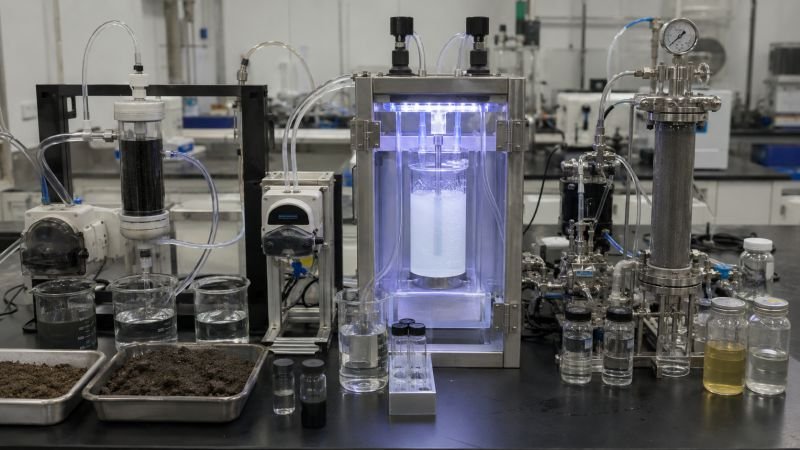
Nanoscale zero-valent iron, commonly abbreviated nZVI, is the most widely deployed nanomaterial in groundwater remediation and the subject of the most field evidence. Its mechanism is direct electron transfer. Chlorinated solvents such as trichloroethylene and perchloroethylene carry electron-deficient carbon-chlorine bonds. Zero-valent iron is an electron donor. When nZVI particles contact these solvents in groundwater, iron donates electrons to the chlorine bonds, stripping chlorine atoms away and converting the solvent to ethene and chloride ions – neither of which poses a remediation problem.
The particle’s high surface area, typically 25 to 60 square metres per gram for field-deployable nZVI formulations, ensures this reaction proceeds at rates fast enough to be practically useful. A single injection event at a trichloroethylene-contaminated site can reduce dissolved concentrations by 90 to 99% within days to weeks in the treated zone.
Variables That Govern Nanotechnology in Environmental Remediation Performance
Not all contaminated sites respond the same way to nano-remediation. The effectiveness depends on a set of interacting variables, some controllable by the engineer and some fixed by the geology.
| Variable | What It Controls | Engineering Implication |
|---|---|---|
| Particle diameter | Surface area, reactivity, mobility in porous media | Smaller particles react faster but aggregate sooner |
| Surface coating | Transport distance through aquifer, aggregation resistance | Polymer coatings extend mobility but partially block reactive sites |
| Aquifer geochemistry | Competing oxidation reactions, pH-dependent reactivity | nZVI oxidises faster in aerobic zones, reducing effective lifetime |
| Contaminant concentration | Reaction kinetics and material consumption rate | High concentrations deplete reactive surface in hours |
| Aquifer permeability | Maximum delivery radius from injection point | Clay layers and tight bedrock block particle migration entirely |
Aggregation is the variable that causes the most field problems. Bare iron nanoparticles in water begin to cluster within minutes of injection, losing mobility and reducing effective surface area before they reach the target contamination. Polymer coatings – carboxymethyl cellulose and guar gum are the most common – adsorb onto the particle surface and create electrostatic repulsion between adjacent particles, keeping them dispersed during transport. The cost is a small reduction in reactivity per particle, because the polymer partially blocks surface access.
Does the particle size need to be precisely controlled during synthesis? For field applications, the answer is yes, but within a practical band. Particles in the 20 to 100nm range show acceptable reactivity and transport behaviour in most aquifer materials. Below 10nm, surface chemistry becomes harder to predict and synthesis costs rise steeply. Above 100nm, the material approaches the behaviour of conventional iron powder rather than a nanomaterial.
Everything here is free. Readers are the reason it stays that way.
I make all of it alone, with no ads. If it is worth a coffee a month to you, that keeps the next one coming.
Keep it alive →Physical Limits That Nanotechnology in Environmental Remediation Cannot Escape
There is a constraint that rarely appears at the front of remediation proposals: the nanoparticles themselves may be hazardous to the environment they are meant to protect.
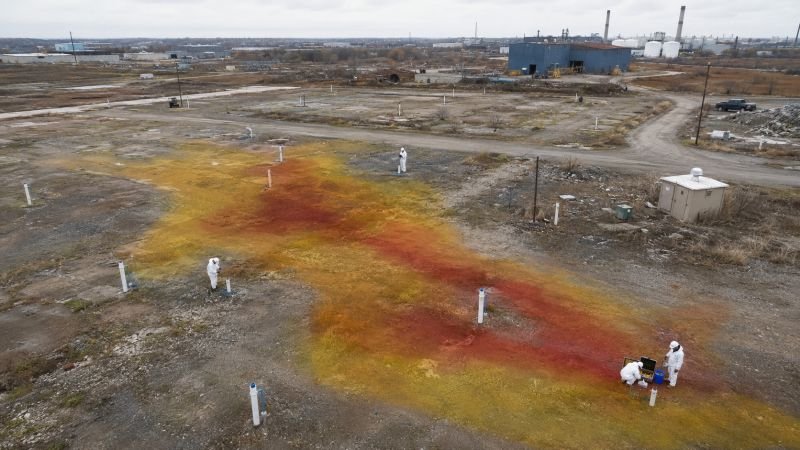
Particles that are not immobilised by rapid chemical reaction continue to migrate through groundwater after injection. Their ecotoxicological behaviour in natural aquifer systems over years and decades is incompletely characterised. Titanium dioxide and silver nanoparticles have demonstrated measurable toxicity to aquatic organisms in laboratory conditions at concentrations plausibly achievable near injection zones. Regulatory authorities in the European Union and North America currently require site-specific risk assessment before any nZVI injection, which adds cost and time to what might otherwise be a rapid deployment. That scrutiny exists for good reason.
The second limit is reactivity lifetime. nZVI converts itself into iron oxide as it reacts. In aerobic groundwater conditions, this happens within hours to days. In anaerobic zones, effective reactivity can persist for months. The material is consumed in the process of doing its work. A site with a continuing contaminant source – a leaking underground tank, a buried drum still releasing solvent – requires periodic reinjection. Nanotechnology treats the dissolved plume. It does not eliminate the source.
The third limit is delivery geometry. Injecting nanoparticles into low-permeability formations is genuinely difficult. Clay lenses, tight bedrock fractures, and heterogeneous sediment distributions all restrict particle migration to a radius smaller than the contamination zone. Whatever the particles cannot reach remains contaminated regardless of how reactive the material is.
These limits are not reasons to dismiss nanotechnology in environmental remediation. They are the constraints within which it works well and outside which it does not.
How Engineers Deploy Nanotechnology in Contaminated Field Sites
Translating nanomaterial reactivity into a working field programme requires solving several practical problems simultaneously, and the injection strategy is where most of them converge.
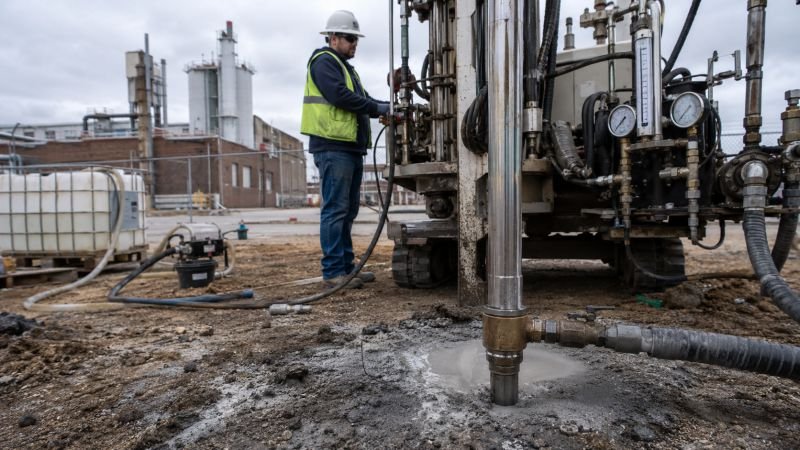
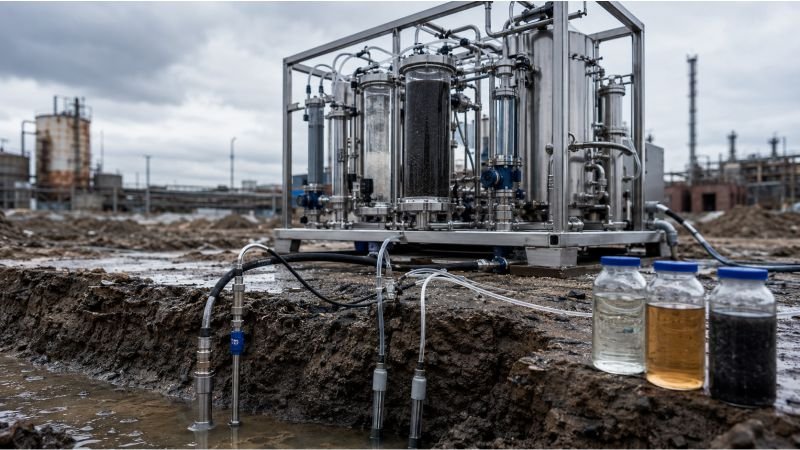
Direct-push technology is the standard delivery method. A hollow steel rod is driven to the target depth and connected to a pump that forces nZVI slurry into the formation under pressure. Injection depths typically range from 2 to 20 metres below ground surface, and slurry concentrations are usually between 2 and 10 grams of nZVI per litre of carrier fluid. Injection pressure must remain below the hydraulic fracture threshold of the formation – exceeding it creates preferential flow paths that carry the slurry away from the contamination zone rather than through it.
Monitoring after injection requires dissolved contaminant sampling from a network of wells positioned downgradient. The signature of a successful nZVI treatment is recognisable: a rapid drop in chlorinated solvent concentrations, a simultaneous rise in dissolved ethene, and a temporary drop in dissolved oxygen as the iron consumes it. At documented field sites in Germany, the Czech Republic, and New Jersey, this signature has appeared within weeks of injection and contaminant reductions have held through multi-year monitoring periods.
What determines whether nanotechnology in environmental remediation is the right tool for a given site is not whether the chemistry works. The question is whether the spatial geometry of the contamination matches what injection-based delivery can actually reach.
Technologies That Grow from Nanotechnology in Environmental Remediation
The field principles deployed today already point toward systems that remain unbuilt.
Reactive nano-sensors – particles designed to both detect a specific contaminant and initiate its destruction simultaneously – would allow contamination mapping and treatment in a single injection event. Functionalised nanoparticles with selectivity for one target molecule could remediate multi-contaminant sites without triggering competing side reactions that consume reactive surface on the wrong chemistry. Self-reporting nanomaterial systems, where the optical or magnetic properties of particles shift measurably as they react, could provide continuous plume monitoring without additional borehole infrastructure.
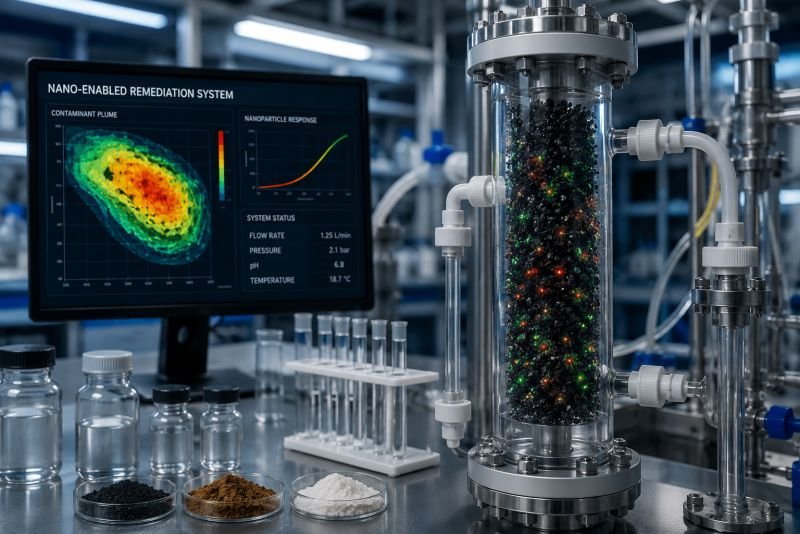
Nano-biohybrid approaches are further along than any of these. Several research programmes have demonstrated that nanoparticles can be used to deliver electron donors directly to indigenous bacteria within a contaminated aquifer, accelerating the natural bioremediation rate without introducing foreign organisms. The material and the biology are working together rather than independently.
None of these exist at commercial field scale. The physics that would allow them is not in dispute.
The View From NoSuchDevice
I find nanotechnology in environmental remediation genuinely unusual for one specific reason: the science is not the bottleneck. That is rare. The chemistry is understood. The field evidence from Bitterfeld, from Czech Republic sites, from dozens of North American deployments, is convincing. The physics does what it is supposed to do. What is slowing this down is regulation, the ecotoxicology data gap, institutional conservatism among site owners, and the fact that pump-and-treat contracts are already in place and nobody wants to cancel them.
The ecotoxicology concern is the one I take seriously. Injecting engineered iron particles into aquifers connected to drinking water sources deserves careful monitoring. The fact that iron oxide is environmentally unremarkable does not fully answer questions about what the nanoparticles do in the hours before they oxidise, or what happens to polymer coatings once they detach. I would want to see another twenty years of monitored field data from early deployment sites before calling this problem solved.
But the direction is correct. Treating contamination where it lives, at the scale where chemistry actually operates, is a more logical approach than extracting billions of litres of water to process at the surface. The geometry is right. The reactivity is right. Getting the safety data right is the remaining obligation, not an obstacle to dismiss.
Technologies Related to This Concept
| Technology | Concept |
|---|---|
| Molecular Disassembly Reactors | Concept: Reactors that break down complex waste into basic molecular components for reuse. |
| Nanobot Swarms for Ocean Clean-Up | Concept: Tiny robots that detect and neutralize pollutants in the ocean while monitoring water quality. |
| Smart Material Recyclers | Concept: Materials embedded with nanotech that allows them to self-recycle when triggered. |
| Bioengineered Plastic-Eating Organisms | Concept: Genetically modified organisms that consume plastic waste and excrete useful compounds. |
| Solar-Powered Air Quality Drones | Concept: Drones that use solar energy to monitor and help address air pollution across large areas. |
You read the whole thing.
That is rarer than it should be, and it is the exact kind of attention I built this archive for. I make every piece alone, with no ads and no investor deciding what gets written. If you want the next machine taken apart like this one, you can help me make it.
A coffee a month is enough to keep it free for everyone.
Prefer crypto or a one time gift? Other ways to give →