




What Is nanoscale zero-valent iron?
Nanoscale zero-valent iron is metallic iron produced as particles roughly 1 to 100 nanometers across and used as a strong reducing material in soil and water treatment. Its chemistry comes from elemental iron at the surface, which readily gives up electrons to oxidized contaminants and then converts into ferrous ions or iron oxides. The small particle size creates far more reactive interface per gram than conventional iron powder.
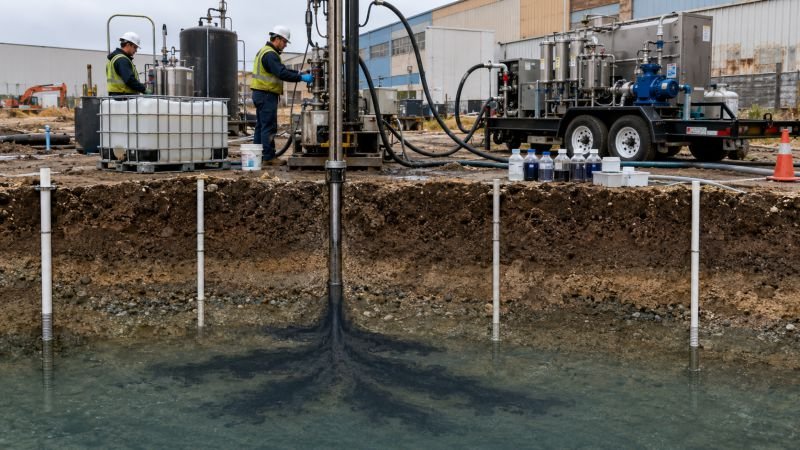
In real systems, nZVI is injected as a slurry or blended into porous treatment media so particles can contact dissolved compounds, corrosion products, and mineral grains. A common reaction shorthand is Fe0 -> Fe2+ + 2e-, showing why chlorinated molecules can be reduced after contact. Mobility, aggregation, pH, and dissolved oxygen determine how far the particles move and how long useful reactivity persists underground.
The material matters because it enables in-situ treatment without excavating contaminated ground, especially in groundwater remediation chemistry where reactions must happen below the surface. Used in devices include injection skids, metering pumps, mixing tanks, and monitoring wells that deliver and track reactive slurries. Its value comes from combining pore-scale transport with direct redox treatment at the pollutant location.
Example:
At a chlorinated solvent site, an nZVI slurry can be injected into a plume so dissolved contaminants are reduced within the aquifer rather than pumped to the surface.
Related Terms:
NoSuchDevice is a free archive of machines that do not exist yet but already have a shadow in physics. I research and write every entry alone, with no ads. Take a look around the archive, or help keep it free.