






What Is Bernoulli’s principle?
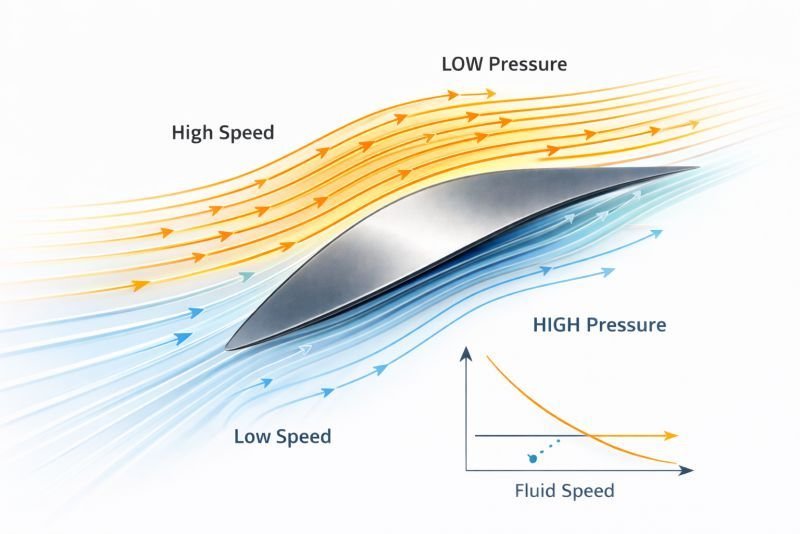
Bernoulli’s principle states that, along a streamline in incompressible flow, higher fluid speed corresponds to lower static pressure. The result follows from conservation of mechanical energy in the fluid: when kinetic energy rises, pressure energy falls if elevation effects are small. This relation helps explain how shaped aerodynamic surfaces generate force from moving air.
On turbine blades, air accelerates differently over upper and lower surfaces, creating a pressure imbalance that contributes to lift. That lift combines with local flow direction and blade motion to produce torque at the hub. In practice, designers evaluate Bernoulli effects together with viscous phenomena, because real performance also depends on boundary layers, turbulence intensity, and Reynolds Number.
The principle matters because it provides a compact physical model for pressure distribution in rotating aerodynamic energy systems. Accurate pressure predictions inform airfoil selection, pitch control strategy, and operating envelopes that avoid severe separation, enabling higher efficiency and more stable power output under changing wind conditions. It remains a core check when interpreting pressure tap data and computational fluid dynamics results, especially during blade profile optimization and validation.
Example:
During moderate wind, pressure measured near a blade suction side drops as local velocity rises, increasing lift and rotor torque.
Related Concepts:
- Pressure Coefficient
- Reynolds Number
- Lift Coefficient
NoSuchDevice is a free archive of machines that do not exist yet but already have a shadow in physics. I research and write every entry alone, with no ads. Take a look around the archive, or help keep it free.