






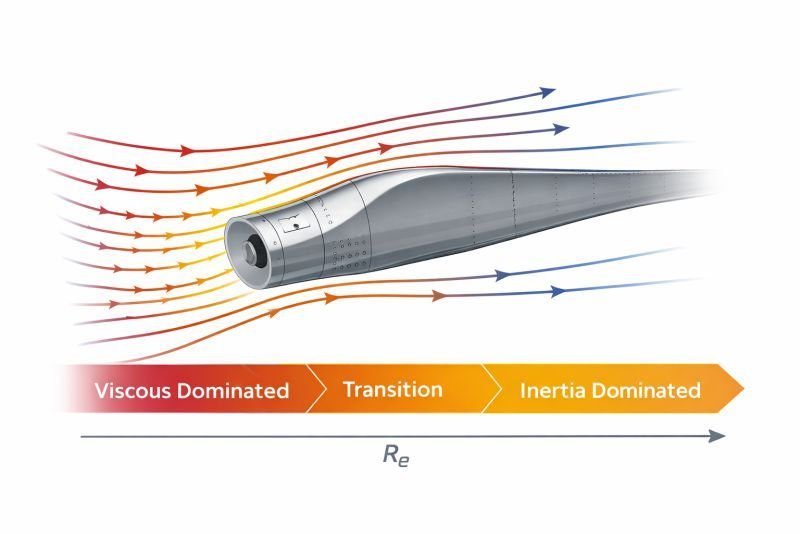
What Is Reynolds number?
Reynolds number is a dimensionless quantity that compares inertial forces to viscous forces in fluid flow. It is typically expressed as Re = rho v L / mu, where velocity and characteristic length scale with density and viscosity to describe flow regime. Low values indicate viscous-dominated behavior, while high values indicate inertia-dominated behavior with greater tendency toward transition and turbulence.
For turbine blades, Reynolds number varies along the span because local velocity and chord length change from root to tip. This variation affects boundary layer state, separation risk, and the lift and drag curves used in aerodynamic modeling. Designers choose profile families and surface finishes that perform across expected operating ranges rather than at a single nominal condition.
The concept matters because it determines how well laboratory data and simulations map to full-scale machines in wind turbine blade performance modeling. It also explains why small rotors do not behave as direct geometric copies of large ones, requiring adjusted Airfoil and control choices for efficient real-world operation. It therefore guides test condition selection for wind tunnels and scaled prototype validation campaigns.
Example:
A small residential rotor may run at lower Reynolds number than a utility turbine, causing earlier separation on similar blade profiles.
Related Concepts:
- Boundary Layer Transition
- Lift Coefficient
- Aerodynamic Drag
NoSuchDevice is a free archive of machines that do not exist yet but already have a shadow in physics. I research and write every entry alone, with no ads. Take a look around the archive, or help keep it free.