





What Is Betz limit?
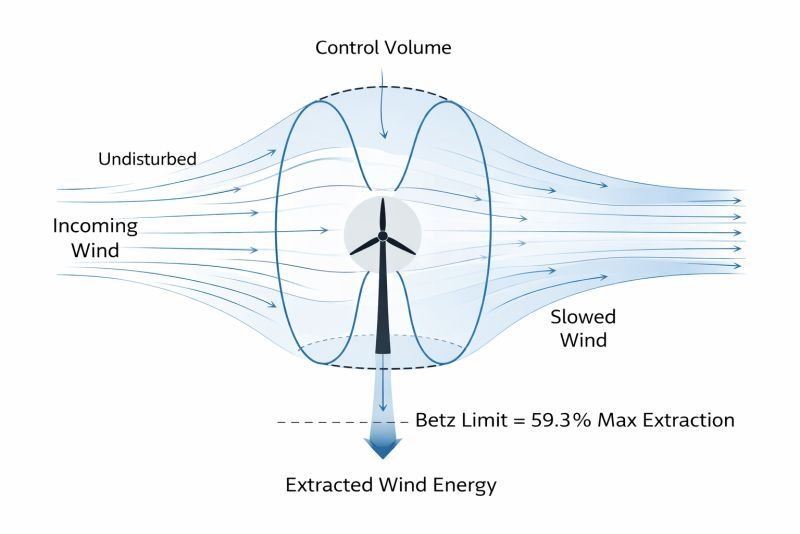
Betz limit is the theoretical maximum fraction of kinetic energy that any open-flow wind rotor can extract from passing air. Its value is 16/27, or about 59.3 percent, and it follows from momentum conservation in a control volume around the turbine. If a rotor removed all kinetic energy, downstream air would stop and block incoming flow, so continuous power generation would become impossible.
Real machines operate below this ceiling because wake rotation, tip losses, profile drag, and control constraints reduce achievable power coefficient. Rotor geometry, pitch scheduling, and inflow quality determine how closely a design approaches the limit across varying wind speeds. Engineers use this benchmark to compare aerodynamic performance without confusing physical limits with drivetrain or generator efficiency.
The concept matters because it sets a non-negotiable reference for wind turbine power coefficient analysis and system design tradeoffs. It also frames why improvements in Airfoil quality, control response, and wake management increase output only up to a bounded fraction of available flow energy rather than indefinitely. This bound helps separate feasible engineering gains from unrealistic performance claims during design evaluation.
Example:
A rotor capturing 0.48 power coefficient in steady offshore wind is high-performing but still below the Betz theoretical maximum.
Related Concepts:
- Power Coefficient
- Tip Speed Ratio
- Wake Losses
NoSuchDevice is a free archive of machines that do not exist yet but already have a shadow in physics. I research and write every entry alone, with no ads. Take a look around the archive, or help keep it free.