






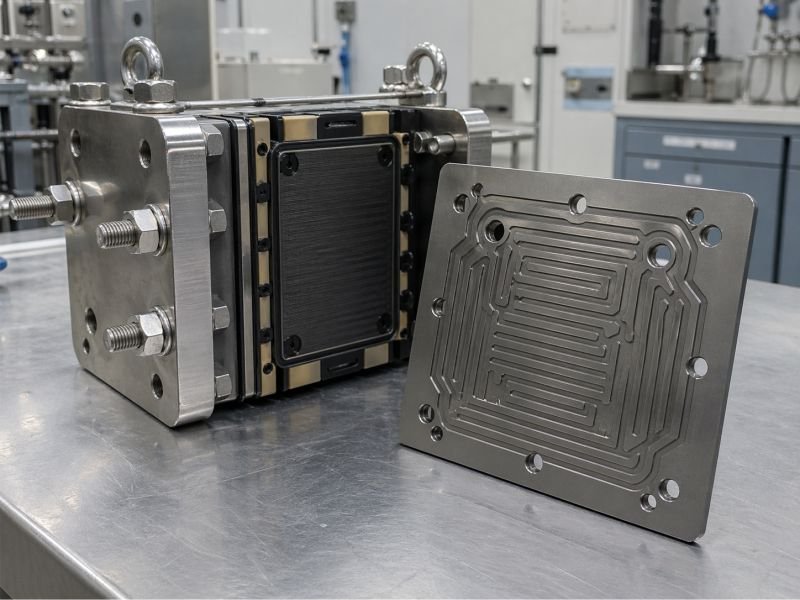
What Is Bipolar Plate?
A bipolar plate is a conductive separator used in stacked electrochemical cells such as fuel cells and electrolyzers. It routes gases or liquids across the active area, collects current, and isolates neighboring cells so voltage can add in series. Its behavior depends on low electrical resistance and controlled flow geometry. A simple relation is R = rhoL/A, where reducing path resistance improves electrical efficiency.
In real stacks, bipolar plates are machined or stamped with flow channels that spread reactants, remove water, and carry heat away from the membrane electrode assembly. Materials include graphite, coated stainless steel, and conductive composites, each balancing corrosion resistance, strength, conductivity, and mass. In hydrogen power systems, bipolar plates also help keep pressure drop within usable limits while maintaining uniform reactant delivery.
This component matters because stack size, durability, and output all depend on it. Poor plate design raises ohmic loss, creates hot spots, and causes uneven current density from cell to cell. Used in devices include proton-exchange membrane fuel cells, alkaline electrolyzers, and redox flow batteries. Engineers therefore treat the bipolar plate as both an electrical part and a fluid-management structure.
Example:
A lightweight drone fuel cell stack can use thin metallic bipolar plates to cut mass while preserving current collection and gas distribution across each cell.
Related Terms:
- Electrolyzer
- Current Density
- Membrane Electrode Assembly
NoSuchDevice is a free archive of machines that do not exist yet but already have a shadow in physics. I research and write every entry alone, with no ads. Take a look around the archive, or help keep it free.