

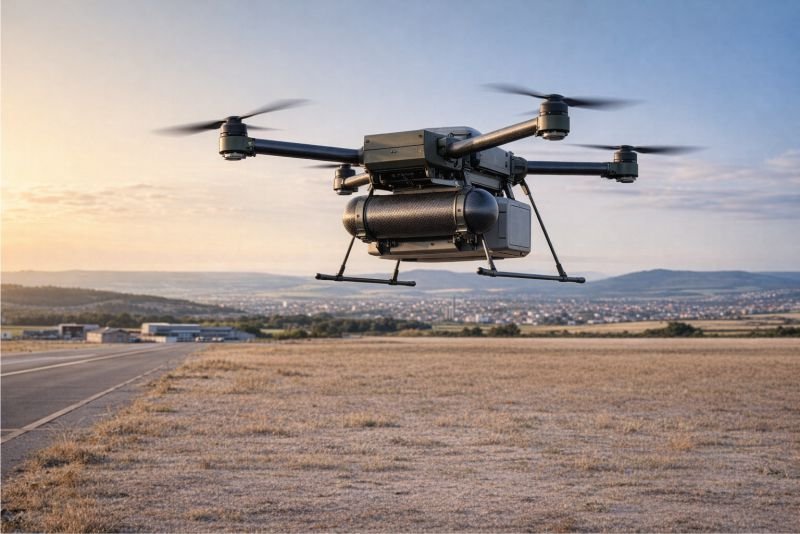
A cargo drone lifts off from a distribution hub outside a mid-sized European city, carrying a 2-kilogram medical package to a clinic 35 kilometers away. The route is straight, the weather cooperative, the airspace cleared. The drone will not make it. At a cruise draw of 1,200 watts, its 6-kilogram lithium-ion pack gives roughly 40 minutes of flight. That covers 25 kilometers, maybe 28 with a tailwind. Somewhere around kilometer 26, the flight controller begins its mandatory return sequence, and the clinic keeps waiting.
Nobody blames the airframe. Nobody blames the motors. Lithium-ion cells store about 250 watt-hours per kilogram, and that number has been crawling upward by single-digit percentages per year for over a decade. Every serious materials projection says it will keep crawling. For surveillance loops and real estate photography, 250 Wh/kg is adequate. For anything resembling logistics, it forces a choice between payload and range that neither answer resolves.
Hydrogen does not improve the battery. It removes it from the energy equation entirely.
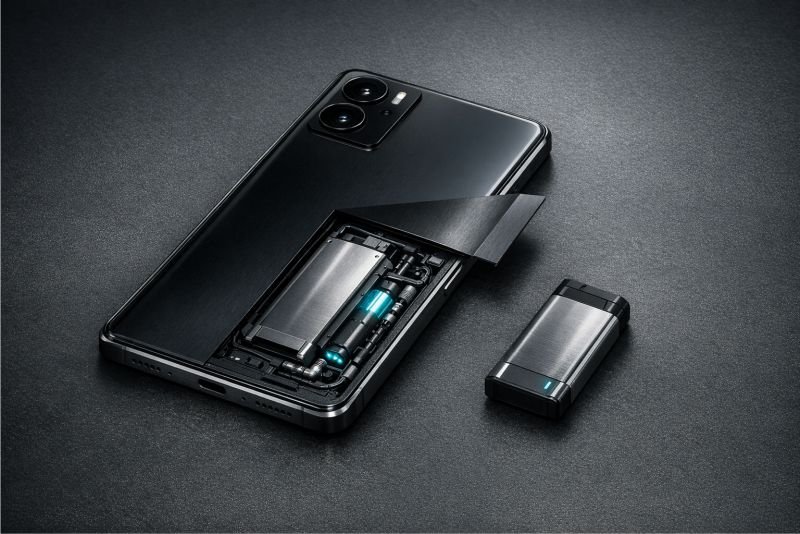
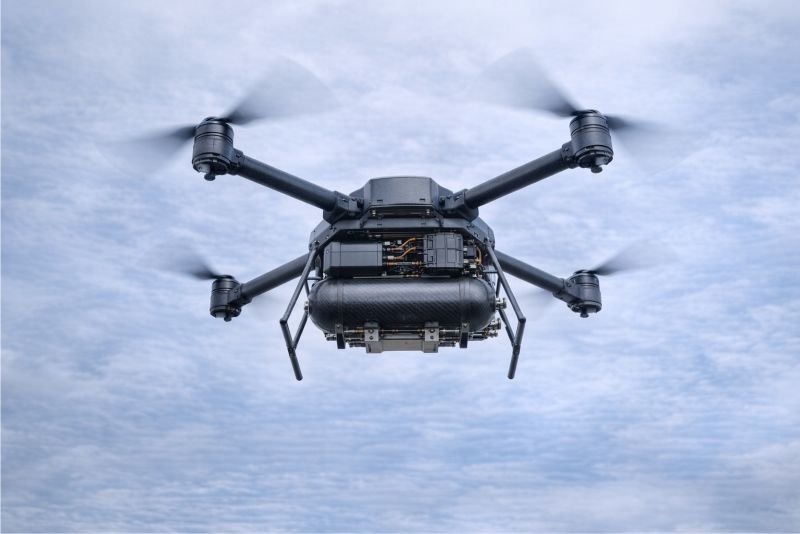
The short version: A hydrogen fuel cell powerplant for drones replaces lithium-ion storage with a miniaturized PEM stack and a compressed hydrogen tank. At the system level, it stores roughly 530 Wh/kg – more than double lithium-ion’s 250 – enough to push a 15-kilogram multirotor from 40 minutes to nearly two hours of cruise flight. The electrochemical conversion of hydrogen to electricity produces only water vapor and low-grade heat.
Key Takeaways
- A 150-gram hydrogen charge carries more usable energy than a battery pack eleven times its weight
- The powerplant pairs a fuel cell for cruise endurance with a lithium buffer for takeoff and maneuvering peaks – neither half works as well alone
- Refueling takes three to five minutes; recharging takes ninety – that gap reshapes fleet logistics from the ground up
- At altitude, the fuel cell breathes thinner air and loses output in a way that is predictable, correctable, and already well modeled
- Scaled to thousands of airframes, hydrogen drone logistics begins to resemble a new kind of infrastructure, not an improved version of the old one
Table of Contents
Why Every Cargo Drone Turns Back at Kilometer Twenty-Five
The energy ceiling on battery-powered multirotors is not a software limitation or a motor efficiency problem. It is a chemistry wall. Lithium-ion cells have a theoretical maximum energy density around 400 Wh/kg, and commercial cells sit at roughly 60 percent of that boundary. Solid-state variants might push closer, but even the most optimistic laboratory figures would add 30 to 40 minutes of flight. A drone that flies 70 minutes instead of 40 is still a short-range machine operating inside a radius where ground vehicles are cheaper.
Hydrogen stores approximately 33,000 Wh per kilogram of fuel mass. That figure is 130 times the energy density of lithium-ion by mass, and it has been sitting in chemistry textbooks for a century without anyone finding a reason to revise it. What kept it out of small aircraft was never the fuel – it was the machinery needed to use the fuel. A proton-exchange membrane fuel cell stack sized for a car weighs 30 to 60 kilograms. Fitting that conversion pathway into an airframe with a maximum takeoff weight of 15 kilograms requires a different kind of engineering, one that the drone described here assumes has been solved.
A Powerplant That Breathes and Weighs Under Four Kilograms
What makes a hydrogen drone powerplant distinct from its automotive cousin is not the chemistry – the PEM fuel cell reaction is identical at any scale. What changes is the engineering tolerance for parasitic mass. Every gram of support hardware that does not contribute to thrust is a gram subtracted from payload or endurance. A car fuel cell can afford 15 kilograms of humidifiers, coolant loops, and air compressors. A drone cannot afford two.
Shrinking the PEM Stack to Fit a Drone Chassis
A 1.5-kilowatt PEM stack for drone use compresses the bipolar plate assembly into a volume roughly the size of a hardcover book. Metallic bipolar plates replace graphite, cutting stack mass by nearly half while holding conductivity within workable range. Membrane electrode assemblies run thinner, which reduces ionic resistance but also reduces tolerance for hydration error. At this scale, air cooling replaces liquid coolant entirely – the stack relies on forced airflow from the propeller downwash and a small dedicated fan during hover. The whole assembly lands between 800 grams and 1.2 kilograms for a 1.5 kW continuous output.
Battery as Load Buffer
A fuel cell responds to load changes over seconds, not milliseconds. A quadrotor performing a gust correction or a rapid climb demands power spikes that arrive and vanish faster than the hydrogen flow rate can adjust. The device described here handles that mismatch with a small lithium-polymer buffer pack – typically 200 to 400 grams – wired in parallel with the fuel cell output. The fuel cell delivers sustained cruise power. The battery absorbs transient peaks and recovers during steady-state flight. Neither component makes a viable drone powerplant on its own. Together they produce an energy system with the endurance of hydrogen and the responsiveness of lithium chemistry.
How a Hydrogen Drone Powerplant Could Operate
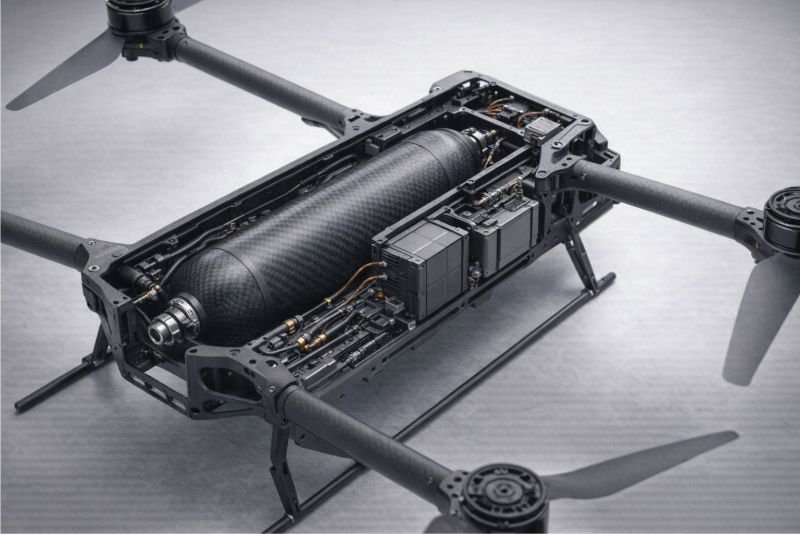
The stack converts fuel. The tank stores it. Between those two components sits every hard engineering decision the device requires.
Choosing the Tank: Compressed Gas at 350 or 700 Bar
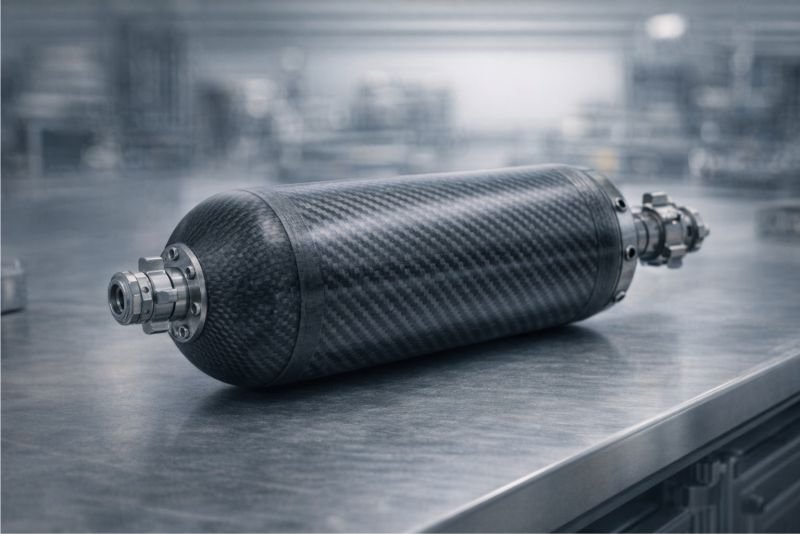
Hydrogen has terrible volumetric density at atmospheric pressure. One kilogram occupies roughly 11 cubic meters at sea level – a volume larger than the drone itself. Compression solves the volume problem and introduces a mass problem. A Type IV carbon-fiber composite tank rated at 350 bar stores hydrogen at a density of about 23 grams per liter and weighs 2 to 3 kilograms for a 150-gram charge. Push to 700 bar and the same charge fits into a smaller cylinder, but the tank walls thicken and the mass savings diminish sharply.
Liquid hydrogen offers far better density – around 70 grams per liter – but requires cryogenic insulation and accepts continuous boil-off losses. For a machine that sits on a pad for hours between flights, boil-off rates of 2 to 5 percent per day make the economics hostile. The concept device here operates on compressed gas at 350 bar, which represents the most plausible balance between tank mass, volume, and operational simplicity for a sub-25-kilogram airframe.
The Energy Equation That Matters
Raw fuel energy density is a misleading number for drone design. What counts is system-specific energy – how much usable electricity the entire powerplant delivers per kilogram of total powerplant mass.
E_sys = (m_fuel x e_fuel x n_fc) / (m_fuel + m_tank + m_stack + m_BOP)
Where m_fuel is fuel mass in kilograms, e_fuel is the specific energy of hydrogen (33,000 Wh/kg), n_fc is the fuel cell net electrical efficiency, m_tank is storage vessel mass, m_stack is fuel cell stack mass, and m_BOP is balance-of-plant mass including the buffer battery.
For the device described here, the numbers run as follows. 0.15 kg of hydrogen, a 2.5 kg Type IV tank, a 1.1 kg stack, and 0.85 kg of BOP including the lithium buffer.
E_sys = (0.15 x 33,000 x 0.50) / (0.15 + 2.5 + 1.1 + 0.85) = 2,475 / 4.6 = 538 Wh/kg
An equivalent lithium-ion pack delivers 250 Wh/kg with no additional system mass. The hydrogen powerplant carries slightly over twice the usable energy per kilogram. At 1,200 watts cruise consumption, 4.6 kilograms of hydrogen system delivers roughly 120 minutes of flight. The same mass in lithium-ion batteries delivers about 55 minutes. Would any logistics operator fly 55 minutes when 120 is available at the same system weight? The question answers itself, which is precisely why the engineering challenge is worth the complexity.
Everything here is free. Readers are the reason it stays that way.
I make all of it alone, with no ads. If it is worth a coffee a month to you, that keeps the next one coming.
Keep it alive →What Thin Air Does to a Fuel Cell at 120 Meters
A PEM fuel cell breathes ambient oxygen. At sea level, air contains roughly 21 percent oxygen at 101.3 kPa. At 120 meters above sea level – a typical regulatory ceiling for commercial drone operations – the partial pressure of oxygen drops by barely 1.5 percent. At that altitude, the effect on cell voltage is negligible and the device operates within its design envelope without correction.
When the Drone Climbs Higher
The calculation changes at 500 to 1,000 meters above sea level, where some agricultural and inspection operations take place relative to terrain elevation. Oxygen partial pressure at 1,000 meters drops to about 90 kPa. The Nernst relationship predicts a voltage loss of roughly 10 to 15 millivolts per cell, which across a 40-cell stack translates to a 2 to 3 percent reduction in total output. Manageable, but the flight controller needs to account for it when planning endurance reserves. At 3,000 meters – relevant for mountain infrastructure inspection – the loss approaches 8 to 10 percent and starts eating into the endurance advantage that justified the hydrogen system in the first place.
Thermal behavior cuts in a more favorable direction. A fuel cell running at 50 percent electrical efficiency converts the other half of the hydrogen energy into heat. At cruise output of 1.2 kilowatts, that means roughly 1.2 kilowatts of waste heat generated inside a compact stack. On the ground, that heat needs active management. In flight, ambient airflow at 10 to 15 meters per second strips heat from the stack surfaces continuously. The drone’s own motion becomes the cooling system – a relationship that improves at higher speeds and gets worse during stationary hover. Longer hover segments require the onboard fan to compensate, adding perhaps 15 to 30 watts of parasitic load.
One side effect worth noting: the device is nearly silent relative to internal combustion alternatives. A micro gas turbine drone produces 75 to 90 decibels at 10 meters. A hydrogen fuel cell powerplant, with no combustion and no reciprocating parts, adds roughly zero acoustic output beyond the electric motors and propellers themselves. For wildlife monitoring and urban delivery, that silence is operationally meaningful.
Where Two-Hour Endurance Rewrites the Mission Profile
Doubling flight time does not simply let a drone fly longer. It changes which missions exist at all.
Three Operations That Stop Being Theoretical
A precision agriculture drone surveying a 500-hectare farm with multispectral sensors currently requires six to eight battery swaps, each involving a landing, a 90-minute charge or a manual battery exchange, and a re-launch calibration. A hydrogen-powered variant covers the same area in two or three flights with fuel stops under five minutes. The survey that once consumed a full working day compresses into a morning.
Infrastructure inspection follows a similar logic. A pipeline corridor 80 kilometers long cannot be surveyed in a single battery-powered sortie. It can be covered in two hydrogen sorties with a single mobile refueling point at the midway mark. Long-range cargo delivery – the application that triggered the opening scenario of this article – moves from a 25-kilometer operational radius to something approaching 60 or 70 kilometers, depending on payload fraction and wind conditions.
| Power source | System energy density | Endurance (15 kg MTOW) | Turnaround time | Best suited for |
|---|---|---|---|---|
| Lithium-ion battery | ~250 Wh/kg | 35-50 min | 60-90 min (charge) | Short-range survey, photography |
| Hydrogen fuel cell (350 bar) | ~530 Wh/kg | 100-130 min | 3-5 min (refuel) | Long-range cargo, agriculture, inspection |
| Solar-augmented battery | ~280 Wh/kg effective | 45-65 min | 60-90 min (charge) | Daytime fixed-wing endurance |
| Tethered electric | Unlimited (grid-fed) | Unlimited | N/A | Fixed-position surveillance only |
Solar augmentation adds 10 to 20 percent effective endurance to fixed-wing platforms with sufficient wing area, but contributes almost nothing to multirotors where the disc area is occupied by propellers. Tethered systems eliminate endurance limits entirely while eliminating mobility entirely – a useful trade for perimeter surveillance, irrelevant for logistics. Hydrogen occupies the space where long endurance and full mobility are both required, and no other power source currently reaches that intersection at sub-25-kilogram scale.
From a Single Drone to a Hydrogen-Fed Sky
A single hydrogen drone with two hours of endurance is a better tool. A thousand of them sharing a refueling network is a different system altogether. The seed technology here is the powerplant. What grows from it depends on the ground infrastructure that feeds it.
The Three-Minute Turnaround
Battery-powered drone fleets schedule operations around charging cycles. A fleet of 20 drones with 90-minute charge times needs 20 chargers and accepts that at any given moment, roughly two-thirds of the fleet is grounded. Hydrogen refueling at 350 bar takes three to five minutes per tank swap or direct fill. The same fleet of 20 drones, with a single compressor station and two fill nozzles, keeps 18 or 19 airframes in the air during peak operations. Fleet utilization rates jump from 30-35 percent to something above 85 percent. That is a logistics transformation before anyone improves the drone itself.
What Emerges When Thousands Fly
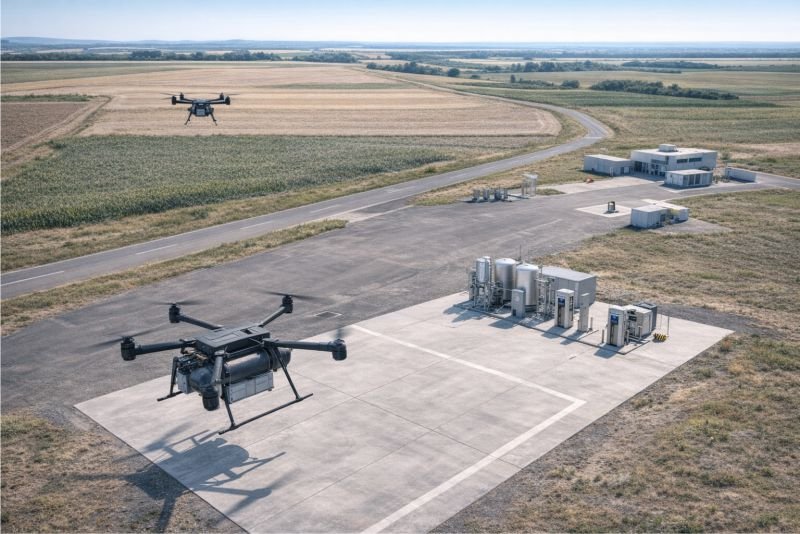
Scale the refueling model past a single hub and the architecture starts looking less like aviation support and more like a distributed energy network. Electrolyzer stations at solar or wind farms produce hydrogen on-site. Local storage tanks feed drone refueling pads embedded in rural distribution points, rooftop logistics hubs, agricultural cooperatives. The hydrogen does not travel far – it is produced and consumed within the same region, which eliminates most of the transportation cost that makes centralized hydrogen distribution uneconomic at small scale today.
First-generation devices – single drones with bolt-on fuel cell kits – prove that the endurance math works. Second-generation systems integrate the powerplant into the airframe from the design stage, optimizing thermal paths and structural loads around the tank rather than around a battery bay. Third-generation deployment stops being about individual aircraft. At that point, the device is not a drone with a fuel cell. It is a node in an aerial logistics grid that happens to run on hydrogen, and the refueling network underneath it starts to serve ground vehicles, backup power systems, and other hydrogen consumers that individually could not justify the infrastructure. The drone fleet becomes the anchor tenant for a regional hydrogen economy.
The View From NoSuchDevice
I keep coming back to the turnaround time. The endurance advantage is real and the arithmetic is solid, but what actually changes the game is the difference between three minutes and ninety minutes on the ground. A battery fleet is a fleet that mostly sits. A hydrogen fleet is a fleet that mostly flies. Everything downstream – coverage area, delivery density, cost per kilometer – follows from that single operational fact.
I do not think the individual drone powerplant is particularly far from buildable. Lab-scale PEM stacks at the right power-to-weight ratio exist. Lightweight composite tanks exist. The hybrid buffering architecture is standard power electronics. What does not exist is the ecosystem – the refueling pads, the distributed electrolyzers, the regulatory framework for pressurized hydrogen on autonomous aircraft. The seed is nearly mature. The soil it needs to grow in has barely been tilled.
And that is what makes this interesting as a concept class rather than just a product. A hydrogen drone by itself is a longer-flying drone. A hydrogen drone network is a logistics layer that did not exist before – one that carries its own energy infrastructure with it and leaves behind refueling nodes that other technologies can use. I find it difficult to dismiss a device whose failure mode is “accidentally built useful hydrogen infrastructure.”
Whether it reaches civilizational scale depends on how cheap electrolytic hydrogen gets in the next two decades. If green hydrogen lands below three dollars per kilogram – a target several national energy strategies have committed to – then the operational cost of hydrogen drone logistics falls within range of diesel-powered ground delivery. If it does not, the device remains a niche tool for agriculture and inspection, useful but contained. Either way, the powerplant described here sits squarely in the territory where the physics is settled and only the engineering calendar remains open.
You read the whole thing.
That is rarer than it should be, and it is the exact kind of attention I built this archive for. I make every piece alone, with no ads and no investor deciding what gets written. If you want the next machine taken apart like this one, you can help me make it.
A coffee a month is enough to keep it free for everyone.
Prefer crypto or a one time gift? Other ways to give →