





What Is Crystal Lattice?
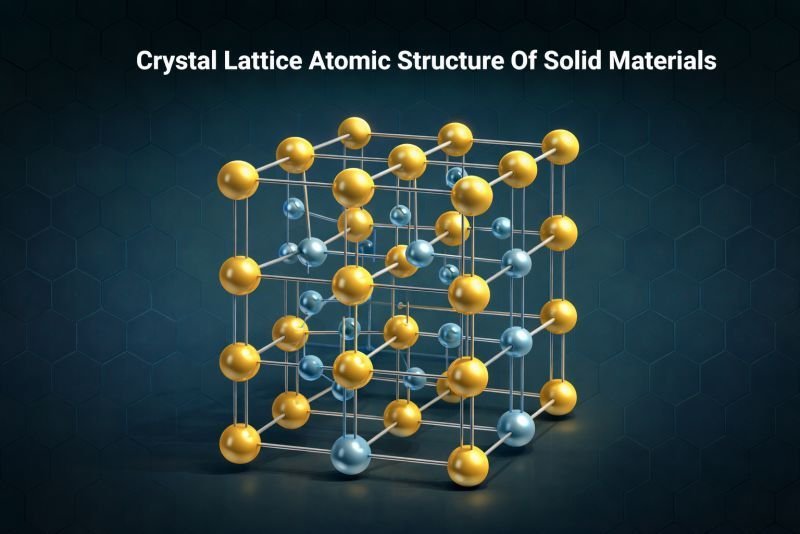
A crystal lattice is the repeating three-dimensional arrangement of atoms, ions, or molecules that forms the internal structure of many solid materials. Instead of being randomly distributed, the particles occupy specific positions that repeat regularly throughout the material, creating a geometric pattern known as a lattice. Each repeating block of this pattern is called a unit cell, and the entire solid can be imagined as billions of these cells stacked together in space.
The exact arrangement of atoms inside a lattice determines many physical properties of the material, including electrical conductivity, mechanical strength, thermal behaviour, and optical characteristics. Small differences in symmetry or spacing between atoms can dramatically change how the material responds to forces, heat, or electric fields.
In domains such as piezoelectric energy harvesting materials, the geometry of the crystal lattice determines whether mechanical stress can shift atomic charges and produce an electric dipole across the material.
Example:
When pressure is applied to certain crystals, the distortion of their crystal lattice shifts positive and negative charges, producing a measurable electric voltage.
Related Concepts:
- Unit Cell
- Electric Dipole
- Cantilever Harvester
NoSuchDevice is a free archive of machines that do not exist yet but already have a shadow in physics. I research and write every entry alone, with no ads. Take a look around the archive, or help keep it free.