





What Is Exciton?
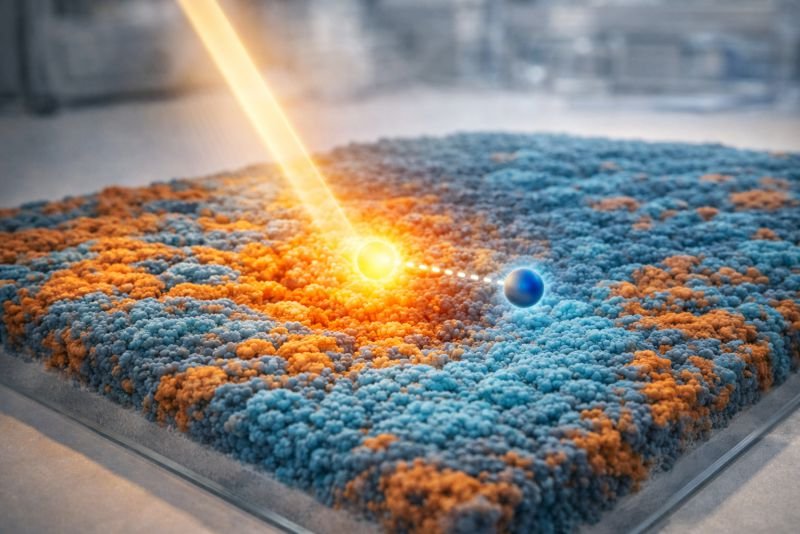
An exciton is a bound electron-hole pair created when a photon excites a semiconductor without fully separating charge. The electron and hole remain linked by Coulomb attraction and move through the material as a neutral quasiparticle rather than as two free carriers that can immediately enter an external circuit.
In organic photovoltaic charge separation, an exciton typically diffuses only 5 to 20 nanometers before recombining. Its binding strength depends strongly on Dielectric Constant because weak electrostatic screening in carbon-based semiconductors keeps the electron and hole tightly coupled.
A simplified expression for the binding energy is E_b ~= e^2 / (4 pi epsilon r), where larger separation r or higher permittivity epsilon weakens the attraction. Why it matters is that every organic solar-cell architecture must bring the exciton to an interface fast enough for charge splitting to beat recombination.
Used in devices include organic solar cells, OLED displays, and excitonic sensors. Researchers study excitons with photoluminescence and transient absorption measurements because diffusion length, lifetime, and binding energy determine how much absorbed light can become useful current in a working photovoltaic device.
Example:
An exciton created in a polymer solar film must reach a donor-acceptor interface within a few nanometers or it will recombine before generating charge.
Related Concepts:
- Dielectric Constant
- Charge Transfer State
- Recombination
NoSuchDevice is a free archive of machines that do not exist yet but already have a shadow in physics. I research and write every entry alone, with no ads. Take a look around the archive, or help keep it free.